

Many crimes over the years have been described as a “loss of innocence” of one particular city or town, and in the case of Austin, Texas, this crime is unarguably the horrific quadruple murder that took place on the night of December 6th, 1991.
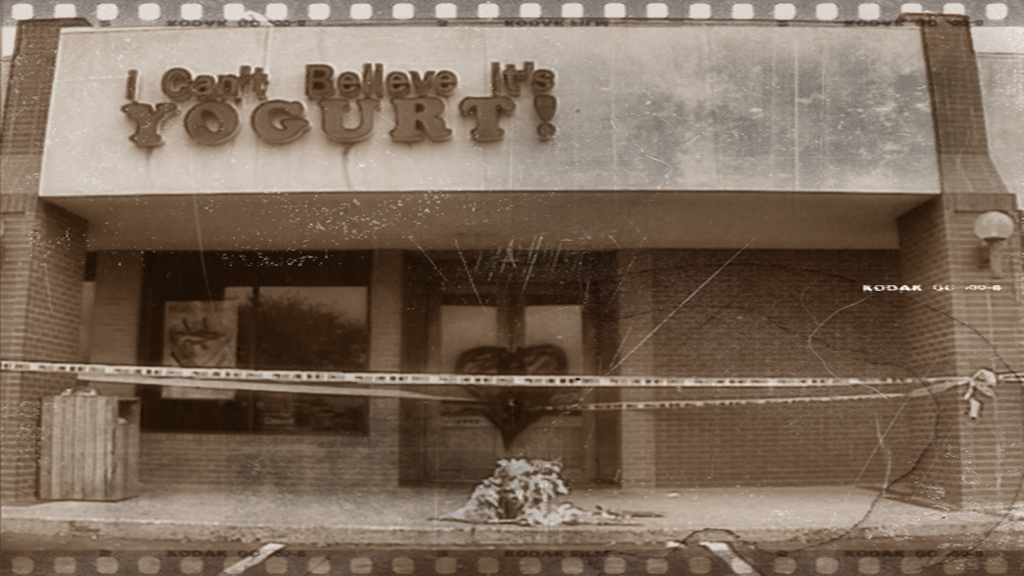
Seventeen-year-old girls Eliza Thomas and Jennifer Harbison worked at the I Can’t Believe It’s Yogurt store, located in the Hillside strip mall on West Anderson Lane. On December 6th, they were working the closing shift; Eliza’s parents had both dropped by the shop to check on their daughter at separate times between nine-thirty and ten p.m.
At some point before the store closed, Jennifer’s fifteen-year-old sister Sarah, and Sarah’s thirteen-year-old friend Amy Ayers, came to the shop as well. They had been hanging out at the Northcross Mall down the street all evening; all four girls were planning a sleepover at the Harbison home, and Sarah and Amy were going to help close the store and then get a ride with the older girls. The shop was closed at its regular time of eleven p.m., with the cash register being rung out with a “no sale” tag at three minutes past the hour.
About forty-five minutes later, a police officer cruising by the strip mall noticed that the yogurt shop was ablaze, and contacted the fire department, who arrived six minutes after the call. When firefighters forced their way into the store, they discovered the stacked and burned bodies of four teenage girls. All were nude, and had been bound and gagged with pieces of their own clothing.
As the investigation commenced, authorities began trying to piece together what had happened, though because the scene had first been processed as a fire and not as a homicide, much crucial evidence was lost or contaminated. It appeared that at least two assailants had either entered the store after closing, or had been in the store previously and had forced the girls into the stockroom at gunpoint. Though robbery was initially thought to be the motive, a bank bag full of money was found beneath the front counter. Sources differ, however, on how much cash was taken from the premises, with some claiming only fourteen dollars was stolen from the register, and some stating it was five-hundred-forty dollars.
After the four victims were autopsied, it was discovered that at least two of them—Amy and Jennifer—had been raped. All had been shot in the head with either a .22 or .380 caliber semi-automatic pistol; Amy had been shot twice, perhaps because she had struggled. After the girls were dead, the killers had partially stacked their bodies and then started a fire in the corner nearest the victims, though it is unclear if any accelerant, such as lighter fluid, was used.
The crime understandably shocked the city of Austin, and police were immediately placed under enormous pressure to solve the case as quickly as possible. Amid a flood of useless tips and bizarre false confessions, investigators did get a few promising leads in the days following the murders.
The first of these came from a man named Dearl Croft, a former police officer who had been eating yogurt in the shop a few hours before the girls were killed. He said that he had noticed a somewhat suspicious individual wearing a large green jacket, similar to Army fatigues, walking toward the rear of the shop. Croft said he asked Eliza Thomas where the young man was going, and Eliza answered that he was going to use the restroom. Croft further said that the man in the green jacket had emerged from the bathroom and sat at a booth with another young man wearing a black jacket. The witness described the first man as being about five-foot-six with dirty blond hair, while the second man was of a larger build. Both men, Croft said, appeared to be in their late twenties or early thirties, and were definitely still in the shop as of ten-forty-seven p.m.
While neither of these two men was identified, police did link a suspect to the murders fairly swiftly: this was sixteen-year-old Maurice Pierce, who had been picked up carrying a .22 caliber pistol at the Northcross Mall, the same mall where Sarah and Amy had been hanging out prior to their deaths.
When questioned about the yogurt shop murders, Pierce claimed that he personally didn’t know anything about the crime, but that his fifteen-year-old friend Forrest Welborn had borrowed the gun and perpetrated the slaughter. Pierce also implicated two other friends, seventeen-year-olds Michael Scott and Robert Springsteen; the four teenagers had stolen a Nissan Pathfinder from a car lot on the night the girls were killed and driven it to San Antonio.
Though ballistics on the .22 found in Pierce’s possession did not appear to match the firearm used in the killings, police eventually corralled all four young men into custody and began grilling them about the quadruple homicide. It should be noted from the outset that a large portion of the interrogation was handled by officer Hector Polanco, who would later be temporarily suspended from the force after it came to light that he had coerced confessions in a 1988 rape and murder case, though he was later reinstated.
After several hours of questioning, all four suspects in the Austin yogurt shop murders confessed to their part in the crime, though even from the beginning, it appeared that their accounts of the homicides were somewhat contradictory, with details being fed to them by police after they failed to correctly “guess” the right answers. Even after the confessions, though, Maurice Pierce and Forrest Welborn were never prosecuted, as a grand jury felt that there was insufficient evidence to try them. The cases against Michael Scott and Robert Springsteen, however, proceeded; Springsteen was convicted in 2001 and given a death sentence, while Scott was convicted in 2002 and received life in prison.
In 2006, Springsteen’s conviction was overturned on the basis of an unfair trial, and in 2008, attorneys for Scott and Springsteen petitioned to get more stringent DNA testing performed on their clients for a comparison to DNA recovered from the scene. The DNA profile of the unknown man (or men) that had been obtained from the yogurt shop victims did not match the DNA of any of the four initial suspects. Both Scott and Springsteen were released in 2009.
A year later, Maurice Pierce, whose firearm possession had first led authorities to questioning the four suspects, was pulled over in a routine traffic stop in Austin. Pierce took off running, was tackled by police officer Frank Wilson, and ended up stabbing Wilson during the ensuing struggle. Wilson subsequently shot Pierce dead. Frank Wilson recovered from his injuries.
While some researchers remain convinced that Pierce, Welborn, Scott, and Springsteen were indeed the perpetrators of the gruesome slayings, others maintain that the most likely suspects were the two mysterious individuals seen in the yogurt shop by Dearl Croft. To this day, neither of these men has been identified.
For a time, investigators speculated that Jennifer, Eliza, Sarah, and Amy had been murdered by serial killer Kenneth McDuff, also known as the Broomstick Murderer, who had been convicted in 1966 of three homicides, but was paroled in 1989 and suspected of committing many more crimes after his release. Though he initially confessed to the yogurt shop murders, he later recanted, saying that if he really had done it he would have been proud of it. McDuff was executed by lethal injection in 1998 after being convicted of a separate murder.
The heartbreaking case of the Austin yogurt shop murders is still open, and remains a source of lingering trauma in the city. In early 2022, authorities announced that new DNA technology was allowing fresh progress to be made toward solving the crime, though no further information has been released as of this writing.
 Crime Immemorial