
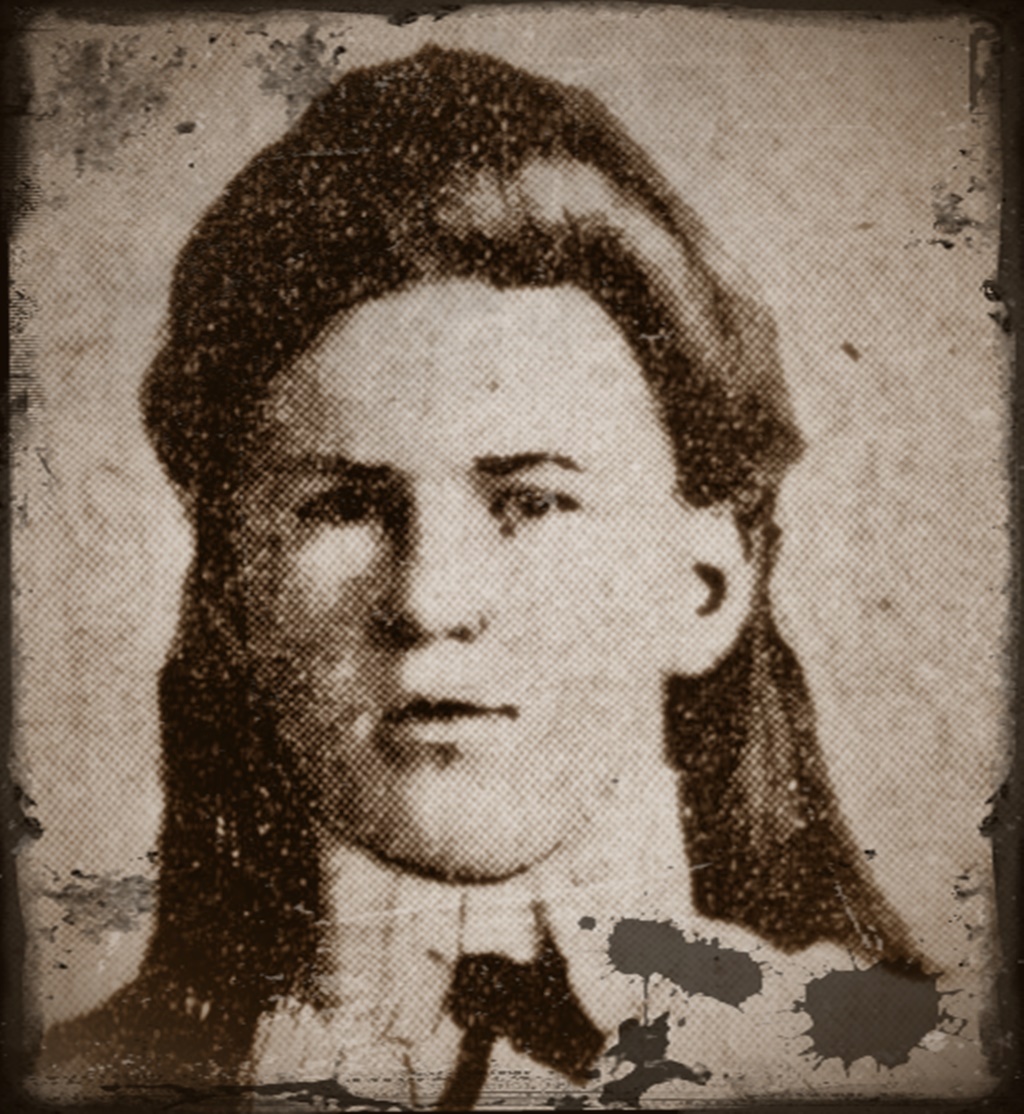
Fifteen-year-old Eleanor “Nora” Fuller had been born in China but later lived in San Francisco with her mother and three siblings. The previous year had been a rough one for the Fullers, as Nora‘s parents had recently divorced. Money was tight, and Nora was obliged to quit school in 1902 and begin looking for work. Though she had her heart set on a theatrical career, and had made an inquiry to an agency to find employment for her on the stage, on January 8th it seems that another opportunity happened to catch her eye.
The advertisement in the San Francisco Chronicle read, “Wanted: Young white girl to take care of baby; good home and good wages.” Nora answered the ad, and three days later, she received a postcard in reply, telling her to meet a man named John Bennett at the Popular Restaurant at 55 Geary Street at either one or six o’clock in the afternoon.
At five p.m., Nora set out for her appointment. An hour later, the phone rang back at the Fuller household, and Nora’s twelve-year-old brother answered it. On the other end of the line, Nora’s voice informed him that she was at John Bennett’s residence at 1500 Geary Street, that she had been hired for the position, and that her employer wanted her to begin work immediately. Nora’s mother didn’t much like that idea, and told her daughter to come home and start the job on Monday. Nora hesitantly agreed to this, and then hung up.
She was never seen alive again.
Strangely, even though Nora failed to come home from her ostensible job interview, her mother did not report her disappearance for several more days, but once she did, police immediately went to work trying to track down the girl. They first inquired at the Popular Restaurant, where Nora had supposedly gone before vanishing off the face of the earth.
The owner of the establishment, F.W. Krone, told investigators that at around five-thirty p.m. on January 11th, a man had come up to the counter and let him know that he was expecting a young girl looking for John Bennett, and to please send her to his table when she arrived.
The owner, as well as a waiter who had been employed there for some time, both claimed that the man had been a regular at the restaurant for more than a decade, but that neither of them had heard his name before that particular day. He had, in fact, been known among the staff as “Tenderloin,” because of his habit of always ordering a porterhouse steak and only eating the tenderloin portion.
At any rate, the owner of the Popular told police, he had not seen the girl come into the restaurant. The man had waited for her for about half an hour, after which he had gone outside and paced impatiently for a few minutes before leaving the premises altogether. Restaurant employees described John Bennett as being around forty years old, of average height and weight, with brown hair and a brown moustache, and a smart, respectable appearance.
Investigators also established the bizarre fact that the address of 1500 Geary Street that Nora had given her brother over the phone was not a residence at all, but a vacant lot.
For the next month, extensive coverage of the Nora Fuller case was splashed all over the San Francisco papers, but no trace of the girl, or of “John Bennett,” could be found. And then came the afternoon of February 8th.
On that day, H.E. Dean, an inspector and collector for the Umbsen & Co. real estate company, used his passkey to let himself into a two-story rented property at 2211 Sutter Street. The rent was due, and as the real estate office had received information that the house was still vacant, despite having been rented a month earlier to a man going by the name C.B. Hawkins, Dean was dispatched to check on the property.
As he went inside, he noted that there was no furniture at all on the first floor. He climbed the stairs and noted that the door to one of the back bedrooms was closed. Though he opened it and peered in, he became a little anxious when he noted that the shades were drawn, and that there were pieces of clothing strewn on the floor. Sensing something wasn’t right, he retreated from the house and returned a short time later with a policeman named Officer Gill in tow.
The two men re-entered the house, went upstairs, and discovered the naked, decomposed body of Nora Fuller, lying on the bed in the back bedroom. She had been raped and strangled, and her body had been horribly mutilated.
Also found on the property was one towel, a mostly-empty bottle of whiskey, the butt of a cigar, and several pieces of junk mail addressed to Mrs. C.B. Hawkins of 2211 Sutter Street. One of these circulars had been opened and stuffed into the pocket of a jacket belonging to Nora Fuller, which was left on the floor of the bedroom. Nora’s purse was also found, but contained neither money nor the postcard which had brought her along on this fatal adventure.
The bed, it was determined, was second-hand, and had been purchased the day after the house had been rented, as had the sheets, the pillows, and the quilt, which had simply been thrown onto the bed without being laundered first. The only other furniture found in the house was a single, second-hand chair.
Upon forensic examination, it was determined that Nora had some alcohol in her system, and that the last thing she had eaten was an apple, consumed only an hour or two before her death. Nora’s mother confirmed that she had eaten an apple before setting out for her appointment, suggesting that Nora had likely been murdered almost immediately after arriving at her destination.
It was theorized from the outset that the man known as “John Bennett” and the man who had rented the house at 2211 Sutter Street under the name “C.B. Hawkins” were probably the same man. Bolstering this assertion was the fact that several proprietors of furniture shops in the area confirmed that a man fitting Bennett’s description had indeed purchased pieces of furniture and bedding only days before Nora‘s disappearance, and that he had had the items delivered to the 2211 Sutter Street address. The fact that this mysterious individual had gone to the trouble of renting a house under an assumed name and buying furniture to go in it seemed rather bizarre if he was planning to murder the girl as soon as she arrived there.
However, a friend of Nora’s named Madge Graham told police something that might have partially explained the peculiarities. Nora, Madge claimed, had been dating an older man by the name of Bennett for quite some time. In fact, Madge admitted that she herself had covered for Nora a few times by telling Nora’s mother that she and Nora were at the theater together, when in actuality, Nora was out with Bennett.
Madge even went so far as to say that the whole situation with the ad for the nanny job had simply been another ruse to fool Mrs. Fuller into thinking that Nora was interviewing for a job, when really she was meeting her much older beau. This would perhaps explain why the address that Nora gave to her family was not a real address.
Madge’s story was also somewhat corroborated by the testimony of a grocer named A. Menke, who said that Nora often came in to use the phone at the store to call a nearby hotel, even though her family had a phone at home.
However, police did not seem to take Madge’s story entirely seriously, and as the case heated up, another lead began to come together.
On January 18th, exactly one week after Nora’s disappearance and exactly three weeks before her body was found, police had received a seemingly unrelated report that a man named Charles B. Hadley, a clerk at the San Francisco Examiner, had embezzled a large sum of money from his employers and vanished.
In the course of investigating the theft, and following the discovery of Nora Fuller’s body, police interviewed Hadley’s girlfriend Ollie Blasier, who told them a few interesting things. First of all, Ollie provided samples of Charles Hadley’s handwriting, which bore a marked resemblance, not only to the handwriting of John Bennett which had appeared on the classified ad form he had submitted to the San Francisco Chronicle, but also to the handwriting of C.B. Hawkins on the rental agreement for the house at 2211 Sutter Street.
Ollie also told police that Hadley had a particular fondness for tenderloin, that he had seemed oddly “disturbed” upon reading the newspaper coverage of the Nora Fuller murder, and that she had found blood on a few pieces of his clothing sometime around the time the Fuller girl had been murdered. She further stated that even though Hadley was clean-shaven, he had been known to wear a false moustache from time to time.
Though investigators considered the remote possibility that Ollie could be a particularly vindictive ex-girlfriend who was simply trying to frame the man who had abandoned her, the circumstantial evidence was quite compelling. It was even discovered later that not only was Hadley—whose real name was found to be Charles Start—wanted for another charge of embezzlement in Minneapolis back in 1889, but that he had also allegedly raped another fifteen-year-old girl in San Francisco in 1900.
Unfortunately, despite a massive nationwide manhunt for Charles Start, aka Charles B. Hadley, aka C.B. Hawkins, aka John Bennett, the culprit was never apprehended, and it was rumored that he committed suicide shortly after his disappearing act. The horrific murder of Nora Fuller remained unresolved, and even her final resting place has since been lost to time.
 Crime Immemorial