
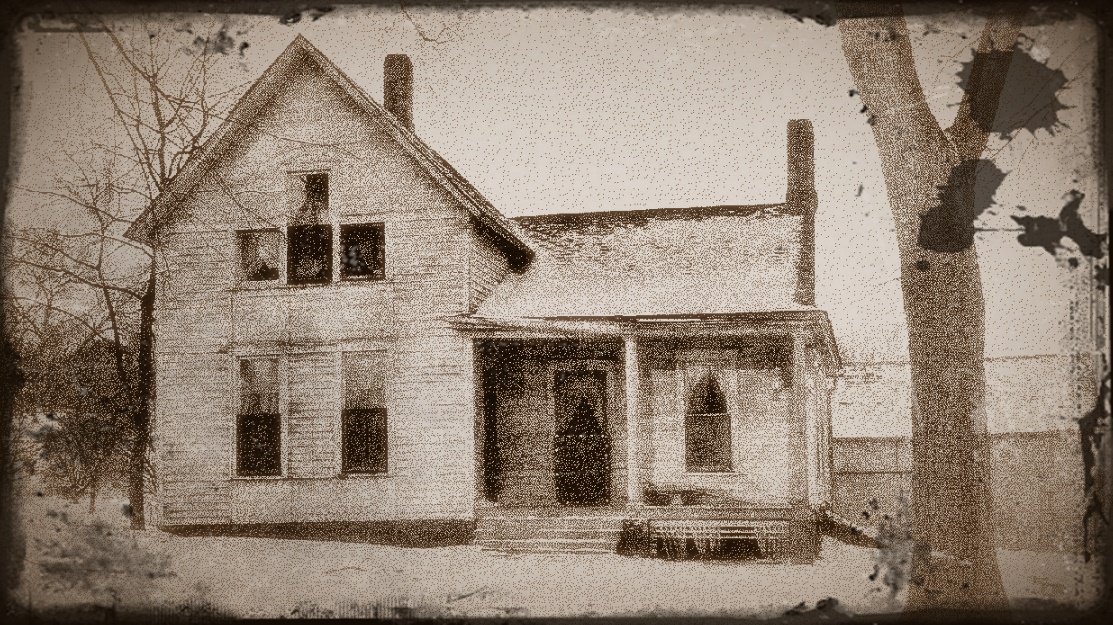
Most everyone with an interest in true crime has no doubt heard of the notorious Villisca axe murders, in which eight people were brutally dispatched by an unknown assailant sometime during the night and early morning of June 9th and 10th of 1912. Though many suspects have been put forth and investigated over the decades, the mass murder remains tragically unsolved.
In recent years, however, some researchers have put forward the theory that the victims at the center of the Villisca slayings were only the final casualties in a reign of terror perpetrated by a serial killer who may have been riding the rails across the Midwestern United States (and possibly the Southwest) in 1911 and 1912. While some have dismissed the hypothesis—sometimes referred to as the McClaughry theory, named after forensic investigation pioneer Matthew W. McClaughry—as overblown by the media, details surrounding several of the other axe murders leading up to the massacre at Villisca certainly suggest that the same assailant might have been at work.
We’ll get into these other crimes later on, but first, let’s discuss the best known of these cases, the one that still generates fascination and fervid speculation more than a century after it occurred.
The Moore family was well-off and highly regarded in the community of Villisca, Iowa, and they were also heavily involved with the local Presbyterian church. In fact, on the evening of June 9th, the entire family was attending the Children’s Day Program at their regular place of worship. The program had been co-organized by matriarch Sarah Moore herself, and several of the Moore children had participated in the events, which had commenced at around eight o‘clock. There had been something of a social hour after the festivities ended on that Sunday night, and the family mingled with friends for a little while before calling it an evening.
At around nine-thirty, the Moores—father Josiah, mother Sarah, and children Herman, Mary, Arthur, and Paul—left the church and headed back toward home. They were accompanied by two of ten-year-old Mary’s friends, a pair of sisters named Ina and Lena Stillinger, who were eight and twelve years old, respectively. The party of eight arrived at the Moore residence at a little before ten o’clock, and treated themselves to milk and cookies before retiring to bed.
And not long after that, an unspeakable fate befell them all.
Early the following morning, the Moores’ elderly neighbor Mary Peckham glanced out her window and became concerned. The Moore household was eerily quiet; all of the curtains were tightly drawn, and none of the family members had emerged from the house to begin the daily chores. The horses were neighing in the barn, and the chickens were still locked in their pens. Mary walked over to the house and knocked on the front door, but received no answer, and then discovered that the door was locked when she attempted to open it.
Mary summoned Josiah’s brother Ross Moore, who also knocked and shouted for an answer from inside the silent house. When none was forthcoming, he unlocked the door with his copy of the house key. He disappeared into the dimmed interior while Mary waited anxiously on the front porch.
Ross crept through the front parlor, first opening the door to the downstairs guest bedroom. It was there that he discovered two bodies lying upon the bed, their faces covered with coats. The headboard of the bed was splashed with blood. Ross immediately retreated back out of the house and told Mary that something terrible had happened, ordering her to contact peace officer Hank Horton.
When Horton arrived, he was accompanied by Presbyterian minister Wesley Ewing and two doctors, J. Clark Cooper and Edgar Hough. The men made a thorough search of the white frame house, and confirmed Ross and Mary’s worst fears: everyone inside was dead. The entire Moore family and their two houseguests had all been savagely bludgeoned to death with the blunt side of an axe. Their heads had been struck with so many blows that their skulls had simply been obliterated.
The ensuing investigation, despite being something of a circus, did manage to turn up several clues; unfortunately, none of them seemed to add up to any coherent motive for the grisly crime. It appeared that the entire family had been murdered in their sleep, at some point between midnight and five in the morning. The murderer had fetched an oil lamp from a cupboard and bent the wick to keep the illumination in the house dim enough to avoid waking his victims, but bright enough for him to perform his horrific deeds. The killer or killers had apparently begun with Josiah and Sarah in the upstairs master bedroom, and then worked his way through the children in the household, beginning with the four Moore children in the bedroom next to their parents’ and then moving downstairs to slaughter the Stillingers.
It was further theorized that the perpetrator had holed up in the family’s barn for some time prior to the killings, watching the house and perhaps waiting for the Moores to fall asleep, before picking up Josiah‘s own axe from the yard and entering through an unlocked back door.
From the position of her body on the bed, it looked as though Lena Stillinger was the only victim who had awakened during the attack and attempted to wriggle away from the onslaught. Her nightgown had been pushed up around her waist, and her undergarments had been thrown under the bed. There was no evidence that she had been raped, although a sexual motive could not be ruled out, given the circumstances.
In the guest bedroom where the bodies of Lena and her sister Ina were found, the partially cleaned but still bloody axe had been left behind, along with part of a broken key chain, and, bizarrely, a two-pound slab of bacon that had been wrapped in a dish towel and propped against the wall.
Other inexplicable clues left at the scene included a plate of uneaten food in the kitchen, sitting beside a bowl of bloody water, which had presumably been used by the killer to wash his hands. There was also the chilling detail of the fabric that covered the crushed heads of all eight of the victims; blankets in the case of Josiah and Sarah, various pieces of clothing in the case of the children. The murderer had also taken the time to cover all the mirrors and windows in the house with aprons and other pieces of clothing that he had retrieved from various dresser drawers around the home.
In a final, dreadful flourish, it was determined that the murderer had actually returned to all his victims after they were dead, in order to completely destroy their heads with dozens of further blows with his axe. The upswing of the fatal implement had been so vicious that multiple gouges were found in the ceilings above the Moores‘ beds.
Clearly, theft had not been the intent of this heinous act, for nothing appeared to have been stolen from the home, save for the house keys, which the killer had used to lock the doors before he disappeared into the rising dawn. But barring robbery, police were having a difficult time discovering what exactly the reason could have been for such an atrocious attack, which seemed far too brutal to be random.
To that end, suspicion soon fell on a prominent Villisca local and an Iowa State Senator by the name of Frank F. Jones, who had once owned a farm equipment business at which Josiah Moore had been a successful salesman for seven years. However, five years before the murders, Josiah had left Jones’s employ and set up his own business rivaling his former boss‘s, allegedly taking Jones’s most valuable account along with him. There were also rumors that Josiah had had a fling with Jones’s rather libertine daughter-in-law, though there was little evidence to support such a claim. It was said around town, though, that Jones and Moore were such bitter rivals that they would cross the street to avoid one another, and townsfolk speculated that this hatred could well have boiled over into a murderous, vengeful rage.
As theories about Jones’s involvement began to be constructed, Villisca became somewhat divided along religious lines, with the Moores’ fellow Presbyterians on one side favoring the idea that the Methodist Frank Jones was responsible for the crime, and the Senator’s Methodist supporters on the other side defending him vociferously. At the encouragement of Detective James Wilkerson of Kansas City, a grand jury investigation was undertaken to determine whether Jones had any connection to the slaughter of the Moore family.
While Wilkerson apparently did not believe that Jones had physically committed the murders himself, he hypothesized that Jones had hired someone to swing the axe. That someone, he believed, was a man named William “Blackie” Mansfield, who was suspected in the gruesome axe murders of his own family in Blue Island, Illinois, as well as a few other, similar crimes in Kansas, Illinois, and Colorado, which will be discussed in a bit.
However, it was later established, through payroll records, that Mansfield had seemingly been four-hundred miles away from Villisca on the day of the killings. That didn’t stop many of the townsfolk from still subscribing to the theory that Frank Jones had paid the suspected axe murderer to do away with his rival, though, and the subsequent investigations and rumors essentially ruined Jones’s political career.
Those who didn’t subscribe to the killer-for-hire scenario favored another suspect who, while evidently having no personal beef with the Moores, nonetheless seemed an extremely likely candidate. Wandering English preacher Lyn George Jacklin Kelly was known as something of a sexual deviant, a peeping Tom who had been in and out of mental institutions throughout his life following a breakdown he suffered as a teenager.
Two days before the Moore family was slain, Kelly had been caught peeping into windows around town; and even more incriminatingly, the preacher had actually been present at the church function that the Moores had attended on the evening prior to their deaths, and easily could have followed them the three blocks to their home.
Casting further suspicion on the odd little man was the fact that he was left-handed, as investigators presumed the killer was, and also that he had caught a train out of Villisca sometime around five in the morning on June 10th. Kelly had also allegedly told a couple who he spoke with at the train station that a grisly murder had taken place in Villisca; this was at five-nineteen a.m., about two hours before the bodies were discovered. In addition, he had apparently sent some blood-spattered clothes to a dry cleaner in a neighboring town.
And as if that wasn’t damning enough, Kelly came back to Villisca a week after the murders and told officials that he worked for Scotland Yard and wanted a tour of the Moore murder house.
Kelly was actually charged with sending obscene materials through the mail in 1914, and in 1917, was arrested for the Villisca murders. After a prolonged interrogation, he signed a confession, which read in part, “I killed the children upstairs first and the children downstairs last. I knew God wanted me to do it this way. ‘Slay utterly’ came to my mind, and I picked up the axe, went into the house and killed them.”
Though this confession seemed fairly cut and dried, Kelly recanted it not long afterward, and the witnesses who claimed that Kelly had spoken to them about the murders at the train station also later reversed their testimony. The first grand jury panel that had assembled to indict him ended in a hung jury, so a second panel was convened, which eventually found no evidence directly linking him with the Moore murders. Kelly was released.
Other suspects were also scrutinized, such as transient railway worker Andrew Sawyer, who seemed overly obsessed with the killings and was reported to police by his employer because of his erratic behavior. He seemed a strong candidate until it was discovered that he had been arrested for vagrancy in another town on the day of the murders, and was sitting in a jail cell at the time the crime occurred. Several other transients and strangers in Villisca were brought in and interrogated, but were likewise found to have no connection to the slayings.
Two of Josiah’s brothers-in-law, Sam Moyer and Roy Van Gilder, were also briefly considered, but there was little reason to seriously suspect that either of them was responsible. The only factor that made Sam a person of interest was the allegation that Josiah and Sam were supposed enemies, but this supposition was based on hearsay, and at any rate, Sam could prove that he had been in Nebraska on the day of the slayings.
By the same token, Roy was only suspected because he was reportedly abusive to his family, and had allegedly been seen in Villisca at around the time of the murders, despite not having lived there for many years. Further investigation into Roy’s movements, though, easily demonstrated that he had been nowhere near Villisca when the Moore family was slaughtered.
Another possibility that was bandied about, as I mentioned earlier, portrayed the Moore family as just the final link in a chain of random slayings around the Midwest and elsewhere. In 1911 and 1912, there was a bizarre string of unsolved axe murders, somewhat far apart in distance but all taking place in close proximity to the railroads, and sharing some interesting similarities with the Villisca case.
On September 17th, 1911, for example, six people—Henry F. Wayne, his wife Blanche, and their two-year-old daughter, plus a woman named Alice Burnham who lived next door to the Wayne family with her own two children, ages three and six—had been killed with an axe in Colorado Springs, Colorado. Though Mrs. Burnham’s husband Arthur was initially arrested for the murders, mostly because he apparently didn’t show enough emotion when presented with the aftermath of his family’s gruesome destruction, he was eventually released due to lack of evidence and a solid alibi, and continued to proclaim his innocence until his death from tuberculosis some time later.
The killer in the so-called Burnham-Wayne Murders, it should be noted, had also obscured the windows of the houses to prevent being seen by passersby—with bedsheets in this case—had covered the heads of his victims with sheets and blankets from the beds, and had partially wiped off the axe head, just as in the Villisca murders. The blunt side of the axe, furthermore, was also used in the crime, rather than the blade side.
Then, in Monmouth, Illinois on September 30th, 1911, a man named William E. Dawson, his wife Charity, and their 13-year-old daughter Georgia were bludgeoned to death with a pipe as they slept. As in Villisca, nothing of note had been stolen from the home. A flashlight found in the murdered family’s yard was etched with the words “Colo. Springs, Sept. 4, ’11,” leading investigators to speculate that these crimes were connected to the Burnham-Wayne Murders.
This case was long considered solved due to the fact that three black men—John Knight, Loving Mitchell, and Tom Lewis—were charged with the murders, though Lewis and Mitchell were eventually released due to lack of evidence. Knight, who had been serving a twenty-year sentence for burglary at Joliet in Illinois, was found guilty and sentenced to nineteen years, though many researchers argue that Knight did not kill the Dawsons, and that the likely assailant was the same purported mass murderer responsible for the other homicides in the series.
On October 15th, 1911, chauffeur William Showman, along with his wife Pauline and their three small children, were similarly butchered in Ellsworth, Kansas. Just as in Villisca, the axe was a weapon of convenience, having been taken from the neighbors’ yard. In addition, the killer had attempted to clean the axe blade, and the chimney of the family’s lamp had been removed and the wick bent down. A piece of cloth had also been placed over the telephone, as if to muffle the sound should it ring.
At this stage, authorities and the media were beginning to link all these gruesome massacres together, attributing them to some as-yet-unknown monster they dubbed Billy the Axman. Following the Showman murders, investigators developed a theory that the man likely responsible for all the crimes so far was Charles Marzyck, who had once been married to Pauline Showman’s sister. Marzyck had been convicted of grand larceny in 1906 and had supposedly threatened witnesses who testified at his trial, but since his release in 1910, no one was entirely sure where he had gone. According to reports, Marzyck had once lived in Denver and may have spent some time in Colorado Springs, since he had a brother there; he had lived in Monmouth, Illinois at one point as well, according to at least one source.
There was then a period where the killer, whoever he was, went fallow for a time. According to the McClaughry theory, the next crime in the series didn’t occur until June 5th, 1912, only four days before the massacre at Villisca. In this earlier homicide, which occurred in Paola, Kansas, Rollin Hudson and his wife Anna were slain in their beds, though in this instance, the murder weapon was not found. A lamp with a bent wick that was missing its chimney was discovered, however, just like in the Showman murders.
In some of these cases, including the Hudson homicides, the killer attempted or actually perpetrated an attack on a second set of victims. In Paola, the assailant had broken into another house not far from the Hudson residence, but had apparently fled out of a window after knocking a lamp chimney to the floor and waking up the home’s inhabitants. And in Colorado Springs, the killer had struck at two separate houses, murdering everyone he found inside.
The fact of these paired attacks is significant, because in Villisca, a woman who worked the night shift at the telephone exchange, Xenia Delaney, reported hearing footsteps outside the building and then the rattle of the doorknob as someone attempted to get in through the locked door. She then heard footsteps retreating down the street. This occurred on the night of the Moore family murders, at a little past two in the morning.
Though other axe murders took place around this same time period—including one in Mount Pleasant, Iowa on Halloween night of 1911, and one in Rainier, Washington on July 10th of the same year, both of which featured a killer who covered the faces of his victims—there don’t appear to be enough similarities to link them with the others in McClaughry’s series.
Proponents of the serial killer theory, including McClaughry himself, lay the blame for this litany of slaughter at the feet of a man named Henry Lee Moore, who was no relation to the family slain at Villisca. Henry Lee Moore was a Missouri native with a fascination for true crime and dead bodies. His first run-in with the law occurred in Wichita, Kansas in May of 1910; the charge was forgery. Once released on parole a year later, he got involved with a sixteen-year-old girl who ended up rejecting him because he didn’t have a home of his own; Moore apparently decided to do something extreme about his living situation.
In December of 1912, he took a train to Columbia, Missouri, but instead of going back to his family home, checked into a local hotel under an alias. The following day, he broke into the house where his mother Georgia and grandmother Mary lived, and killed them both with an axe. He abandoned the murder weapon in a ditch nearby, then returned to the hotel to clean up. The next day he went back to the house and pretended to “find” the bodies.
Because Moore had been excessively sloppy at the crime scene, leaving blood on his own clothes and lying about his whereabouts, it didn’t take long before he was picked up by the police and charged with the double murder. He was convicted in March of 1913, and received a life sentence, though he was paroled in 1949, when he was eighty-two years old, and in 1956, his sentence was formally commuted. Though there are records of him living at a Salvation Army center in St. Louis following his release, no one knows when or where he died.
Though it should be noted that McClaughry’s hypothesis is mere speculation, it is interesting that the string of possibly related axe murders only began to occur shortly after Moore was released on parole, and stopped after his arrest for killing his relatives (though a similar axe murder took place in Blue Island, Illinois in July of 1914). There is much evidence to suggest that many of the crimes are indeed connected, but many researchers have cast doubt on the idea that Henry Lee Moore was the man responsible for all of them. The killing of his mother and grandmother in Columbia, they argue, was undertaken for financial gain: Moore was apparently hoping he would inherit his mother’s house in the event of her death. Furthermore, the murders were so haphazardly executed that Moore was captured almost immediately, which doesn’t seem to quite square with the motiveless phantom who was able to slip into and out of his victims’ homes unnoticed after butchering entire families as they slept.
So who killed the eight people at Villisca, and the others in Colorado Springs, Monmouth, Ellsworth, Paola? Was it the same individual who allegedly cut a swath through the nation’s midsection in the early twentieth century, hopping trains from destination to destination, choosing his victims at random and killing without mercy or reason? More than a century has passed, and the questions remain.
The house where the Moores met their horrendous end still stands, and serves as Iowa’s most macabre tourist attraction, as well as a magnet for paranormal investigators. Despite intense interest in the case from professional and armchair investigators alike, the identity of the person who walked into the pretty white house and smashed in the heads of eight innocent people has never been uncovered.
 Crime Immemorial