
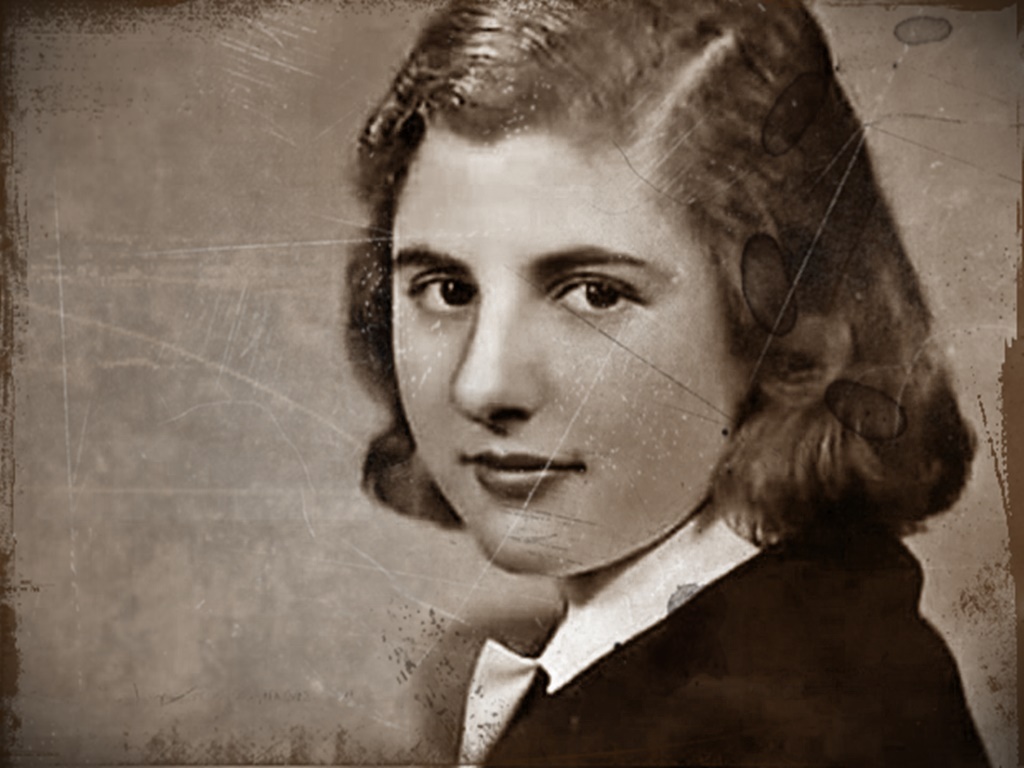
In the autumn of 1944, a privileged young person with dreams of Hollywood stardom would find her hopes brought to an abrupt end by a brutal and apparently random murder.
Georgette Bauerdorf was born into a wealthy family, the daughter of a New York City oil tycoon. Both she and her sister Connie were given a proper upbringing at a convent school, and after their mother died in 1935, the family moved out to California, where Georgette attended the same school as Myrna Loy and Shirley Temple had.
Georgette graduated in 1941, and immediately set her sights on an acting career. While waiting for her big break, she worked both for the Los Angeles Times as well as at the Hollywood Canteen, one of many supper clubs which catered to lonely GI’s. Georgette would spend her evenings drinking and dancing with the soldiers, and by all accounts, she was quite a popular fixture at the club.
On Wednesday, October 11th, 1944, Georgette was working at the Hollywood Canteen, as she did most evenings, and it was apparently a night just like any other. At the end of her shift, at a little after eleven p.m., she drove back to her apartment in the 1936 Pontiac she had borrowed from her sister, after which she apparently ate a late night snack consisting of string beans and melon, and changed into her pajamas for bed. These would be some of her last actions on earth.
About forty-five minutes after she presumably arrived home, at around midnight, the janitor of the apartment building, Fred Atwood, heard a woman’s heels clicking very loudly on the floor, as though someone was walking back and forth, and then there was a large crash. He could tell that these noises had come from Georgette’s apartment, though at the time he was not alarmed, since it simply sounded as though she had dropped something.
At around two-thirty in the morning, a downstairs neighbor heard a woman screaming and then the words, “Stop! Stop! You’re killing me!” Only half awake and assuming it was simply a lovers’ quarrel, the neighbor ignored it and went back to sleep.
On the following morning at ten minutes past eleven, janitor Fred Atwood and his wife, who was also the maid, entered Georgette’s apartment to clean it. In the bathroom they were confronted with a horrifying sight: the body of Georgette Bauerdorf, clad only in a pajama top, lying face down in the overflowing bathtub.
Investigators determined that Georgette had been savagely beaten and raped before being suffocated by a length of bandage shoved down her throat. The extent of the bruising on her body and the fact that the knuckles on her right hand were broken suggested she had put up an almighty struggle against her attacker.
The perpetrator had also stolen $100 from her purse, though he left all her other valuables behind, and then he made his getaway in Connie’s 1936 Pontiac, which had been parked outside.
Because the light bulb over Georgette’s front door had been deliberately unscrewed, police hypothesized that someone had either lain in wait in the darkness for Georgette to come home, or had somehow lured her to the door some time after she had gotten ready for bed. Though fingerprints were taken from the light bulb, no matches could be found.
The stolen car was discovered abandoned a short time later, its gas tank empty and a fresh dent on its fender, but no solid clues could be gathered there either.
Due to the nature of Georgette’s work at the club, it was thought that one of the servicemen she entertained had likely followed her home that night and killed her. To that end, an unnamed soldier who had a bit of a crush on Georgette and had reportedly been seen cutting in on all her dances on the night of her death was brought in for questioning after he identified himself to police. After a brief investigation, however, it was determined that this man—named as Corporal Cosmo Volpe—could not have been the killer, as he was logged returning to his barracks well before the murder.
Other soldiers whose names had been mentioned in Georgette’s diary were also duly investigated and subsequently cleared. Though Georgette had many admirers, friends and family members all stated that her convent upbringing had given her a rather strict outlook in regards to dating and propriety, and though she enjoyed the attentions of her suitors, she never spent too much time with just one, and never spent time with them alone, much less invited them back to her apartment. It seemed that the man who had killed her had simply appeared on her doorstep out of nowhere and then melted back into the night after performing his unspeakable deed.
In later years, some researchers speculated that Georgette might have been a victim of Jack Anderson Wilson, a possible suspect in the infamous Black Dahlia case, but proponents of this theory have put forth some inaccurate claims in order to make it seem as though Georgette Bauerdorf and Elizabeth Short knew each other, which records now show they did not.
Former LAPD homicide detective Steve Hodel, however, who made quite a media splash in 2003 with his book Black Dahlia Avenger, in which he accused his father, Dr. George Hodel, of murdering not only Elizabeth Short, but Georgette Bauerdorf as well, claims that there are numerous similarities between the two crimes, including the supposed taunting letters sent to police in both cases, and the fact that both murders involved choking with a medical-grade bandage. Authorities have stated that this hypothesis is unsubstantiated.
Georgette’s body was eventually shipped back to New York for burial, and the trail of her killer soon went cold. Whoever murdered the vivacious aspiring starlet left no clue of his identity behind, and still remains unknown, nearly eight decades on.
 Crime Immemorial