

The Wallace case has been called “the classic English whodunnit,” and though the details seem tailor-made for fiction, they were all frustratingly real. At the heart of the mystery stood fifty-two-year-old insurance agent and chess enthusiast William Herbert Wallace, who lived at 29 Wolverton Street, Anfield, Liverpool, with his wife of seventeen years, Julia. The Wallaces, by all accounts, were a quiet, ordinary, middle-class couple who evidently got along just fine and enjoyed playing music together in their home during the evenings, William playing violin, Julia at the piano.

On the evening of January 19th, 1931, William was scheduled to play in a chess match at the City Café, the regular Monday night meeting spot of the Liverpool Chess Club. William played in games there off and on, though it had been a few months since his last one. Fellow players described William as having a great love of the game, despite being not terribly good at it. He arrived at the City Café at around seven-thirty.
Shortly after he arrived, the club captain, Samuel Beattie, handed him a message. Apparently, a man giving the name R.M. Qualtrough had phoned about twenty-five minutes previously and had asked to speak to William about purchasing a life insurance policy. The message stated that William should come to 25 Menlove Gardens East the following night at seven-thirty to finalize the transaction.
Though William claimed he did not know anyone named R.M. Qualtrough and had never heard of Menlove Gardens East, he vowed to keep the appointment, perhaps because it was during the Depression, money was hard to come by, and he was hoping to get a nice commission out of the deal. So decided, he played in his chess match and then headed back home.
The following evening, William boarded the tram near his house at a little before seven. Having worked for quite a while for Prudential as an insurance salesman as well as a collections agent, William was quite familiar with the city, but he had never heard of a street called Menlove Gardens East. Perhaps for this reason, after transferring to a second tram, he kept pestering the tram conductor and the ticket collector, asking them if they knew where the street was, and at which stop he would have to disembark to locate it.
Neither man had ever heard of Menlove Gardens East either, though they assumed that the address, if it existed, was likely situated near Menlove Gardens West, North, or South, or perhaps near Menlove Avenue. They advised William to transfer at Penny Lane and get off at Menlove Avenue to start the search from there. William, who seemed agitated, reminded them more than once not to forget to call out the Penny Lane stop.
Once William was finally off the tram, he asked several people in the street if they knew where he could find 25 Menlove Gardens East. He checked a map at a newsstand and asked the woman working there about it. He asked a handful of passersby. He then approached a police officer, to whom he related the entire story of the strange message and the unknown caller. He even went to 25 Menlove Gardens West and asked the couple living there if they knew an R.M. Qualtrough. No one could help him, and at last he had to conclude that Menlove Gardens East did not exist, and that the mystery caller had sent him on a wild goose chase. He gave up and boarded a tram to take him back home.
He arrived back at 29 Wolverton Street at about a quarter to nine. His neighbors, the Johnstons, were on their way out for the evening when they saw William in the back alley, seemingly upset. When they asked him what was wrong, he said that he was having trouble getting into his house. The front door would not unlock with his key, he said, and neither would the back. The Johnstons, who had a spare key to the Wallace home, offered to fetch their copy and try it out, but then, oddly, William tried the back door again, and this time his key opened it with no problem.
The Johnstons remained outside while William went into the darkened house and lit the gas lamps. Only a minute or two had passed before William reappeared at the back door, his face pale. “Come and see. She has been killed,” he said.
And indeed, William’s wife Julia was undoubtedly deceased. She lay on her stomach in front of the gas fireplace, the side of her head bashed in so violently that her brain was partially exposed. The front parlor was awash in blood, with droplets of the stuff splattered on the walls up to a height of seven feet. Underneath the body lay a partially burned raincoat.
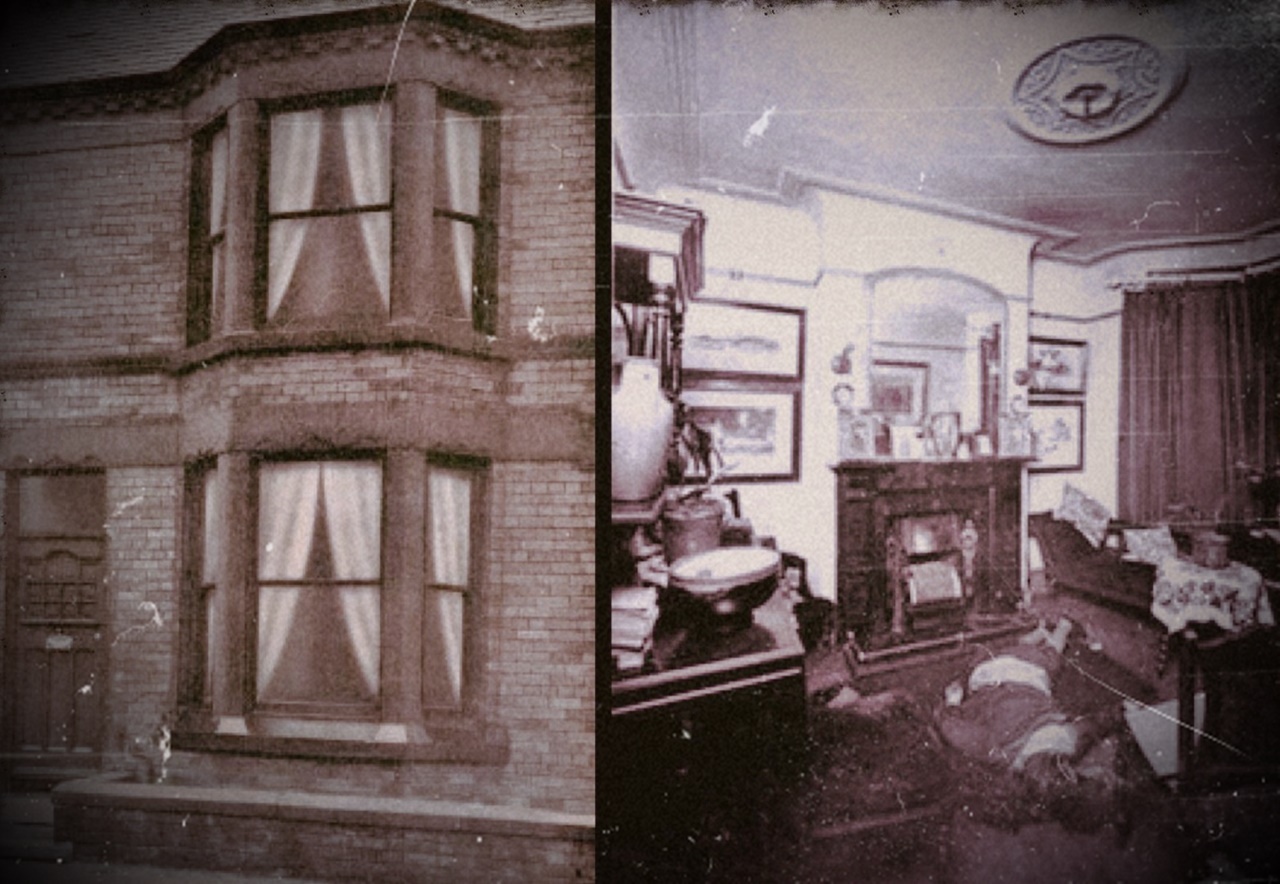
It appeared that robbery could have been a motive, for a locked cabinet which contained William’s insurance collections had been pried open, and William claimed that four pounds in cash had been taken, the modern equivalent of about three-hundred pounds sterling. However, Julia’s handbag, which had been open on the kitchen table, still contained a not insubstantial sum of money. The bedroom looked as though it had been halfheartedly rifled through, but nothing else in the house seemed to have been disturbed or stolen, though an iron bar and a fireplace poker were missing from the parlor. One of these implements was assumed to be the murder weapon, though neither was ever found.
The subsequent police investigation into the murder left much to be desired. A strike in 1919 had led to many experienced officers being sacked, and the men that remained were often under-qualified for the tasks to which they had been assigned. To wit, the forensic examination of Julia‘s body, performed by medical professor John McFall, was perfunctory at best. He placed the time of death at around eight o’clock, give or take, solely judging by the progression of rigor mortis, which was known to be an unreliable determinant even in 1931. He failed to perform any further tests that would fix the time of death more accurately, and he later revised his initial finding to place the time of death two hours earlier, at six in the evening.
This revision was almost certainly a mistake, for witness accounts of the day of Julia’s death contradicted McFall’s assertions. In fact, a teenaged milk delivery boy claimed he had spoken to Julia when he collected the milk money at six-forty-five, and his story was corroborated by a young man who was delivering newspapers in the neighborhood at the time and saw the boy speaking to Julia on the doorstep of number 29. The time of Julia’s death would become a significant aspect of the crime as the investigation grew ever more complex.
Despite the police bungling, investigators did manage to assemble enough clues to determine that William Herbert Wallace was likely responsible for killing his wife. It seemed suspicious, after all, that William had received the mysterious phone call directing him to the phantom address on the same night that his wife was murdered. It was also taken into account that William was not a regular enough fixture at the chess club for a potential murderer to be sure that he would be there on that particular evening; it all just seemed far too convenient.
Also dubious was the fact that William seemed to have made a great deal of fuss about asking several random strangers about the Menlove Gardens address, almost as though he was trying to ensure that he was seen by as many people as possible in order to secure an alibi. In fact, the police officer who William had spoken to claimed that even before William had asked about the address, he had asked the officer if it was eight o’clock yet, receiving the answer that it was only seven-forty-five, thus fixing the time definitely in the officer’s memory.
There were also a few other oddities pointing toward William’s guilt. There was the whole strange ordeal with the Johnstons seeing William unable to get into his house until they arrived, which police thought could suggest that William had been waiting to go inside the house until he had witnesses to him finding Julia’s body.
It was also a given that whoever had killed Julia either had keys to the house or knew Julia personally, since there had been no forced entry, and since she was known to be distrustful of strangers and would not have let someone she didn’t know inside. The killer had to have known the layout of the home, and known where William kept his insurance collection money. The murderer had also presumably locked the doors of the house on his way out.
Most damningly, police also discovered that the phone call to the City Café from R.M. Qualtrough had been placed from a phone box only four hundred yards from the Wallace house, which also happened to be right next to the stop where William caught the tram to search for the address in the message. In addition, police could find no one named R.M. Qualtrough in the area, though Qualtrough was a fairly common last name in that part of Britain.
Assembling all of these facts, police put together a likely-sounding story: William Herbert Wallace concocted an elaborate subterfuge which involved calling the chess club the night before the murder, disguising his voice and giving a false name, then bludgeoning his wife the next night before jumping on a tram to keep his phantom appointment, making sure he was seen by multiple people until he was certain that enough time had passed for him to safely go back home without any suspicion falling on him. The icing on the cake was pretending that he couldn’t get into his house with his key until the neighbors happened along to act as witnesses when he “discovered” Julia’s body.
The savagery of the slaying also suggested a crime of passion rather than a robbery gone wrong; Julia Wallace was bashed in the head eleven times with overwhelming violence. It was also discovered that the Mackintosh raincoat found beneath Julia’s corpse belonged to William, which led police to theorize that he had worn it while he killed her to keep himself from getting covered in blood.
As open and shut as the case seemed to be, though, there were some facts that worked against the whole hypothesis. Perhaps the most significant of these involved the time at which Julia had been killed. Had she died at eight o’clock, as the initial report stated, then William was provably across town. And it was already established that she had not been killed at six o’clock, as the revised report claimed, since at least two witnesses had seen her alive and well sometime around six-forty-five.
Additionally, for William to have killed Julia before he left on his quest to Menlove Gardens, he would have had a miniscule—and some say impossible—window of time to perform the deed. It was established with certainty that in order to catch the tram on which he was seen, he would have had to leave his house no later than six-forty-nine, only four minutes after Julia was seen alive. At six minutes past seven, he was spotted by another tram conductor and ticket collector making his transfer, and it was these two men he had initially asked about the strange address.
In sum, for the police’s scenario to be true, even assuming that the milk delivery boy and newspaper boy were off on their times, William would have had less than ten or fifteen minutes to beat his wife to death, clean himself up, change his clothes, rifle through the house a little, wrench open his cabinet to take the money, and finally make his way down to the tram stop. Though this might have been just barely possible, it seemed unlikely, especially since William had always been in poor health and was not the most spry fellow. Further, other than a tiny clot in the toilet, there was no blood found anywhere else in the house, including in the shower and sink drains, which would have been expected had William rinsed off before heading out on his fool’s errand.
Nonetheless, William was arrested for his wife’s murder two weeks later, and after a four-day trial, was found guilty and sentenced to hang. But in an unprecedented move, less than a month after the conviction, the judge overturned the jury’s verdict, citing a lack of evidence, and William was set free.
Whether William was guilty of the killing, either directly or indirectly, was never established, but in the end he obtained no real benefit from it. The bad publicity surrounding the crime forced him to move to a different city to escape the death threats he received daily, and Prudential was obliged to give him another job in which he no longer had to deal with the public. He died only two years after his release, succumbing to a chronic kidney ailment.
Numerous theories were put forth about who had killed Julia Wallace, but none of them completely succeeded in fitting all the pieces together. While it is somewhat unlikely that William committed the murder himself, given the time frame, it has been put forth by many writers that he hired someone to carry out the grim task, or that someone he knew committed the act in revenge or desperation. That someone is usually suspected to be Richard Gordon Parry, a junior employee at the insurance firm where William Wallace worked. Though Parry had been questioned by police at the time, his fiancée Lily Lloyd gave him an alibi, and another woman named Olivia Brine also insisted that Parry had been at a gathering at her home from five-thirty to eight-thirty on the evening of the slaying. He was subsequently dismissed as a suspect.
However, in 1981, a man named John Parkes who had worked in a garage near the murder site in 1931 claimed that Parry had driven into the garage on the night of January 20th and asked him to wash off his car. The garage employee stated that there had been a bloody glove on the front seat of Parry’s vehicle, and that Parry had explicitly stated that he would hang if police were to see it. There is an indication that this witness testimony was taken seriously by police at the time, so much so that they made a thorough search of Parry’s house and car, but found no solid evidence to suggest he was the murderer. If John Parkes’s statement is true, though, it could explain some mystifying aspects of the crime.
It is known that Richard Parry worked with William Wallace at Prudential. It is also known that Parry was quite young and spent money like water, driving an expensive car and seemingly always short of cash. It was rumored that he had been embezzling from the firm and that William Wallace had purportedly discovered this fact and reported it to his superiors, which may have resulted in Prudential asking Parry to quietly leave the company.
It is also certain that Parry knew William well, and was also good friends with Julia; he had been to the Wallace home for tea on several occasions, and additionally would have known where William kept his money, since he had filled in on William’s rounds many times when William was out sick.
It is also notable that Parry was involved with an acting troupe that often met at the same café as William’s chess club, and that he could have seen the chess match roster with William’s name on it, which had been posted in the café for several weeks prior to the murder. Parry was also allegedly fond of calling people up and affecting funny voices as pranks, which seems a significant hobby, given the R.M. Qualtrough phone call that sent William off on his fruitless address hunt.
If Parry was the killer, it may have been more likely that he acted on his own volition, either as a straight robbery or perhaps to get back at William for allegedly ratting him out about the stolen money. He easily could have made the phone call from the booth near the Wallace home to ensure that William would be out for the night, and then gone to the house and convinced his friend Julia to let him inside. Some writers also posit that Parry had an accomplice that night named Richard Marsden, who also worked for Prudential and knew Julia Wallace quite well. It has also been speculated, in regards to this hypothetical sequence of events, that the men had only gone to the Wallace home with the purpose of robbery, not murder, but panicked and killed Julia when she realized what they were up to and confronted them.
On the other hand, had William Wallace been involved in the crime in a murder-for-hire scheme, he could have provided Parry and/or Marsden with a key; although if this was the case, it seems strange that William recommended Parry as a suspect to police, and equally strange that the men would go to such lengths to construct a ridiculously elaborate alibi that could have gone wrong in numerous ways. Though press at the time made much of the fact that William Wallace was a chess player, and by implication some type of devious genius, in reality he was only a mediocre dabbler, and perhaps not the evil mastermind he was portrayed as, especially since suspicion for the killing fell on him almost immediately.
In a less likely scenario, a few writers have also pointed a finger of blame at neighbor John Johnston, who was present when William found Julia’s body. Though it is true that the Johnstons had a spare key to the Wallace house, the only real reason to suspect John was a vague confession he reportedly made on his deathbed, when he was suffering from senile dementia and probably had no idea what he was saying.
Several books and numerous debates later, the murder of Julia Wallace is still no closer to being solved, and at this stage, it’s likely it never will be. It remains one of Britain’s most notorious and labyrinthine unsolved murders, one that’s inspired countless mystery writers and armchair detectives, but still defies resolution, nearly a century later. About this particular crime, famed author Raymond Chandler himself once said, “I call it the impossible murder because Wallace couldn’t have done it, and neither could anyone else. The Wallace case is unbeatable; it will always be unbeatable.”
 Crime Immemorial