
The Walker Family
The last few days of 1959 would be tragically notable for the shocking massacre of an entire family that recalled the infamous slaughter at the Clutter farm in Kansas only a little more than a month before. In fact, recent developments may point to a connection between the case that inspired Truman Capote’s true crime classic, In Cold Blood, and the murder that took place in late December in Osprey, Florida.
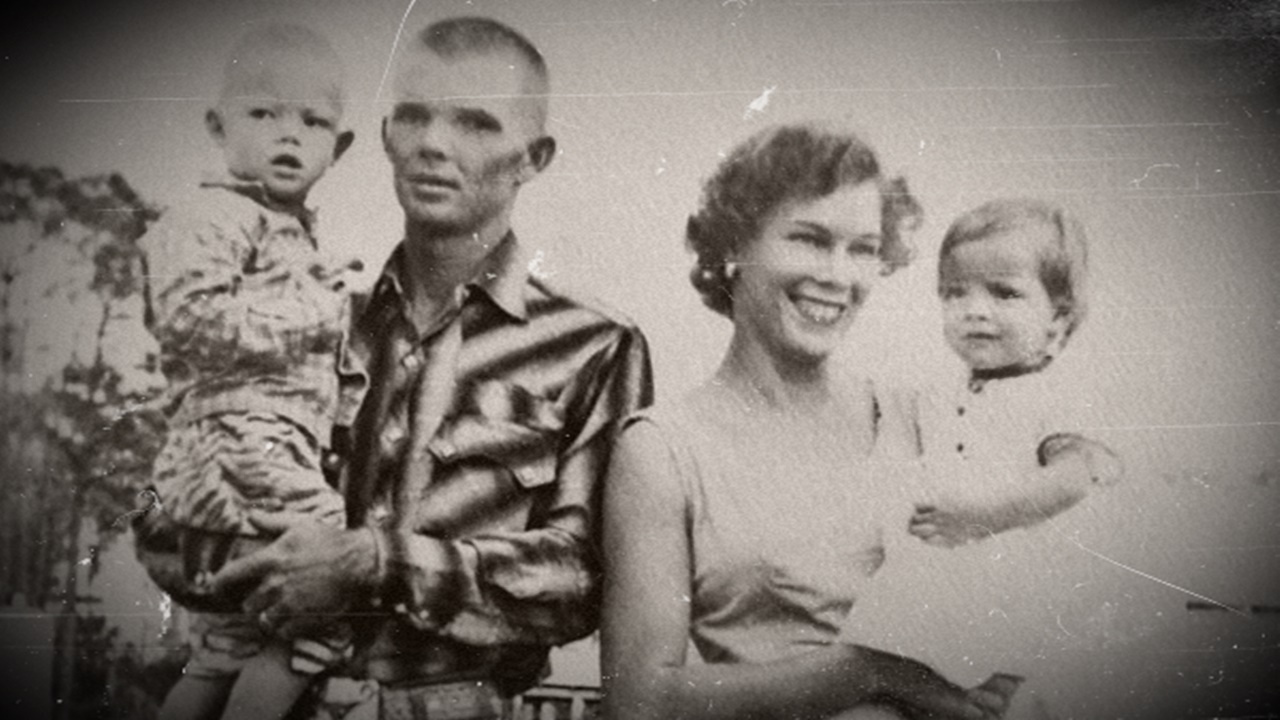
It was the week before Christmas of 1959. The 19th of December, a Saturday, had been a busy day for Cliff and Christine Walker, as they ran around doing various errands: picking up some groceries, visiting a few car lots to test drive some newer model automobiles in preparation for trading in their old Chevy, and stopping to buy some treats for their two children, three-year-old Jimmie and one-year-old Debbie.
After they had completed all their planned activities, the family dropped by to see their friends, Don and Lucy McLeod. Don and Cliff were planning on going hog hunting very early the next morning, but they took the opportunity on this particular afternoon to go out to the woods and hunt for a little while as the women and children stayed at the McLeod home socializing.
Once the men returned, Don loaded up the Jeep with some cattle feed, and since the children wanted to ride in the Jeep, Cliff stayed behind with the kids while Christine headed for home in the family car by herself. Cliff told Christine he’d only be fifteen minutes behind her, and he was as good as his word.
After Cliff and the two toddlers left the McLeod home, no one but their killer saw them alive again.
At around five-thirty on Sunday morning, Don McLeod headed over to the Walker house to pick up Cliff for their hunting trip. He fully expected Cliff to be awake and ready to go, cup of coffee in hand, but strangely, the house was dark. He also found it unusual that there was still a cut Christmas tree and a few gifts on the porch, as if the family had been interrupted in the process of taking things inside.
Don knocked on the front door, but received no answer. He then tried to peer in through the windows, but saw nothing except for one dim light. He was alarmed, and initially thought that perhaps there had been a gas leak which had rendered everyone inside unconscious. So believing, he used his pocket knife to slice through the back screen door, undo the latch, and enter the silent house.
The moment Don turned on the light in the front room, he saw Christine’s bare feet; she was lying in a pool of blood in the doorway to the living room. As he looked around, horrified, he then noticed that Cliff and Jimmie were also covered in blood, curled up in the corner and obviously dead. Don rushed outside and drove to the nearest pay phone to call the police.
When authorities arrived, they began to catalogue the grisly scene. Twenty-four-year-old Christine Walker had been raped, beaten, and shot twice. Twenty-five-year-old Cliff Walker had been shot once in the face. Three-year-old Jimmie, still holding a lollipop stick, had been shot three times in the head. And most gruesome of all, one-year-old Debbie was found in the bathtub, floating in a few inches of bloody water. She had been shot once through the top of the skull, a wound which had apparently not killed her, since she was subsequently drowned in the tub.
From the evidence left behind, investigators began to piece together a timeline of what might have happened after the Walkers were last seen on Saturday afternoon. It was thought that Christine had arrived home at a little past four. She had parked the car in a different spot than usual, indicating that another car was perhaps parked in her regular spot in front of the house.
Because it appeared that Christine had put away some groceries in the kitchen and had even displayed a Christmas card given to her by Lucy McLeod earlier that day, it was theorized that the killer was already hiding in the house when she arrived home, or that he had approached the house afterwards and she had no reason to fear him, as he was perhaps known to her.
The man must have attacked her shortly after she arrived. It was clear that she had fought him viciously, for one of her high-heeled shoes was found on the porch, covered in blood, as though she had used it as a weapon before being dragged back into the house and murdered.
Investigators believed that Cliff and the children had arrived home in the Jeep about half an hour after Christine got there, and probably surprised the assailant in the act of raping and murdering Christine, at which point the perpetrator shot all of them as well.
Clues found at the scene included a piece of cellophane from a pack of cigarettes, a bloody cowboy boot, and a single, bloody fingerprint on one of the bathtub faucets. Police also noted that a few items were missing from the home, including a small sum of money, Cliff’s pocket knife, the Walkers’ framed marriage certificate which had been hanging on the wall, and, oddly, Christine’s high school majorette uniform, which had been wrapped in plastic in a cedar chest in the couple’s bedroom.
From the outset, there were two distinct lines of inquiry. The first theorized that whoever the killer was, he likely lived in the area, and had perhaps even known the Walker family. Evidence pointing to a local killer included the fact that Christine had apparently not been afraid of the man when he came to the house; the fact that items personal to the family but not otherwise particularly valuable were stolen; and the fact that the assailant had killed the children, suggesting that he was afraid one of them would be able to identify him. Later on, bloody clothing that had been used by the killer to partially clean the crime scene was found in a shed near the Walkers’ property, bolstering the theory that the killer had known his way around the area.
To that end, one of the strongest early suspects was a twenty-one-year-old man named Curtis McCall, who some residents believed had been having an affair with Christine, though he denied this. Curtis did have a history of belligerent behavior, and admitted once owning a .22 caliber handgun, though he told police he had sold it some time before. Curtis was given several polygraph tests, but the results were inconclusive.
Also considered briefly were a sixty-five-year-old lecher named Wilbur Tooker, who had apparently made several passes at Christine and had been threatened by Cliff, and one of Cliff’s cousins, Elbert Walker, whose strange behavior at the Walker family funeral triggered police suspicions. Both men were later cleared due to lack of evidence.
Serial killer Emmett Monroe Spencer actually confessed to the crime at one point, but police didn’t take his confession seriously, as he was known to be a pathological liar.
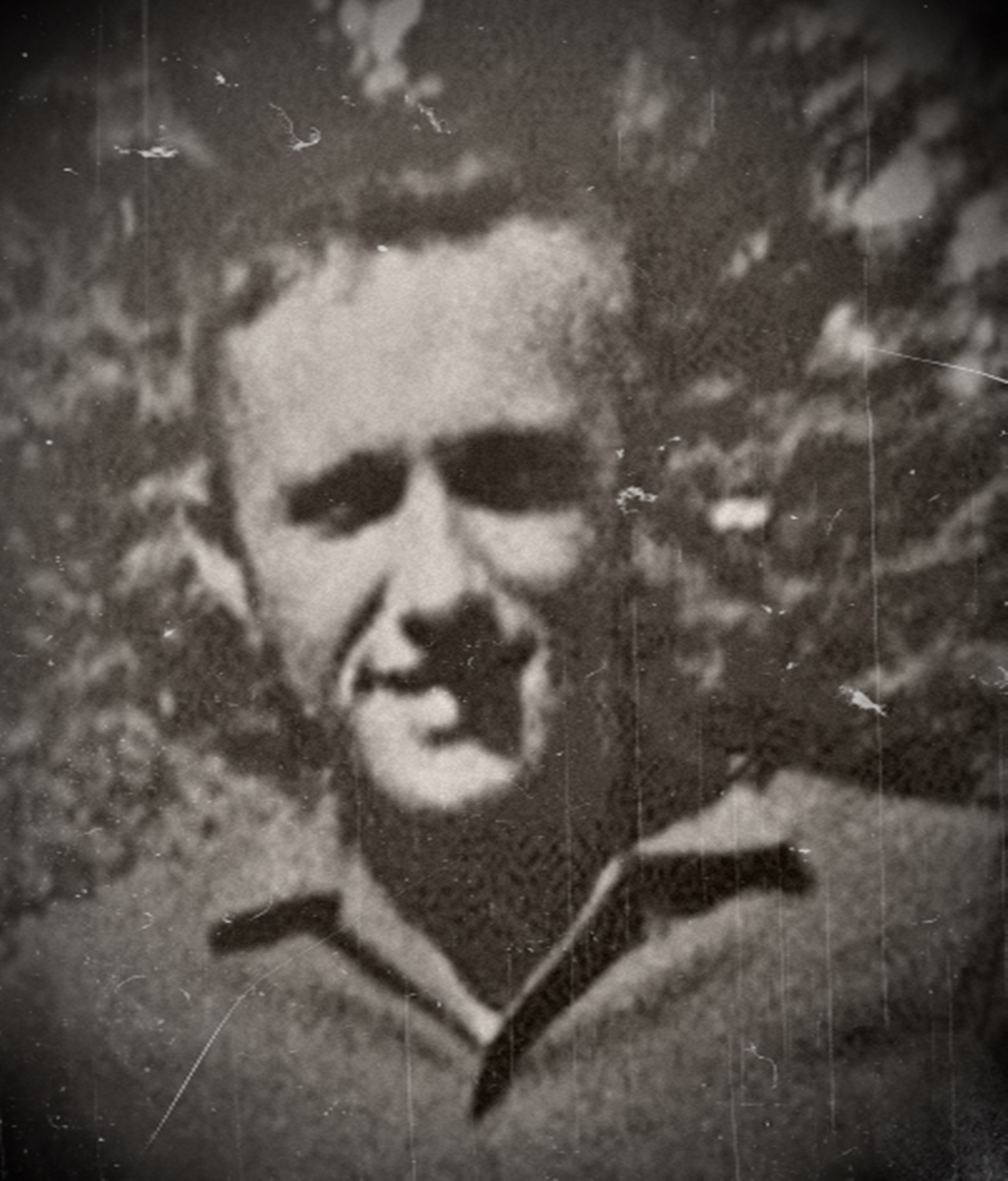
Probably one of the best-supported hypotheses, however, was the second line of inquiry, a theory that didn’t hinge on a local perpetrator at all. Many investigators, in fact, conceded that the Walkers could have been murdered by the very same killers who had recently been apprehended for the notorious slaying of the Clutter family in Kansas: Richard “Dick” Hickock and Perry Smith, who would later become household names after the crime was the subject of Truman Capote’s In Cold Blood.
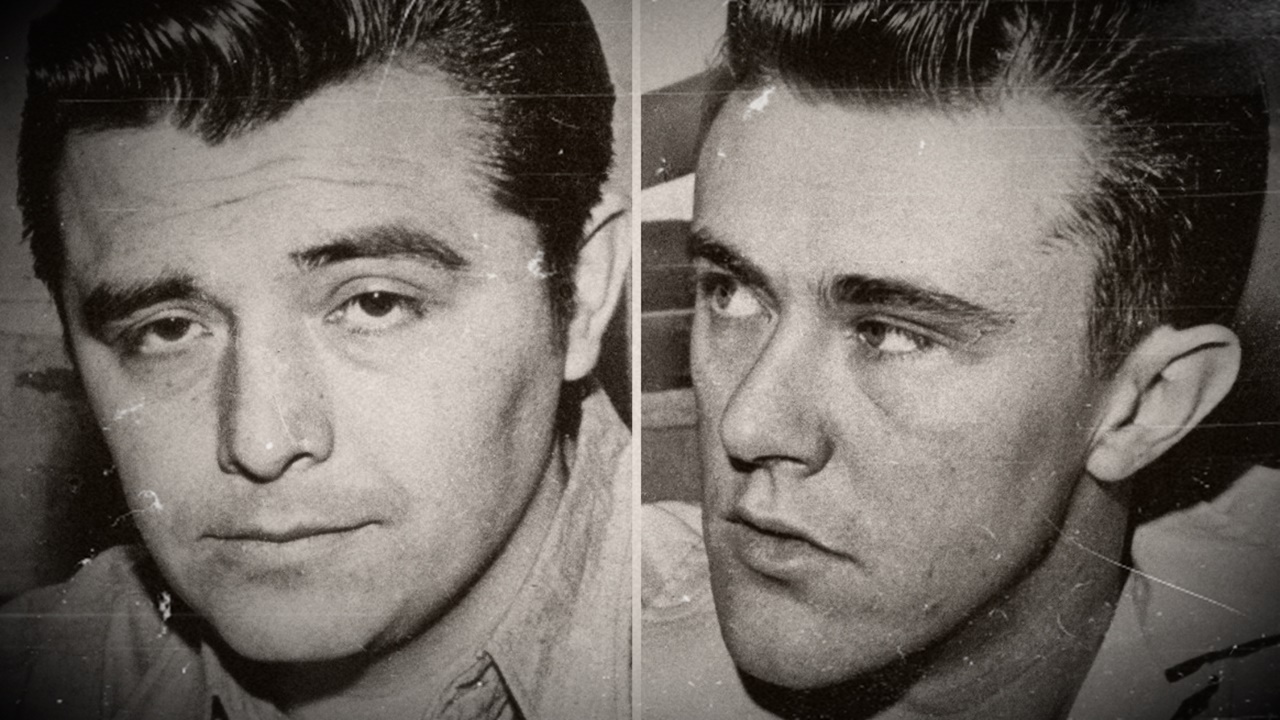
The Clutters had been robbed and murdered on November 15th of 1959, and Hickock and Smith were arrested for the crime in Las Vegas on December 30th. After their photos were splashed all over newspapers across America, several witnesses came forward and placed the killers in Florida at around the time the Walker family was murdered.
Hickock and Smith were not only spotted in Tallahassee three days after the Walker slaying, but they were thought to have stayed in a hotel in Miami on the night of December 18th, and were seen in a department store in Sarasota, only a few miles from the Walker home, on the same day as the murders.
Interestingly, Smith and Hickock were believed to have driven to Florida in a stolen 1956 Chevrolet Bel Air, which was the same type of car that the Walker family was considering purchasing. Investigators speculated that perhaps the killers could have gained entry to the Walker home by telling Christine that they were selling their car.
But perhaps the most damning piece of circumstantial evidence tying Smith and Hickock to the Walker murders was the fact that when the killers were taken into custody for the Clutter murders, police found a pocket knife in their automobile that matched the description of the knife belonging to Cliff Walker that was taken from the murder scene. Also found in the killers’ possession was a shirt and a pair of socks belonging to a toddler.
Authorities questioned Smith and Hickock about the Walker slaying, but they denied involvement, and were able to pass polygraph tests that seemingly cleared them of suspicion. They were hanged six years later for the murders of the Clutters, but researchers were still curious as to whether they had killed the Walkers as well. It seemed too much of a coincidence that Smith and Hickock had allegedly been in the area of Florida where a murder very much like one they confessed to committing in Kansas had occurred.
In 2012, the corpses of Perry Smith and Dick Hickock were exhumed so that DNA samples could be taken and compared to semen samples taken from Christine Walker‘s body. Unfortunately, the samples obtained were so degraded that results of a comparison were inconclusive, though investigators determined that the involvement of Perry Smith in the crime could not be ruled out.
The Walkers’ marriage certificate, incidentally, which had reportedly been stolen during the attack, was later recovered among some papers that a relative of the family gave to Cliff Walker’s niece.
The outcome of the case remains unclear, and the killer or killers of the Walkers and their children remain a mystery.
The Boles Family
In the summer of 1965, in California, a family was heading out for a mountain holiday that would ultimately and inexplicably turn ugly.
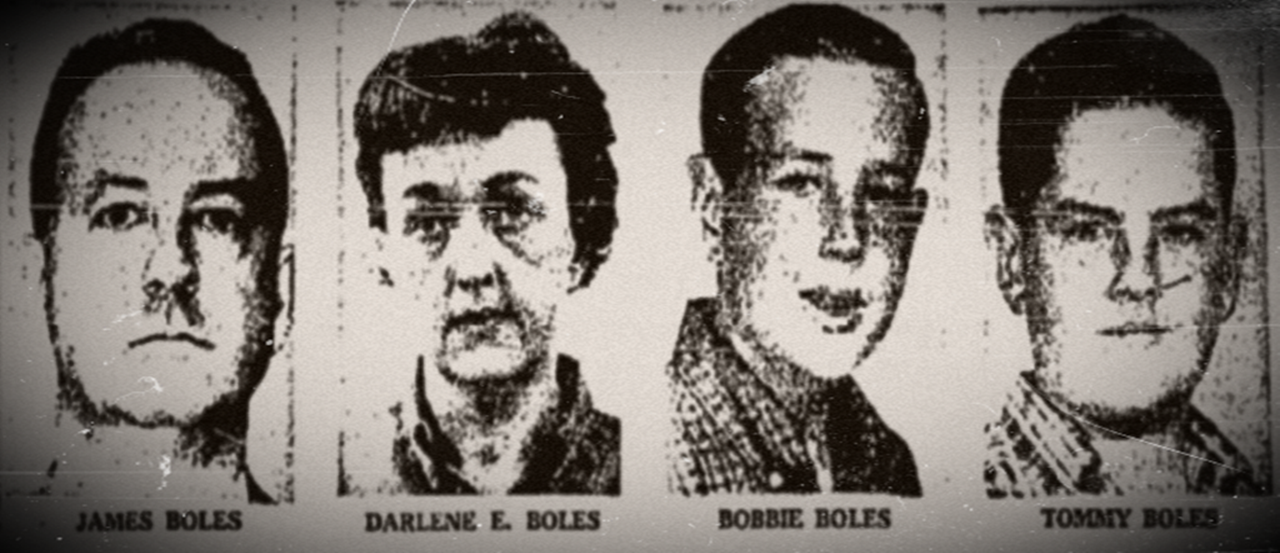
Jim and Darlene Boles lived and worked in Los Angeles, and were raising two teenaged boys, thirteen-year-old Bobby and twelve-year-old Tommy. Wanting to eventually have a remote place to get away from the city and back into nature, the couple had purchased some land up in Crestline about a decade before, though they had only just finished construction on their vacation cabin in the summer of 1965. The family had driven to the property in a pickup truck on August 7th to move in some furniture, with a view to spending the following weekend there, just relaxing away from the rat race.
On Friday, August 13th, Darlene Boles had met her mother Rina Rice after work, and the two of them had gone shopping. Darlene had purchased a few items for the planned weekend at the cabin, and seemed to be looking forward to the trip. Later that evening, Darlene, her husband Jim, and their two boys packed up the car and headed for the mountains.
On the morning of Monday, August 16th, Jim’s mother Hester Boles was beginning to get worried. Jim and Darlene were supposed to have returned to Los Angeles on Sunday night, but Hester thought it strange that she hadn’t yet heard from her son. She first phoned the plant where Jim worked, but was told that he had not yet arrived. Her fears mounting, she then called Darlene’s mother Rina Rice, who was also becoming concerned, as she had not heard from Darlene since Friday night.
Rina then phoned her son Floyd and told him that she thought something was wrong. Floyd initially believed his mother was overreacting, but agreed to look into the matter. He couldn’t call the Boles’ Crestline cabin, as the phone had not yet been installed there, and he couldn’t quite remember where the cabin was located, since he had only been to the property once, shortly after the Boles’ had purchased it in 1955.
Floyd attempted to get someone from the office of the contractors who had built the cabin to drop by and check out the property. An employee there said they would see to it, but after a couple of hours with no word, Floyd finally called the sheriff’s office of San Bernardino County, though because he could not provide the address of the cabin and the sheriff’s office was understaffed, he got the runaround there as well.
After several more hours of frustrating phone calls to various police departments, none of whom seemed keen to help him, Floyd himself enlisted one of his employees who knew the Crestline area, John Wilcoxin, to drive up there with him and see what was going on.
The two men didn’t arrive at the cabin until five p.m. on the afternoon of August 16th. Though Floyd was unsure as to which of the Boles’ two vehicles they had driven to the cabin, he noticed right away that neither one of them was present at the site.
They walked up to the cabin and peered into the large front window, and immediately, Floyd realized that something awful must have happened: the Boles’ dog Barbara lay across the sofa, covered in blood and clearly dead.
Floyd entered the cabin through the unlocked front door, though at first he didn’t see anyone. However, as soon as he walked into the master bedroom, he was horrified to find three bodies lying in pools of blood. Jim and Bobby were positioned next to the bed, while Darlene lay in a crouching position on the floor of the closet. All the victims had been shot multiple times.
Floyd quickly fled the cabin, shouting to John what had happened, and the two men then drove to the nearby sheriff’s substation. Officers were soon dispatched to the scene.
Detectives noted the large quantities of blood all over the living room and dining area, forming a trail that led from the master bedroom. They also recovered five .22 caliber shell casings from around the couch where the dog had been killed.
Proceeding into the master bedroom, police found the three bodies arrayed around the room, and also discovered the remains of the fourth family member, Tommy Boles, who was located in the closet partly underneath the body of his mother. It appeared that Darlene had been attempting to shield her son from the gunfire. Thirty more shell casings were found near the bodies.
Other forensic evidence recovered from the scene included a smear of blood on a bedsheet—presumably from the killer wiping off a knife blade—and a set of footprints that had been left by the assailant after treading in Jim Boles’ blood.
There was no sign of forced entry, and it did not appear that the cabin had been ransacked for valuables, as none of the furniture had been disturbed. Though Jim’s wallet was found to contain no cash, it wasn’t clear if he had brought any cash with him, and his credit cards remained untouched. No other significant physical evidence was found at the site.
The following day, the Boles’ 1962 red Dodge was discovered abandoned off of Bowl Road in Crestline. Investigators obtained partial prints from the driver’s side door, and also recovered the key from beneath the vehicle. Witness accounts suggested that the car had been left there at approximately ten p.m. on Sunday night, though a paper boy later told police that he had spotted the red Dodge in the same location on Sunday morning at around six-thirty a.m., though it might have been parked facing the opposite direction than it was when police discovered it on Tuesday.
Significantly, a neighbor named Dr. Weir who had been driving back to his cabin at around eight-thirty p.m. on Saturday night stated that he had almost been run off the road by a red Dodge, which was speeding in the opposite direction. Dr. Weir said that a Caucasian male had been driving the vehicle, though he could not describe the individual with any further specificity.
In the ensuing days, authorities conducted interviews with other residents who maintained cabins in the area. The Boles’ had been seen numerous times during the day on Saturday: one neighbor, Herman Hintz, had loaned Jim Boles a stepladder at around three p.m., and the entire family had been seen eating a late lunch at a local café about an hour later. At this café, witnesses reported that Jim Boles had received a phone call which had appeared to upset him.
A local woman named Lillian Mainer asserted that the Boles’ had come to her cabin at some time on Saturday evening to pick up some rat poison. She further told police that Darlene Boles had specifically told her that they had just moved to the area, with the implication that the boys would be starting school in Crestline in the fall. Mrs. Mainer was also certain that Jim Boles had mentioned that they were supposed to meet someone back at their cabin at eight p.m.
Additionally, one couple, the Ogles, had reportedly chatted with Jim and Darlene Boles on Saturday evening between six-thirty and seven p.m., but had noticed nothing amiss. They further stated that there had been a very loud party going on at another nearby cabin that Saturday night, which likely would have covered up the sound of any potential screams or gunshots. Several other residents independently corroborated the time and volume of the party, which took place at a cabin owned by a Dr. Shonan.
Another couple, Mr. and Mrs. Williams, reported that at a little past one p.m. on Saturday afternoon, they had noticed two cars parked in the Boles’ driveway, one of which was a light-colored vehicle similar to a station wagon, and the other a dark-colored vehicle of unknown make and model. Neighbor Mary Jane Guigent also reported seeing a large white or beige car parked at the bottom of the Boles’ driveway at about four-thirty p.m. on Saturday.
Herman Hintz, the man who had loaned Jim Boles the stepladder, stated that upon arriving at his own cabin at around ten-thirty p.m. on Friday night, he had seen two boys sitting on the fender of a small white sports car that was parked along the road. He told police they had looked so suspicious that he had taken note of the license plate number, which he subsequently passed over to investigators.
Whatever happened to the Boles must have happened at some time late on Saturday night, because according to all witnesses in the area, the family’s red Dodge was no longer parked in front of their cabin as of ten a.m. Sunday, and another neighbor, Sophie Ann Mager, stated that she thought she heard a woman screaming and the sound of a car horn very late on Saturday night.
However, one witness, Raymond Gollon, seemed to contradict this sequence of events when he reported to detectives that he thought he had heard gunshots at around six p.m. on Saturday evening, and had soon after seen a dark-skinned, thirty-year-old man with floppy dark hair and a moustache walking down the hill from the direction of the Boles’ cabin. A man fitting this general description was also reported by another witness on Saturday evening, sitting in a car on an undeveloped plot of land not far from the Boles’ property.
Investigators soon began to delve into the private lives of the Boles family in an attempt to uncover a motive for the seemingly senseless crime, though from the outset, they ran into a morass of contradictions. While some friends and acquaintances of the couple insisted that Jim and Darlene had been very close and enjoyed a stable marriage, others claimed that the short-tempered Boles’ had a volatile relationship, and would have divorced if it wasn’t for their children.
It was even suspected that Darlene had been carrying on an affair with a coworker named William Hedin. Hedin at first denied having had intimate relations with Darlene, though did admit that they were close friends and spent quite a bit of time together, since they were on the same work-sponsored bowling team. He later relented a little and said that he and Darlene might have become intimate at some stage, though he would not confirm the nature of their relations outright.
Hedin also told police some other intriguing information, namely that Darlene had lamented that all of the family’s money was tied up in their condo and their new cabin, and that she felt bad that she wouldn’t be able to loan her brother any money. She also allegedly told Hedin that her ex-husband had been coming around asking for money as well, though she did not specify why he wanted it.
Eerily, Hedin further stated that Darlene had made a comment to him on Friday, August 13th that if she went to the cabin that weekend, she was afraid she wouldn’t come back. Another friend of Darlene’s likewise told police that Darlene had reported to her that she had a prophetic dream or a premonition that she would not be returning from the cabin.
Police also pursued a few leads involving some juries that Jim Boles had recently served on, with the suspicion that perhaps an associate or relative of one of the defendants that he had helped to convict had gone to the cabin to exact revenge. It seems that nothing much came of this angle, however.
Detectives then tracked down Darlene’s first husband, Harvey Fulton, who had been married to her for only a brief time when she was seventeen years old, after which the pair had requested an annulment. Fulton told police that he had not seen or heard from Darlene in years, and had not even known she had remarried. Although there were some rumors circulating at Darlene’s workplace that Fulton was actually stalking Darlene and at one point had broken into the Boles’ condominium and beaten her up, police found nothing to corroborate these tales and dismissed them as idle gossip.
One initial suspect who seemed far more likely was a man who had worked as a cook at the San Moritz Club, the restaurant where the Boles family had eaten on the Saturday prior to their murder. A waitress who worked at the restaurant reported that the cook had been fired the week before, but was nonetheless seen sitting on the hood of a blue car in the restaurant’s parking lot on Saturday afternoon, watching the patio where the Boles family was seated.
Not only that, but a seventy-five-year-old woman named Ann Scheehan informed police that when she had been staying in a Crestline cabin on August 3rd, a man had opened her front door and stood on the threshold looking at her before turning around and running away after she asked him what he wanted. When shown photographs at the police station, the woman pointed to a picture of the cook and identified him as looking very similar to the man who had been in her cabin.
The cook was apparently a sex offender who was on parole, and had been fired from the restaurant because he had been engaging in a homosexual relationship with a coworker, which was against the conditions of said parole. Though the inquiry into his guilt initially seemed promising, police could find no evidence tying him to the Boles massacre.
Six days after the murders, a Forestry Service worker named Donald Edwards confessed to the crime to two of his superiors. Edwards was taken into custody, and the .22 caliber rifle he owned was confiscated, but as the questioning continued, Edwards retracted his confession, claiming he had only been joking. A polygraph test was administered, which suggested that he was not involved in the slaying, and he was eventually released.
Another man named Jack Ray, who was likewise employed at the San Moritz Club, also confessed to the murders, but was dismissed as a suspect after it was determined that he had simply been trying to show off.
An apparent break in the case occurred when the San Bernardino County Sheriff’s Department received a teletype from the police department in Mobile, Alabama. It turned out that an individual by the name of George Robert Stewart, a suspect in the molestation and murder of two young boys in Mobile, was believed to be headed to Bellflower, California to stay with a friend. As investigators looked into his background, they discovered that Stewart—who had been in and out of mental hospitals for years and had been diagnosed as psychopathic– had worked at a religious camp only two miles from the site of the Boles slayings, beginning in July of 1965.
Stewart was eventually apprehended in Arlington, Texas, and detectives from San Bernardino County were able to question him about the Boles murders. Though Stewart confirmed that he had been in the vicinity of the Boles’ cabin at around the time of the slaying, he categorically denied harming the Boles family, and seemed particularly offended that investigators would suggest that he had shot a dog.
But polygraph results indicated deception, and detectives believed that Stewart might have been responsible for the massacre, or at least knew who was. They also noted that Stewart owned a pair of shoes with a very similar—though not exact—sole pattern as the shoe prints found at the crime scene. It was speculated that since roughly two years had passed between the Boles murders and the questioning of George Robert Stewart, the difference in sole patterns could have been explained by wear.
Though authorities were confident that Stewart was their man, in the end they had no solid evidence to charge him with the quadruple homicide. No murder weapon was ever found, and no particular motive tied Stewart to the family. Stewart was never charged with the slaughter, nor was he ever indicted for the double murder in Alabama which had brought him to the attention of the San Bernardino police. He was, however, later imprisoned in Illinois for numerous sexual assault and abuse charges.
The massacre of the Boles family in their Crestline, California cabin remains an eerie and unsolved mountain mystery.
The Miyazawa Family
Just as the year 2000 was coming to a close, an unbelievably heinous mass murder would occur in the largely peaceful nation of Japan: the wholesale slaughter of an entire family whose details would be picked up by news media around the world. Despite a wealth of forensic evidence left behind at the scene, however, the identity of the killer (or killers) is still unknown.
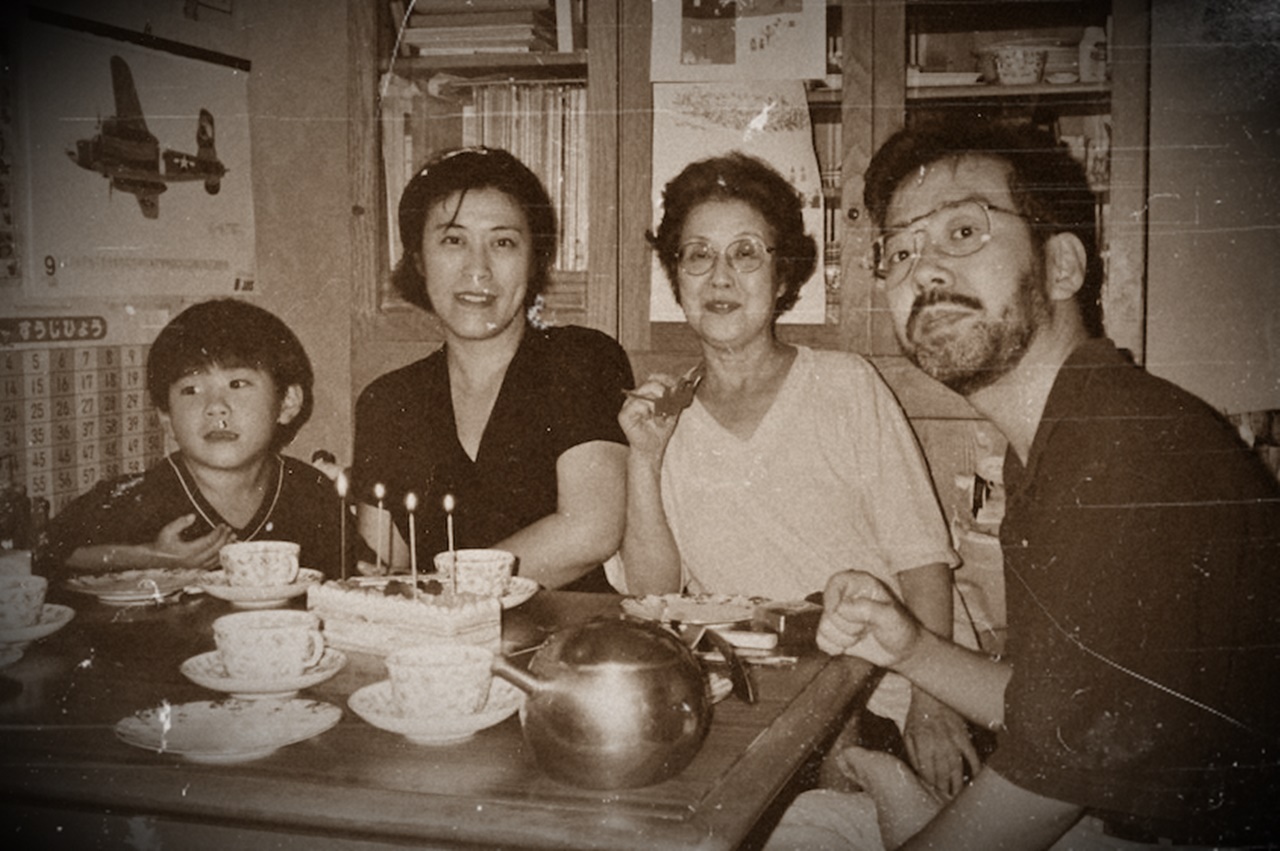
The Miyazawa family consisted of forty-four-year-old Mikio, who worked at an international marketing firm called Interbrand; his forty-one-year-old wife Yasuko, who was a teacher; and the couple’s two children: eight-year-old daughter Niina and six-year-old son Rei. By all accounts, the family was well-regarded in the community, had no known enemies, and seemed completely normal in every way.
In 1990, the Miyazawas had moved into one half of a large duplex in the suburban Setagaya district of Tokyo. Yasuko’s mother Haruko, her sister Irie, and Irie’s husband lived in the other half of the house, the rear of which faced a large public park; the properties were only separated by a chain-link fence.
In fact, this park was in the process of undergoing an expansion, and for this reason, most of the other residents of the Miyazawas’ neighborhood—once totaling over two-hundred families—had moved out, and the population had been reduced to just four households. The Miyazawas were planning to move out themselves before too long. Unfortunately, their plans would never come to fruition.
On December 30th, 2000, it seems that the family was in festive spirits, preparing for the New Year, which is a very significant holiday in Japan. They had spent the late afternoon at a nearby shopping center, and in the evening, eight-year-old Niina had gone over to see her grandmother next door; the two of them had watched a TV program together before the child returned to her own home at around nine-thirty p.m.
Afterwards, Mikio went on his computer in the study and checked some work emails, while Yasuko and Niina watched television in the loft upstairs. Rei was most likely in his room alone, probably sleeping.
It is not clear exactly when the intruder entered the home, though because Mikio had accessed a password-protected email on his computer at ten-thirty-eight p.m., it was presumed to be sometime after that, perhaps between eleven-thirty p.m. and midnight. Later investigation suggested that the killer had most likely entered the home by climbing a tree behind the house and removing the screen from an open, second-story bathroom window.
The bodies of the four Miyazawas were not discovered until around ten o’clock the following morning. Yasuko’s mother, attempting to phone her daughter, became concerned when the call failed to go through; unbeknownst to her, the intruder had cut the phone lines. She then went next door and knocked, but received no answer. At that point, she used her spare key to enter the home, and immediately spotted the lifeless body of Mikio Miyazawa, covered in blood and slumped at the bottom of the staircase. He had been stabbed multiple times, mostly in the neck and head.
A horrified Haruko then went upstairs and found Yasuko and Niina, both lying dead at the foot of the ladder that led up to the third-floor loft. Both had also been stabbed numerous times, with far more vicious mutilations than were evident on Mikio’s remains. Investigators would later surmise that the killer had continued to stab the victims long after they were dead.
Inside a second-floor bedroom, the body of six-year-old Rei was also discovered, lying in his own bed. He had not been stabbed, but strangled with bare hands, most likely while he was still asleep, which indicated to authorities that he had probably been the first member of the family to die.
Whoever the perpetrator of this ghastly crime had been, they had seemingly little worry or care about getting caught. Police determined that the murderer had stayed in the Miyazawas’ home for between two to ten hours after he had killed the family, eating several ice cream bars out of their freezer, taking a nap on the living room sofa, using Mikio’s computer to check out some bookmarked web pages, and most revoltingly, defecating in one of the toilets and neglecting to flush.
In addition, he had left several pieces of his own bloody clothing behind, as well as bandages and maxi-pads that were later found to have his blood on them, indicating that he had been injured in the course of the homicide and had attempted to administer first aid to himself. A few bandages were also found to have Niina’s blood on them, suggesting that the killer had either transferred the girl’s blood onto the bandages while he was tending to his own cuts, or that Niina and her mother had not been killed outright, and had attempted to stanch the blood flow on their own wounds before the assailant had returned to finish the job.
Further, the killer left both murder weapons at the scene: a sashimi knife that he had brought with him to the house, and a knife that he had taken from the Miyazawas’ own kitchen. Forensic examination of Mikio Miyazawa’s wounds determined that the blade of the sashimi knife had broken while the killer was stabbing him, leading the killer to fetch a kitchen knife from the victims’ home in order to stab Yasuko and Niina.
The shocking crime immediately drew copious media attention, and a survey of neighbors and other witnesses was utilized in order to put together a rough timeline of what had happened, as well as obtain a description and possible motive of the likely suspect.
Firstly, according to friends and family members of the Miyazawas, Mikio had engaged in several verbal altercations with a group of skateboarders who were making a lot of noise in the skate park, which was situated directly behind the house and separated from the backyard by a simple fence. Mikio had reportedly also had harsh words with members of a local motorcycle gang in the week or so prior to the murders, for the same reason; i.e. that they were causing a noise disturbance. Though this might have been coincidence, authorities left open the possibility that one of the people Mikio had argued with had decided to take revenge on the family.
Another possible angle to this scenario was the fact that Yasuko, a few days before her death, had told her father-in-law that she had seen a car parked in front of their house on several occasions, which struck her as unusual, since the vehicle did not belong to any of their neighbors, and the park behind the Miyazawa home had its own parking lot for visitors.
Other neighbors had also reported seeing a strange man who looked to be in his forties walking around the Miyazawas’ property on or around December 27th. A man of this similar description, but wearing a backpack and clad in “skater” type clothing inconsistent with the weather, was also spotted at the nearest train station on December 29th. Reportedly, a man dressed in a similar fashion had purchased a sashimi knife from the Kanagawa Prefecture shopping center only a few miles from the Miyazawa home on the same day.
As the investigation continued, more crucial information came to light. A passerby who had been walking near the Miyazawa home on the night of the murders, for example, claimed he heard what sounded like a couple arguing, coming from inside the house. And although Yasuko Miyazawa’s mother and sister, watching television in the house next door while the slaughter was taking place, had not heard anything alarming that night, they did state that they had heard a fairly loud thump from next door at around eleven-thirty p.m. Authorities presumed that this thump was the sound of Mikio falling to the bottom of the staircase after being stabbed.
A taxi driver also came forward and asserted that after midnight on December 31st, he had picked up three men in the area of the Miyazawa home. All were in their late thirties or early forties, and spoke very little. The cab driver also reported that one of the men had blood on his hand, some of which was smeared on the seat of the taxi. This dovetailed neatly with the witness statements of medical personnel at a clinic located at Tobu Nikko Station, which was about a three-hour journey from the Miyazawa home. According to them, a young man had come to the clinic to be treated for a severe cut on his hand at about four p.m. on December 31st. The man declined to give his name, but staff recalled that he was wearing jeans and a black down jacket. They remembered him distinctly, because he had treated his bone-deep cut with striking indifference.
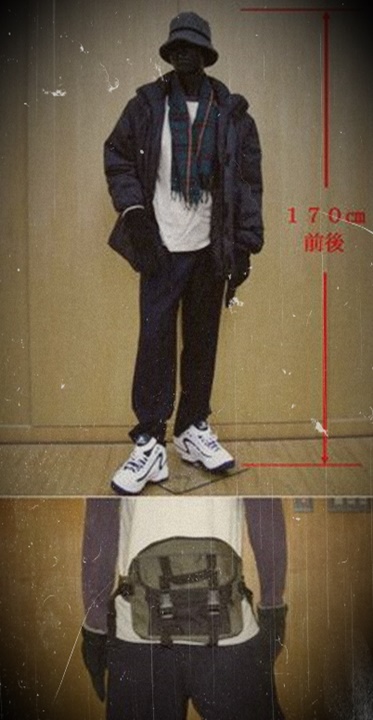
Because the killer had left much of his own clothing behind at the scene, police were able to construct a very specific depiction of what the suspect had been wearing, and coupled this with the varying witness descriptions of the man at the clinic, the man seen around the Miyazawa property at different times before the attack, and the man spotted at the shopping center and the train station. From all these elements, authorities put together the exact ensemble and dressed a mannequin of a similar height—about five-foot-seven—in the outfit the man wore, later releasing photos of the mannequin to the public.
The killer had entered the Miyazawa house clad in baggy dark trousers, a white shirt or sweater with long purple sleeves, a black jacket, a woven gray Crusher hat with a black stripe, black Edwin-brand gloves, and a multicolored scarf. Though the murderer had not left his shoes behind, he did leave bloody footprints, from which investigators were able to identify a particular type of Slazenger brand running shoe. Though this style of shoe was commonly sold throughout Japan, it was not of a size sold in Japan, but a size available for sale in South Korea: twenty-seven-and-a-half centimeters long. Likewise, an analysis of the clothing demonstrated that it had been laundered in hard water, which was more in line with Korean water systems than the soft water system present in Japan.
Additionally, the killer had carried a black handkerchief, which had been recently ironed and had traces of the cologne Drakkar Noir on it. He had also carried a small backpack or fanny pack, which contained a roll of grip tape and some trace grains of sand. This sand, when examined, was of a type originating either from Korea’s Gyeonggi Province, or somewhere in the American Southwest, perhaps near Edwards Air Force Base in Southern California (sources differ).
Analysis of the fecal matter left behind by the killer suggested that he had eaten a dish containing sesame seeds and string beans not long before entering the Miyazawa home. Investigators were also able to procure a DNA profile from the killer’s type-A blood, which suggested that he was possibly mixed race, with an East Asian father and a Southern European mother whose family hailed from around the Mediterranean or Adriatic Sea. The paternal DNA markers indicated that the killer’s Asian heritage could have been Japanese, Chinese, or South Korean, with the latter being statistically the most likely.
Because of the Korean and possibly American connections, police hypothesized that the murderer might have been a recent Korean immigrant, or perhaps an American serviceman stationed at one of the nearby bases.
As to the motive for the gruesome crime, however, investigators seemed to be at a loss. While Mikio Miyazawa’s recent run-ins with the young skaters behind his house and the somewhat “skater” appearance of the clothing the suspect wore might suggest an unbalanced young man out for revenge, witness statements of the suspicious individual or individuals seen around the Miyazawa property prior to the murders nearly all described older men, at least thirty-five years of age, not teenagers.
Some researchers have also put forward a financial motive for the slaying, positing that someone was envious of the millions of yen the families in the neighborhood were being paid by the city to purchase their properties for the proposed park expansion. However, from the unnecessary violence of the crime scene to the fact that hardly anything was taken from the Miyazawa home (other than a few pieces of clothing to replace the ones the killer had discarded, and a small amount of cash), it would seem that robbery was not the primary impetus for the invasion. In fact, it did appear that the killer, during his long stretch in the home after the murders had been committed, had gathered together several of the victims’ credit cards and laid them out on a table top, but didn’t take any of them with him when he left. He also failed to take another large cache of money that was easily seen in the study where he was using Mikio’s computer.
Further, the killer had placed a selection of the victims’ personal but unimportant papers—some of which had been cut up—into the bathtub, along with the wrappers from the ice cream bars he had eaten. He had also, strangely, started to purchase a pair of theater tickets from a website Mikio Miyazawa had bookmarked. These extremely unusual aspects of the assailant’s behavior would seem more in line with an individual bearing a personal vendetta; or perhaps a psychopathic killer who chose the family at random, but had been stalking them for some time and wished to insert himself into their lives to some degree. The fact that the murder of the female members of the family, moreover, had been carried out with exponentially more brutality than that of the males might also indicate a particularly sexual or misogynistic rationale.
More than years have passed since the four members of the Miyazawa family were mercilessly slaughtered in their own home, and in spite of a solid amount of forensic evidence, the murderer remains unidentified. As of this writing, the relatives of the Miyazawas are still engaging in a dialogue with authorities, who feel that it’s time to demolish the fateful house where the murders took place; the home has been abandoned since that night, and is beginning to deteriorate, as well as acting as a constant beacon for curious true crime buffs. Family members wish to retain the property intact, at least until a suspect is arrested, as they feel that perhaps some overlooked evidence may still be discovered there.
It remains to be seen how this conflict will be resolved, and if the killer will ever be found.
 Crime Immemorial