
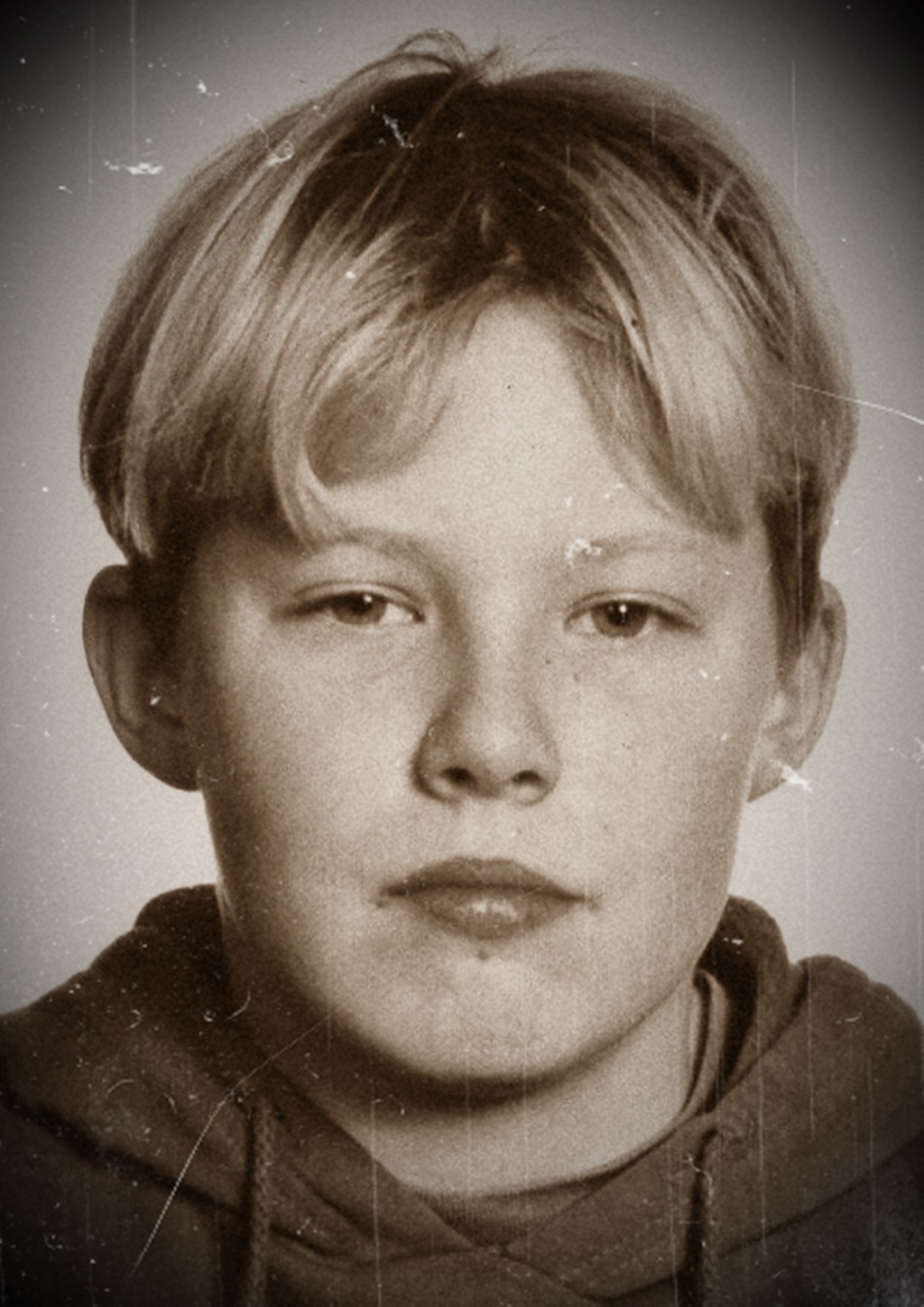
Thursday, March 26th, 1998 was the last day of school before Easter break in Frankfurt, Germany. At a little before eight o’clock that morning, thirteen-year-old Tristan Brübach got up for classes; his father Bernd had left for work nearly four hours before, as usual. Tristan was being raised by his father and grandmother, after enduring the loss of his mother Iris two years prior.
Tristan phoned his father at work that morning and told him that he was having severe back pain, and didn’t want to attend school that day. His father, perhaps suspicious of Tristan’s excuse, told the boy to go ahead to his classes, and then if he was still in pain later on, he could go to see the doctor then.
Tristan appeared to comply, though on his way to school, he reportedly ran into his friend Boris, and the two boys smoked a couple of cigarettes before finally turning up for their second-period class at around nine a.m. Tristan attended classes as normal until lunchtime, but about fifteen minutes into his first class after lunch, he complained to the teacher that his back was bothering him, and asked to be dismissed. When the teacher asked what had happened, Tristan claimed that he had fallen out of a tree the day before, though later evidence suggested that he had actually hurt his back whilst engaging in a rock fight with another boy; Tristan was allegedly the frequent victim of bullies, though he seemed to prefer to keep this fact to himself as much as possible.
The teacher gave permission, and Tristan left the school grounds alone at around one-thirty p.m., taking a local bus and getting off at the Frankfurt-Höchst train station, where he would apparently spend the last two hours of his life.
At one-forty-six p.m., CCTV footage at the busy train station showed Tristan inside a shop, possibly moving toward a pay phone. There was an unknown adult male near the boy, but the footage was too unclear to determine whether the man was interacting with Tristan, or just happened to be standing there. Tristan would also be spotted twice more at the train station, both times by separate classmates, between two-fifteen and two-forty-five p.m. One of the witnesses said that Tristan might have been waiting for someone, but wasn’t entirely sure of that.
It is believed that the last sighting of Tristan alive was at approximately three-twenty p.m. A woman walking her dog through a park near the train station said that Tristan had been sitting on a bench smoking a cigarette and had spoken to her as she passed, asking if he could pet her dog. She said the boy was very friendly and told her that he was quite fond of animals, a personality trait vouched for by essentially everyone else who knew him; he even had a pet rabbit named Hoppelfried back at home. This same woman also claimed that after this encounter, she had looked back and seen Tristan sitting on a bench at the park with two adult males, one sitting on either side of him. The woman stated that the men looked “foreign.”
About ninety minutes later, a group of children were passing through Liederbach Tunnel, a dimly-lit but often-used shortcut that lay underneath a train overpass and ran parallel to the Liederbach River. What the children found within caused them to flee from the tunnel in terror.
After the children reported their find to their teachers at the day care they had been heading toward, the teachers went into the tunnel themselves to confirm the veracity of the children’s story. Seeing the carnage with their own eyes, they phoned the police at eight minutes past five p.m.
Approximately halfway through the tunnel, the body of Tristan Brübach lay, posed as though he was sleeping. A closer examination of the remains, however, revealed the horrific truth: Tristan had been beaten and choked into unconsciousness, dragged into the tunnel, then had his throat slashed from ear to ear, deeply enough that the cut nearly reached his spine. The killer had then bled the boy out into the water flowing alongside the walkway of the tunnel.
As if that wasn’t gruesome enough, the murderer had then excised the child’s testicles from his scrotum, and sliced substantial chunks of flesh off the boy’s thigh and buttocks. As Tristan’s backpack was not recovered from the scene, authorities theorized that the killer had used the backpack to carry away the pieces of the boy’s body, perhaps to keep as trophies, or to use for cannibalistic purposes.
Eerily, it appeared that one of the boy’s shoes had come off during the hypothesized struggle, and after the boy was dead, the assailant had gone to the mouth of the tunnel to fetch the shoe, which he then placed deliberately on the boy’s posed body. The only other evidence of the killer’s presence was a single bloody fingerprint recovered from near the remains.
Investigators were shaken to the core by the savagery of the crime, which was unprecedented in that region of Germany. Even more shocking was the fact that such a brutal murder had occurred in the middle of a normal afternoon in a well-trafficked area, and that the entire grisly slaughter was believed to have been perpetrated inside of fifteen minutes.
As details of the case began to go public, several individuals came forward with further details about what might have happened on that fateful day. Three children who had been planning on cutting through the Leiderbach Tunnel on their way to a soccer field that afternoon, for example, said that as they approached the tunnel entrance, they had seen a man leaning over an “object” about halfway along the tunnel. Though they couldn’t see what the object was, the scene looked so odd that they decided to take the long way around rather than risk walking through the tunnel. Since this sighting occurred at around three-thirty p.m., detectives presumed that these three children, who were about the same age as Tristan, had actually witnessed the murder taking place, but hadn’t realized what they were seeing.
All three children described the man they saw as being about five-foot-seven, with a lean build, light-colored eyes, and long blond hair pulled back in a ponytail or braid. They said he was wearing a baseball cap, looked disheveled or dirty, and most notably had either a harelip or a very large scar in the space between his upper lip and the bottom of his nose. Another woman who had been passing through the area described what seemed to be the same man emerging from the tunnel at approximately the same time. Police used these witness statements to produce a detailed composite image of the suspected murderer, and released it to the public with further profile information, such as the fact that he was likely in his mid-twenties to mid-thirties, antisocial with pedophilic tendencies, and may have had prior interactions with Tristan. But despite the purported killer’s very distinctive appearance and qualities, no one came forward to identify him.
And the case only got weirder from there. Only a few days after Tristan’s funeral, officers at the Frankfurt police station fielded a call from a man who claimed to be Tristan’s killer. He said that he wanted to turn himself in for the crime, and asserted that he was calling from a pay phone at the Frankfurt-Höchst train station. He described himself as five-foot-eleven with long black hair, a very different appearance than the man seen by at least four witnesses on the day of Tristan’s slaying. The mysterious caller abruptly ended the conversation with, “Arrest me.”
Police officers naturally rushed to the train station, but failed to find the caller or any evidence that he had actually been there. To this day it is unknown whether the man who called was actually the murderer or simply someone playing a sick joke. Some amateur sleuths who have listened to the recording of the phone call maintain that the man sounds drunk or otherwise not entirely lucid.
As the investigation progressed, Frankfurt police fingerprinted more than ten-thousand men in the surrounding area, attempting to find a match with the bloody fingerprint recovered from the scene. As of this writing, no match has been found, and DNA evidence has likewise produced no helpful leads.
In March of 1999, detectives found Tristan’s backpack in the woods about sixteen miles from Leiderbach Tunnel. Inside the backpack, they discovered a map of Germany that was printed in Czech, a language that Tristan apparently did not know. This led authorities to surmise that the map belonged to the killer, and that perhaps the assailant had indeed been “foreign,” just as the woman walking her dog had stated.
The finding of the Czech-language map caused another witness to come forward. This woman claimed that she had been in the woods where the backpack was found on the same day as Tristan was murdered. While there, she reportedly came across a man who was acting belligerently, ranting about trying to find his lost sheep and divulging that he was in the French Foreign Legion. The witness also told police that this man had mentioned being from the Czech Republic.
Authorities investigated this lead, but it turned out that the French Foreign Legion already knew who this man was, and later determined that he could not have been Tristan’s killer, as he was recorded as being accounted for by his army unit that day.
The case took a ghoulish turn later in 1999, when Tristan’s grandmother, upon visiting the child’s grave one day in October, found that someone had attempted to dig up the boy’s body. It looked as though an unknown individual had come to the cemetery, laid a tarp down next to the grave, then dug a few feet down into the earth. Although this person had not reached the coffin, he had left the grave open and the tarp alongside, with dirt piled on top of it. This unsettling development was also looked into, but it was never determined whether the killer had come to the grave to “reclaim” the victim, or if some random vandal had simply targeted the grave because of the notoriety of the crime.
Later leads that were explored and abandoned included a tip from an American woman who claimed that her German ex-husband was the murderer; police eventually established that the woman was simply bitter about her ex and was trying to take revenge on him. She was fined for filing a false report.
There was also the glimmer of hope that the murder of Tristan Brübach might be related to two other similar crimes that had taken place in the surrounding area: the disappearance of eleven-year-old Annika Seidel in 1996, and the disappearance and murder of thirteen-year-old Melanie Frank in 1999. Though some aspects of all three crimes were comparable, including the fact that a witness thought they had seen a car with Eastern European license plates at the site of Annika’s abduction, police were never able to establish a definitive link.
One of the more promising avenues of inquiry, at least until fairly recently, was that Tristan might have been murdered by suspected German serial killer Manfred Seel, who was actually not revealed to be a murderer until after his death from esophageal cancer in 2014.
Seel had lived what appeared to be a completely normal life, working in a printing company, marrying, and fathering a daughter. Shortly after his death, his daughter was cleaning out his rented storage unit when she discovered human body parts inside a large blue barrel. The remains were found to belong to a prostitute named Simone Diallo, who had disappeared in 2003.
As investigators looked further into Seel’s past, they established that he often visited prostitutes, some of whom reported being violently abused by him. He is also suspected of murdering two women he worked with back in 1971, and in general is believed to be responsible for between five and nine murders, mostly of prostitutes and drug addicts, between the years of 1971 and 2004. He has posthumously been nicknamed the Hesse Ripper or Jack the Ripper of Schwalbach.
Authorities sought a connection between Manfred Seel and the murder of Tristan Brübach due to the similar mutilations visited upon Seel’s victims and the body of the thirteen-year-old boy. All of the women Seel murdered exhibited evidence of extreme sexual sadism, with their genitals and breasts often maimed or removed altogether.
However, some detectives doubted Seel’s involvement in the Tristan Brübach case, as Seel was believed to only target adult women, not pre-adolescent boys. And in 2017, these doubters were apparently vindicated, as it was discovered that Seel’s fingerprints did not match the print found near Tristan Brübach’s remains.
The Leiderbach Tunnel was gated off in late 1998, and in the years since the murder of Tristan Brübach, numerous theories and urban legends about the slaying have sprung up in Frankfurt. One of the most persistent is that Tristan—an independent thirteen-year-old who lived a somewhat hard life and was used to walking around unsupervised—was perhaps a drug mule or a prostitute, and that one or both of these “professions” contributed to his murder.
Bolstering this dubious hypothesis were the claims of a few other witnesses who reported seeing Tristan talking to various adult men in the days and weeks before his death, and other accounts that reported seeing the blond man with the harelip stalking Tristan or otherwise hanging around the train station appearing to follow other kids. Some amateur sleuths have even taken the detail of Tristan’s reported back pain on the day he was murdered as evidence that he was being sexually abused, either at home or by some shadowy cabal of pedophiles on the street. Though these scenarios are of course possible, there is little to no evidence to support them, and many of the rumors that have emerged in the years since the crime are predicated upon exaggerations of Tristan as a neglected “street kid,” when family members assert that this was definitely not the case.
The murder is still unsolved, and a reward is still on offer for information leading to the arrest of the killer.
 Crime Immemorial