
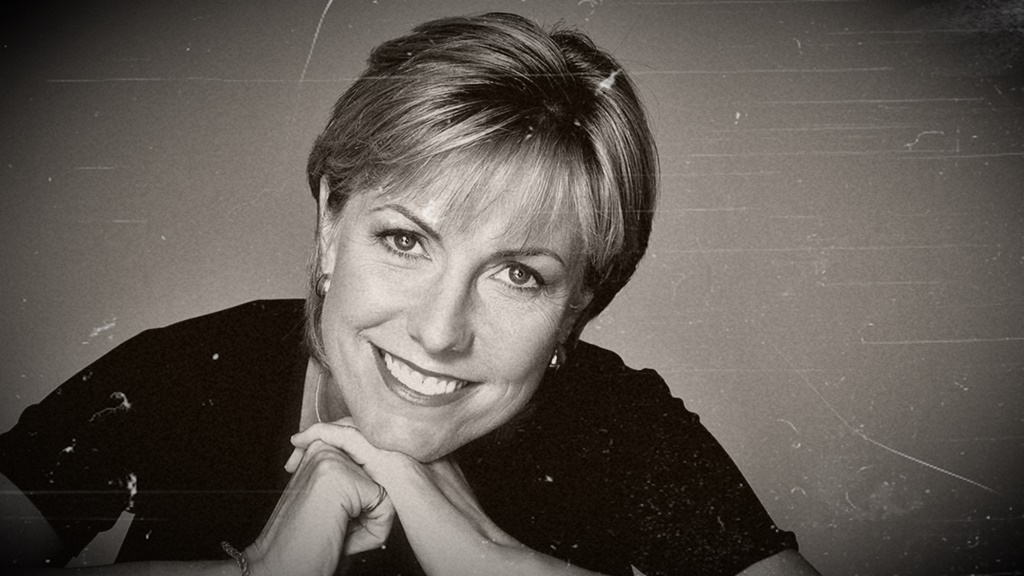
In the spring of 1999, in London, England, a crime occurred that took the nation by storm: the seemingly random assassination of a beloved British celebrity in broad daylight. Media coverage of the murder in the weeks and months afterward rivalled the frenzy following the death of Princess Diana in August of 1997.
Thirty-seven-year-old Jill Dando was a familiar face to millions of people in the UK. Born in Weston-super-Mare, she began working as a journalist for her local newspaper before making her way up to the BBC, first as a regional radio newsreader, then onto a national platform as a TV presenter on such programs as Breakfast Time, Breakfast News, several other daily newscasts, and the travel show Holiday. The BBC had even named her their Personality of the Year in 1997. By the time 1999 rolled around, however, she was probably most famous for co-hosting the popular Crimewatch series, which she had been presenting with Nick Ross since 1995.
On the morning of Monday, April 26th, 1999, Jill left the home of her fiancé, gynecologist Alan Farthing, in Chiswick. The couple had announced their engagement the previous January, and their wedding was set to take place on September 25th of 1999.
Jill drove back to the house she owned in Fulham, in southwest London. She wasn’t really living there anymore; the property had been put up for sale that month, and Jill was in the process of moving out.
At a little past eleven-thirty a.m., Jill approached the front door of her former home, and then, quite suddenly, a man grabbed her from behind, forced her down to the ground, and shot her in the left temple at point blank range before vanishing back into the surrounding landscape. The body of Jill Dando was found by a neighbor fifteen minutes later.
When police arrived on the scene, they found very little physical evidence to identify the killer or the motive for the slaying. Jill Dando had died from a single bullet wound to the head, fired from a 9mm semi-automatic pistol, which had actually been either a modified starter pistol or a decommissioned firearm that someone had restored to usability.
A canvass of the neighborhood produced only one sighting of the assailant, described as a six-foot-tall white man who was about forty years of age. No one had heard a gunshot, though next-door neighbor Richard Hughes—the only person who had caught a glimpse of the killer—said that he had heard Jill exclaim in what sounded like a friendly manner, as though she had been suddenly approached by someone she knew.
Though the area Jill had travelled through that day was awash in CCTV cameras, an examination of the footage seemed to rule out the possibility that the victim had been followed on the day of her death.
The whole of Britain was terribly shaken by the senseless murder of a woman who was so familiar to so many, and Metropolitan Police were under immense pressure to get to the bottom of the case. The investigation into Jill Dando’s death was dubbed Operation Oxborough, but despite countless man-hours devoted to chasing down leads, the inquiry went nowhere for nearly a year.
Then, acting on a tip, police began to look into a man named Barry George, who lived only about five-hundred yards from Jill’s home in Fulham and had something of a checkered past. George was no stranger to the system; when younger, he had been a student at a boarding school for children with emotional problems, and had previously been arrested for impersonating a police officer, indecent assault, and attempted rape. He had even once been picked up hiding in the bushes in front of Kensington Palace—then the residence of Prince Charles and Princess Diana—dressed in military gear and carrying a knife and a weird poem addressed to Charles. Further, George had been diagnosed with several disorders—including epilepsy, ADHD, Asperger syndrome, and antisocial personality disorder, among others—and had a tested IQ of seventy-five.
After placing Barry George under surveillance for a time, police finally arrested him in May of 2000 and charged him with Jill Dando’s murder.
At the ensuing trial, much was made of George’s prior convictions and bizarre behavior, and the prosecution also leaned hard on the fact that a search of George’s flat had uncovered four copies of the memorial issue of Ariel magazine featuring Jill Dando on the cover. A forensic specialist, moreover, testified that there was a single particle which was possibly firearm residue discovered in the pocket of George’s overcoat.
In July of 2001, Barry George was found guilty, despite his protestations of innocence, and sentenced to life in prison.
After several appeals, though, he was granted a retrial in 2008, and at this second trial, he was acquitted and released. At issue this second time around was the fact that the supposed firearm residue was too small of a sample to be of any use as evidence, and the further supposition that George was not intelligent or organized enough to carry out what appeared to be a fairly efficient and professional assassination.
After Barry George’s exoneration, rumors about who might have really killed Jill Dando reached a fever pitch, with some of the scenarios more plausible than others. One of the most enduring hypotheses maintains that Jill was murdered by a Serb hitman in retaliation for hosting a BBC television appeal for refugees fleeing the Kosovo War and the regime of Slobodan Milošević. The BBC program, which aired nearly three weeks before Jill Dando was slain, raised about one-million pounds.
Proponents of this theory also point to the fact that only a few days before the murder, American and British warplanes had bombed the Radio Television Serbia building in Belgrade, an action which killed sixteen staff members. Tony Hall, then the head of news at the BBC, also claimed that he received a phone call after Jill’s death in which a man with an Eastern European accent told him, “Your prime minister Blair butchered innocent young people. We butcher back.” Serbian warlord Željko Ražnatović, better known as Arkan, was named as a suspect in 2012, a dozen years after his death.
Other avenues of inquiry examined in regards to assassination included the possibility that Jill was silenced by someone at the BBC who apparently did not want her to reveal information she had about a purported pedophile ring at the organization; or the prospect that she was targeted by someone in organized crime after exposing or facilitating the arrest of a suspect featured on the Crimewatch program. A few commentators have even speculated that she might have been murdered by a faction of the IRA.
Authorities have also not ruled out more mundane explanations, such as a case of mistaken identity, a botched robbery, the actions of a stalker or obsessed fan, or murderous jealousy on the part of a professional rival. Police also looked into Jill’s private life to determine whether an ex-boyfriend or potential suitor might have killed her, but found no evidence to support this.
No other suspects have come to light in the years since the release of Barry George and the naming of the deceased Arkan, and some investigators have publicly opined in the press that the case may never be solved. Jill Dando’s legacy lives on, however; a memorial garden dedicated to her stands in her hometown of Weston-super-Mare, a broadcast journalism scholarship in her name is offered to one student every year at University College Falmouth, and in 2001, the Jill Dando Institute of Crime Science was founded at University College London.
 Crime Immemorial