
In autumn of 2000, within the shady world of Middle Eastern black market antiquities dealers, the details of an utterly bizarre case would begin to come to light. While authorities initially believed they were faced with a violation of the Antiquities Act at best and an outright forgery at worst, it would soon become apparent that they might very well be looking at a possible homicide investigation.
It began in October, when Pakistani police were investigating a Karachi man named Ali Akbar who had advertised a mummy for sale on the black market for the princely sum of eleven million dollars. After arresting the suspect, authorities were then led to another man named Wali Mohammad Reeki, who had been storing the mummy at his home in Quetta. Reeki claimed he had procured the artifact from an Iranian man named Sharif Shah Bakhi, who had supposedly found the mummy after a nearby earthquake had uncovered it. Bakhi was never located, but Reeki was arrested alongside Akbar for violating Pakistan’s Antiquities Act, and the mummy was seized and taken to Karachi’s National Museum to be examined.
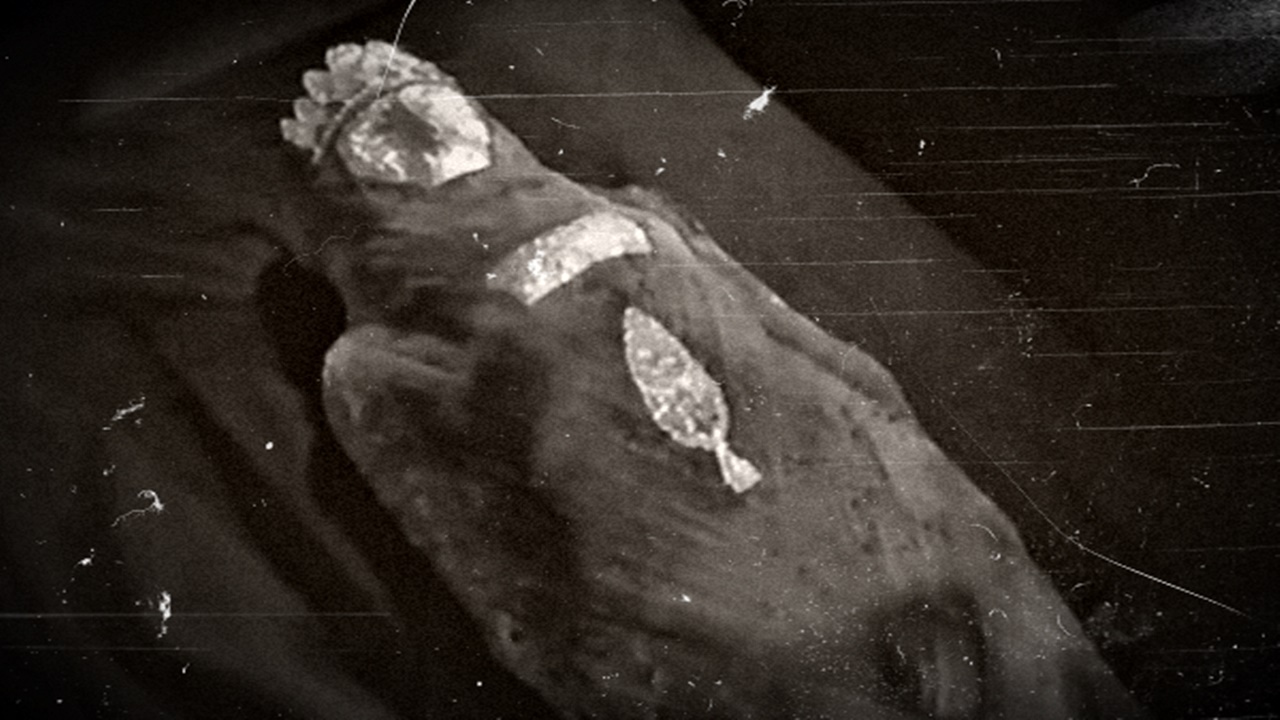
At first glance, the eleven-million-dollar price tag would have seemed excessive, but if the mummy had been genuine, then it would likely have fetched several times that sum. For the artifact, though mummified in an Egyptian style, was thought to be that of a Persian, and Persia had never had any history of mummifying its dead, making the mummy a one-of-a-kind discovery. The gilded wooden coffin was adorned with images and symbology referring to the Zoroastrian deity Ahura Mazda, and further, the mummy bore a fabulous golden crown upon its head, embossed with seven intertwined Cyprus trees.
And as if that wasn’t exciting enough, the mummy was also believed to be of royal blood. Preliminary translations of the cuneiform inscriptions on the sarcophagus appeared to suggest that the body belonged to a woman named Rhodugune, the daughter of famed Persian king Xerxes. The mummified woman would have stood about four-foot-seven, and had likely died in her early twenties. Initial estimates placed the so-called Persian Princess’s death at around 600 BCE.
Soon after the find was made public, a bitter dispute ensued over which country could lay claim to the spectacular mummy, with officials from Iran, Pakistan, and Afghanistan all throwing their hats into the ring and insisting the Princess belonged to them. The National Museum in Karachi, Pakistan held onto the artifact for the time being, but even from the outset, there were doubts about how genuine this supposedly ancient Persian mummy could be. Researchers at the museum pointed out that neither Iran nor Iraq had ever practiced mummification, though admitted that the Persian cuneiform inscriptions might have been a later addition by smugglers. It was also hypothesized that perhaps the Persian Princess had died in Egypt and was mummified there as befitted her rank, but given some special touches to more accord with her Persian heritage.
However, more cracks in the provenance of the artifact soon began to appear. Only two weeks after the announcement of the find, Oscar White Muscarella at the Metropolitan Museum of Art in New York City told authorities that he had received photographs of a very similar mummy from a dealer back in March of 2000, and had concluded from the pictures that the mummy was, in all likelihood, a fake. It turned out that the photos he had received were of the very same mummy, who black market middlemen were attempting to pawn off on the Met for a large fee.
Muscarella had contacted a cuneiform expert for help in translating the inscriptions on the sarcophagus, and while there was indeed a line in the inscription claiming that the interred was the daughter of Xerxes, a large segment of the text had actually been copied verbatim from the inscription on the tomb of King Darius. Not only was this inscription fairly well-known in archaeological circles, but it had also been written much later than the supposed time of death of the Persian Princess. Additionally, whoever had inscribed the breastplate had made several grammatical errors, and had used the later Greek form of the name Rhodugune, rather than the Persian form, which would have been Wardegauna. The mask that covered the mummy’s face, furthermore, was suspected to be only about a hundred years old, though the gold crown was believed to be genuine.
Forensic science would provide even more evidence of archaeological chicanery. Analysis of the wooden sarcophagus, for example, suggested that the coffin was only about two-hundred-fifty years old, substantially younger than the purportedly two-thousand-six-hundred-year-old mummy. And examination of the reed mat on which the mummy’s body rested found that the fibers were likely less than fifty years old, and perhaps even as recent as the mid-1990s.
And when researchers began delving deeper into the mummy itself, the entire edifice of the Persian Princess case came crashing down. Though the body had been mummified in a nominally Egyptian manner, it was noted that the removal of the brain had been sloppily undertaken, with none of the skill and precision seen in other genuine Egyptian mummies. Even more damningly, whoever had made the mummy had removed the heart from the body, something no ancient Egyptian would have ever done, as they believed that the heart was the seat of thought and would be needed in the afterlife.
The body cavity was also found to be filled with modern formulations of drying mediums, such as baking soda and common table salt, and the woman’s hair had been bleached blonde.
As examination of the body continued, and it became clearer that the woman in the coffin must have died fairly recently, investigators began to come to a chilling conclusion: that the Persian Princess very well might have been a modern murder victim.
Bolstering this theory was the fact that the women’s spine had been broken with some heavy blunt instrument, and cause of death was believed to be a broken neck. Her jaw had also been fractured, and forensic scientists determined that she had likely been mummified less than twenty-four hours after her death. Carbon dating confirmed that the so-called “mummy” had died around 1996, when the woman was probably about sixteen years old.
Because the death appeared to have been violent, authorities in Pakistan opened up a homicide investigation to try and determine the woman’s identity and that of her possible killers. While it remains possible that the gang of forgers who mummified her had simply obtained the body through grave robbing or other black market sources, and while it is also conceivable that the woman died in an accident (for example, being run over by a car, dying in a fall, or being crushed in an earthquake), police are treating the Persian Princess case as a murder, and are actively following up on any leads.
The unknown woman in the sarcophagus was laid to rest in 2008, but since then, there has been no further news of the investigation.
 Crime Immemorial