
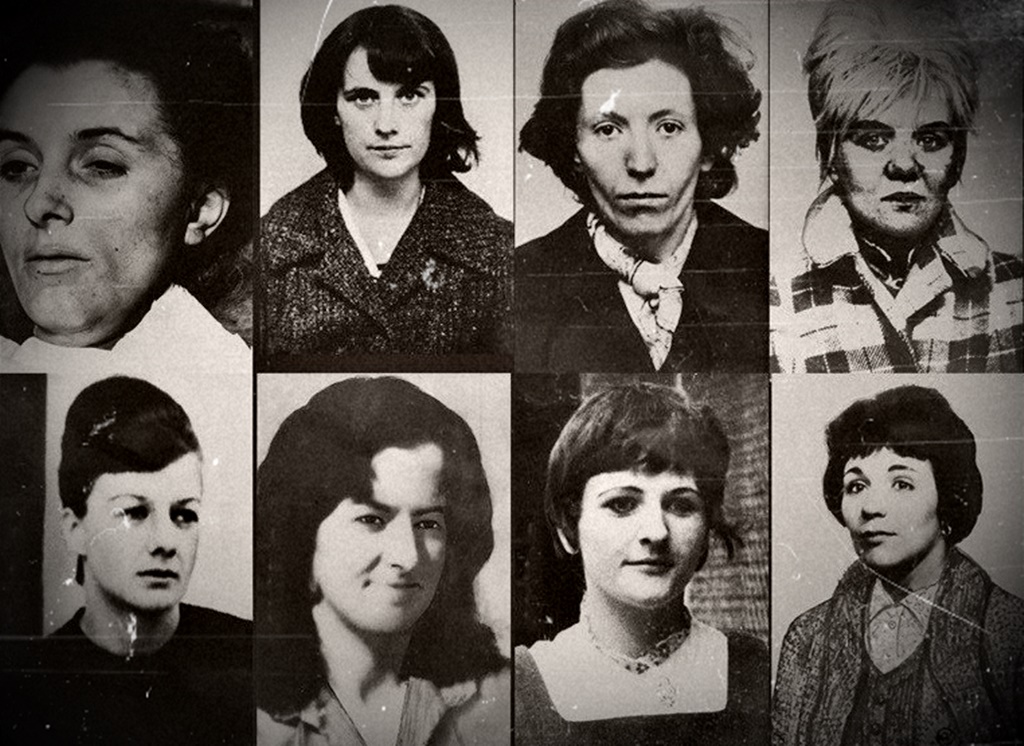
Bottom L to R: Helen Barthelemy, Mary Fleming, Margaret McGowan, Bridget O’Hara
Elizabeth Figg, a twenty-one-year-old prostitute from Cheshire who also went by the name of Ann Phillips, was found dead on a towpath on the banks of the River Thames in London by patrol officers early on the morning of June 17th, 1959.
Elizabeth had been strangled to death. Her clothes were torn open to reveal her naked breasts, and her shoes and underwear were missing, as were any identifying documents or personal belongings she had carried. Investigators surmised that she had been picked up by a client and had removed her shoes and underwear in his car, after which the perpetrator had killed her and dumped her body before driving off with her possessions.
A post-mortem determined that Elizabeth had been murdered between the hours of midnight and two a.m., and this finding was corroborated by a couple who owned a nearby pub and claimed they had seen car headlights and heard what sounded like a woman screaming at a little past midnight on June 17th.
The man who killed Elizabeth Figg was never caught, but more than four years later, a series of brutal prostitute murders in London caused investigators to theorize that her slaying had simply been an early “practice run” in the bloody career of the serial killer who would come to be known only as Jack the Stripper.
On the afternoon of November 8th, 1963, workers at a dump in the Mortlake district of London on the south side of the Thames uncovered the woefully degraded remains of a woman, buried beneath two feet of rubbish. She was found completely naked, except for a single nylon stocking that had been rolled down to her ankle. The digger truck that had unearthed the corpse had severed her head from her body, and possibly dislodged several of her teeth.
The state of decomposition of the remains, and the fact that the truck had damaged the body, meant that the cause of death was uncertain, though forensic evidence led investigators to believe that the woman had been strangled. She was not identified until November 26th, when her fingerprints were matched to a set already on file with the authorities: the victim was twenty-two-year-old prostitute Gwynneth Rees, a Welsh woman who also worked under several different names, including Tina Smart, Georgette Rees, and Tina Dawson.
During the ensuing inquiry, it was discovered that Gwynneth had been working the streets of London since she was a sixteen-year-old runaway, and she had been arrested for solicitation on numerous occasions. She had last been seen alive on September 29th, wearing a gray and brown leopard-print coat and getting into what was thought to be a Ford Zephyr or Zodiac at the corner of Commercial Road and New Road.
Ultimately, eight suspects would be investigated for the murder; the first of these was Cornelius Whitehead, an individual who had procured clients for Gwynneth in the past and sometimes drove a Ford Zephyr. Blood of the same type as Gwynneth’s had been found on Whitehead’s clothing and in the back seat of his car, but as he admitted to assaulting Gwynneth on at least four prior occasions, it was possible that the blood could have come from one of these beatings. Likewise, Whitehead’s associate Michael Holland, who also confessed to participating in the assaults, was detained, but also denied killing Gwynneth.
Another possible suspect was a man named George Dixon, who had some association with the infamous gangsters Reggie and Ronnie Kray. According to a witness, Gwynneth had been deathly afraid of the Kray brothers, and though they were also questioned about her murder, they refused to talk, and it seemed that there was likewise insufficient evidence to implicate their associate, George Dixon.
In fact, despite the thorough vetting of each and every suspect and the questioning of over a thousand witnesses, police were unable to obtain enough concrete evidence to definitively charge someone with the crime. At the coroner’s inquest, Gwynneth’s roommate Brenda Meah testified that the car that Gwynneth had been seen getting into on September 29th was definitely not the car belonging to Cornelius Whitehead. She also stated that Gwynneth had been pregnant at the time of her murder, opening up the possibility that she had died while trying to obtain an illegal abortion.
However, in light of Elizabeth Figg’s murder four years previously, and considering the similar run of slayings that would begin in early 1964, it’s likely that Gwynneth was the second victim of the slippery serial killer who would eventually be dubbed Jack the Stripper.
It was a little past one in the afternoon on Sunday, February 2nd, 1964. Brothers George and Douglas Capon, members of the Corinthian Sailing Club, were preparing for a boat race on the Thames later that afternoon when they spotted the body of a woman lying near the shoreline. Just as in the case of Gwynneth Rees from two months before, this victim was found completely naked, save for nylons rolled down to her ankles.
The muddy corpse was dredged from the river and taken to Hammersmith mortuary, where pathologist Donald Teare conducted a post-mortem. The woman had brown hair and eyes, several missing teeth, and bruising around her jaw that could have either been caused by falling or from being assaulted at some earlier date. She had eaten a full meal very shortly before her death, and it appeared that she had died anywhere from two to seven days before her remains were discovered. No trace of alcohol or drugs was found in her system.
Though the amount of fluid in her lungs was consistent with drowning, she was also found to have a pair of her own semen-stained underwear crammed down her throat, leading investigators to assume that she had been murdered.
Through a match of fingerprints, the dead woman was found to be thirty-one-year-old Hannah Tailford, a prostitute and petty criminal originally from Northumberland who was known to use several aliases, including Anne Taylor, Theresa Bell, and Mary Lynch.
Hannah’s common-law husband William Ewing—who was known by the name Allan Lynch and with whom Hannah had been living for approximately eight years—claimed that the last time he saw her was on January 24th at around nine p.m., when she left their flat in West Norwood, presumably to go to work. Allan Lynch told police that he had not been aware that Hannah worked as a prostitute, stating that he had always believed her to have a job at an all-night café.
As many as eighteen witnesses claimed that they had seen Hannah Tailford in the area at varying times between January 24th, when Allan Lynch stated he had last seen her, and February 1st, the day before her body was found. Neighbors who lived in the flat below that of Allan Lynch and Hannah Tailford asserted that they had heard footsteps on the stairs and the sound of a woman screaming on the early morning of February 1st, though Allan Lynch insisted there had been no women in the flat on that date.
Casting some doubt on Lynch’s version of events was an acquaintance of the couple, Thomas Trice, who told investigators that Lynch had given him a pair of shoes and some articles of clothing belonging to Hannah and told him to get rid of them. When police obtained the shoes from Trice’s home, they found them to be spattered with mud, but there was not enough of it present to make a viable comparison to the mud along the Thames where the body had been discovered.
Despite the suspicions surrounding Lynch, he seemed very distraught by Hannah’s death, and was quite happy to aid Scotland Yard in their investigation, willingly submitting himself to all of their questions.
Over the course of the inquiry, police interrogated nearly seven-hundred witnesses and made several searches of the area around Duke’s Meadows, where it was thought Hannah’s body had been dumped into the river. Though a few leads did turn up, such as a mysterious man named Del who Hannah had apparently been in love with, all of them eventually hit a dead end.
On February 19th, a blue coat that was later identified as Hannah’s was found caught in the propeller of a boat on the Thames. It was the same coat that a witness had seen Hannah wearing on January 29th.
At the inquest, there was some argument over whether Hannah had perhaps committed suicide, and although the underwear stuffed down her throat would have seemed to preclude this hypothesis, the coroner’s jury ultimately left the verdict open.
But in light of the murders that would take place later that year, it seems almost undeniable that Hannah Tailford was likely the second (or possibly third) victim of the serial killer that was stalking the shores of the Thames. And by that spring, it was becoming increasingly clear that this killer was specifically targeting prostitutes for extermination, as the month of April would see two more women turning up dead.
On the morning of April 8th, a police officer came across the body of twenty-six-year-old Irene Lockwood on the banks of the Thames, situated in an area right in between the sites where Elizabeth Figg had been discovered back in 1959, and where Hannah Tailford washed ashore only two months previously.
Like Hannah Tailford, Irene Lockwood was found naked and with no obvious fatal wounds. A fairly deep cut on her shoulder had occurred some time after her death, presumably caused by a boat propeller. Though there were traces of semen in both her mouth and vagina, it did not appear that she had been sexually assaulted. Additionally, the body was found to be covered with some sort of dirt or grime which the river water had failed to wash away.
Also like Hannah Tailford, the cause of death was determined to be drowning, though it was believed that Irene had been unconscious when she was placed in the river. Pathologist Donald Teare also found that Irene had been approximately four months pregnant.
Interviews with witnesses established that Irene had last been seen alive at a pub in Chiswick at around eight p.m. on the evening of April 7th.
Irene Lockwood had lived a very similar lifestyle to the other victims. She originally hailed from Nottingham, and had been working as a prostitute and petty thief since the age of nineteen. She had given birth to a son in 1958, but had relinquished him to the care of the state.
A fascinating and rather eerie fact about Irene’s past was that approximately a year before her own murder, she had been associated with another prostitute by the name of Vicky Pender. Vicky was found murdered in Islington in March of 1963; the main suspect in her death was a man named Colin Fisher, who possessed several hundred pornographic images of both Vicky Pender and Irene Lockwood, who he knew as Sandra.
Colin Fisher claimed that he had been staying with Irene at the time of Vicky’s slaying and therefore could not have been the culprit, but Irene denied this, thereby taking the air out of Colin’s alibi. Colin Fisher was subsequently convicted of the murder of Vicky Pender and spent the rest of his life in prison.
The inquiry into Irene Lockwood’s death would turn up a person of interest almost immediately. During a search of Irene’s flat, police discovered a handbag that contained a business card bearing a phone number, and the name ‘Kenny’ scrawled on the back in pen. This led investigators to the West Kensington residence of fifty-seven-year-old Kenneth Archibald, a handyman employed by the Holland Park Lawn Tennis Club.
Archibald denied knowing Irene at first, though another employee of the club, Joe Cannon, stated that Irene had been present at several after-hours parties he had organized, and further claimed that Kenneth Archibald was definitely acquainted with Irene Lockwood.
There would be a somewhat bizarre development concerning Kenneth Archibald later that month, but before that happened, yet another victim would be added to the ever-growing tally of the presumed serial killer at large.
The nude body of twenty-two-year-old prostitute Helen Barthelemy was discovered on April 24th. She was not found in or around the Thames, but rather in a Brentford alleyway not far from the river. A dark-haired Scottish woman, Helen had been strangled to death, her murder bearing a strong resemblance to those of Elizabeth Figg and Gwynneth Rees.
The remains of Helen Barthelemy, however, yielded some new evidence that opened up a promising line of inquiry: flecks of automotive paint were recovered from the body, and investigators believed that this paint might have originated from the workplace of the likely killer.
Before police could look too much further into this theory, however, a wrinkle appeared in the form of Kenneth Archibald. On April 27th, three days after Helen Barthelemy was found dead, Archibald had not only been scheduled to appear in court on the charge that he had stolen a hearing aid, but he also reported a break-in at his place of employment. Most significantly, though, after hours spent drinking at a pub in Notting Hill, he marched into a nearby police station and confessed that he had killed Irene Lockwood by pushing her into the Thames.
Archibald was summarily arrested, and stood trial in June of 1964. On the stand, however, he recanted this confession and entered a plea of not guilty. As no other evidence was introduced that connected him to Irene’s murder, or indeed to any of the other victims, he was acquitted on June 23rd.
Only three weeks after he walked free, the naked body of thirty-year-old prostitute Mary Fleming was found in a sitting position outside of a garage in Chiswick. Mary had last been seen alive on July 11th, though her remains were not discovered until three days later.
Like Helen Barthelemy, Mary Fleming was originally from Scotland, and also like Helen, had been strangled and was found to have flakes of automotive paint stuck to her skin. Upon questioning residents of the area, investigators determined that the body had likely been dumped out of a car, as several witnesses stated that they heard an automobile reversing down the street not long before the body was found.
Authorities were now certain that they had a serial killer on their hands, and their suspicions would be tragically confirmed a few months down the line.
On October 23rd, 1964, prostitutes Kim Taylor and Frances Brown—who also went by the name Margaret McGowan—were working the streets as usual. A car, later thought to be a Ford Zephyr or Zodiac, the same type of car identified with the murder of Gwynneth Rees the previous year, pulled up beside the women, and Frances Brown got in.
No one knows exactly what happened to Frances during the ensuing month; the one thing that was certain was that she was found dead on November 25th in a parking lot in Kensington. Like previous victims of Jack the Stripper, she had been strangled. But unlike previous victims, witness Kim Taylor had gotten a fairly good look at the man who had picked her up, and was able to give the police a detailed description, though it would ultimately prove useless in establishing the identity of the killer.
One interesting detail about Frances Brown was that a year earlier, she had given testimony at the trial surrounding the so-called Profumo affair, a political scandal that had seen Secretary of State for War John Profumo resigning his post in disgrace after confessing to numerous improprieties, including a brief affair with a nineteen-year-old model. Because of Frances Brown’s connection with the high-profile case, and the fact that she was also allegedly involved in the underground pornography trade, some researchers have theorized that Jack the Stripper may have traveled in similar circles and could have personally known the women he was targeting. Another point in favor of this theory is that previous victim Hannah Tailford had also evidently made pornographic films, and was likewise tangentially involved in the Profumo affair.
Whoever the serial killer was and whatever his motives might have been, he wasn’t quite finished with his murderous rampage, but his final victim would not meet her end until early the following year.
On February 16th, 1965, twenty-eight-year-old Bridget “Bridie” O’Hara was found dead in a storage shed behind the Heron Trading Estate in Acton. She had been strangled, and was found to have paint flecks on her skin, just like the bodies of previous Jack the Stripper victims Helen Barthelemy and Mary Fleming.
Shortly after her remains were discovered, in fact, the samples of industrial paint were traced to the Heron Trading Estate itself, which led police to believe that the previous victims had been stored in the area before being dumped in the Thames. This, in turn, subsequently pointed to one of investigators’ stronger suspects.
Mungo “Big John” Ireland was a Scottish man who had worked as a security guard at the Heron Trading Estate. Just as the authorities were attempting to build a case against him for the Jack the Stripper slayings, however, he committed suicide by asphyxiating himself with carbon monoxide. He left a note for his wife, which read in part: “I can’t stick it any longer. To save you and the police looking for me I’ll be in the garage.” Mungo Ireland died on March 3rd, 1965, and it is unknown if he was in fact responsible for the serial murders.
Another suspect who would turn up dead only months after Bridget O’Hara’s murder was boxing champion Freddie Mills. Apparently, word had gotten around among well-known British gangsters, including Reggie and Ronnie Kray, that Mills was Jack the Stripper. In fact, some sources claim that the serial killer’s identity was common knowledge among Britain’s criminal underground, and that Freddie Mills had a reputation of being a sexual sadist. In July of 1965, however, Mills also died, apparently from a self-inflicted gunshot wound.
Surprisingly, two police officers were separately suspected of being Jack the Stripper, albeit by different researchers. According to David Seabrook’s book about the murders, Jack of Jumps, many senior investigators at the time believed the killer to be Metropolitan Police Detective Andrew John Cushway, though critics of this theory point out that there is little to no evidence connecting him with the murders, other than the fact that he was convicted of a series of break-ins in 1962.
Another officer put forward as a possibility by later writers was Detective Chief Superintendent Tommy Butler, who had become head of the Flying Squad shortly after the infamous Great Train Robbery of 1963. Suspicions about Butler were put forward in a book called The Survivor: Blue Murder, Bent Cops, Vengeance, Vendetta in 1960s Gangland, written by former gangster Jimmy Evans, and Martin Short. In this same book, Jimmy Evans seems to imply that he was also suspected of the Jack the Stripper murders at one point.
Yet another person of interest was Welsh double murderer Harold Jones. In 1921, at the age of fifteen, Jones was convicted of killing two girls in Abertillery, and though he received a life sentence, he was released on good behavior after serving only twenty years. He was known to have moved to London with his wife and daughter in 1947, and though he was not investigated for the run of prostitute murders at the time, later investigators point to the similarities between Jones’ 1921 murders and those of Jack the Stripper, in which the victims were violently killed but not sexually assaulted.
As far as is known, the killing of Bridget O’Hara marked the end of the serial killer’s deadly career, and the trail eventually went cold. Nearly six decades on, the identity of Jack the Stripper, the perpetrator of the so-called Hammersmith Nude Murders, is still a complete mystery.
 Crime Immemorial