

Toward the end of 1970, a remote valley in Norway would serve as the center point of a sinister crime in which both victim and killer are still unidentified, and tantalizing details suggest a possible connection to international espionage.
On November 29th, a man and his two daughters were hiking near Mount Ulriken in Bergen, Norway, in an area known as the Isdalen Valley. Locals, in fact, also knew the location by the far less cheerful appellation of Death Valley, due to its reported history of suicides and the tendency for hikers to disappear without a trace among the fog-shrouded cliffs.
On this particular day, the valley would live up to its name. In a small area partially hidden by rocks, the passersby spotted the horribly charred remains of what appeared to be a woman.
Investigators soon arrived to examine the macabre and peculiar tableau. The woman’s face was so badly burned that she was unrecognizable, and most of her clothes had likewise been burned off, though a pair of nylon stockings and a pair of rubber boots were still mostly intact. Strangely, the woman’s watch and other jewelry had been removed and placed next to the body in a manner that authorities deemed almost ritualistic.
Other items found around the body raised questions as well. There were several melted plastic bottles at the scene which smelled strongly of gasoline, and another empty bottle which had presumably contained liqueur, though most of the labels appeared to have been rubbed off. There was also a broken umbrella, a packed lunch, and a small silver spoon that once bore a monogram that had since been filed away. The clothes that remained on the woman’s body had also had all of their tags removed, and a passport found nearby had been burned almost beyond recognition.
One of the most significant clues found with the remains was a smattering of twelve pink sleeping pills of a brand known as Fenemal. During the autopsy, fifty of these pills were found in the unknown woman’s stomach, though they were only partly digested. Forensic evidence suggested that the woman had died from a combination of Fenemal overdose and carbon monoxide poisoning, a diagnosis that initially led authorities to deduce that she had committed suicide.
Another disturbing detail uncovered during the examination was the fact that the woman’s fingerprints had been mostly sanded off.
As police had little inkling of the mysterious victim’s identity, they dubbed her “Isdal Woman” and released a description and sketch of her to the public in the hopes of gaining some worthwhile leads. The woman was thought to be about five-foot-four, with brown eyes, and brownish-black hair tied back into a ponytail with a blue and white ribbon. Her age was estimated to be anywhere from twenty-five to forty years old. Because of the unusual amount and type of fillings and crowns in her teeth, authorities hypothesized that she may have had dental work done in South America, southern Europe, or perhaps the Far East.
The autopsy also found an unexplained bruise on the side of the woman’s neck that could have possibly been caused by a blow, or a hard fall. Appallingly, the medical examiner also determined that the woman had still been alive when she was set on fire.
Over the ensuing days, new clues began to emerge that drew the case down ever stranger avenues. Police found two abandoned suitcases presumably belonging to Isdal Woman in a Bergen train station. A pair of sunglasses in one of the suitcases contained fingerprints that matched a partial print that was able to be obtained from Isdal Woman’s sanded-off fingertips.
The suitcases also contained more clothing with all the labels removed, silver spoons with filed-off monograms just like the one found at the crime scene, and money in several different currencies. Additionally, there were several wigs, cosmetics, and a tube of prescription eczema cream which had the prescription label—containing her name and that of her doctor—scraped off.
A postcard from an Italian photographer was also found among the woman’s belongings. This photographer was eventually tracked down, and he said that he had met the woman in question when he’d given her a ride to a hotel in Loen, and that the two had dinner together. The photographer told police that she had said she was from South Africa and was spending six months sightseeing around Norway, but gave no further information.
The son of the owner of a shoe store in Stavanger remembered Isdal Woman had purchased the rubber boots found with her body at his father’s store, and may have also bought the umbrella there. He said the woman had spoken English with a faint accent, and that she had smelled vaguely of garlic.
Investigators also recovered a diary from one of the suitcases which appeared to be written in code. When this code was later cracked, it was revealed to be an itinerary of all the places where Isdal Woman had traveled. This itinerary would eventually match up with witness accounts of the woman’s movements in the weeks before her death.
As the inquiry continued, numerous people came forward and reported sightings of the strange woman. She had been seen in several hotels in Bergen, and apparently stood out because of her attractiveness, her elegant and somewhat provocative fashion sense, and her habit of always wearing wigs. Eyewitnesses claimed they had heard her speaking English, French, German, and Dutch at varying times, and many said that she had told them she was a dealer in antiquities. At most of the hotels where she stayed, she frequently ordered porridge with milk.
Investigators further found that Isdal Woman had checked into these hotels under at least eight different aliases, including Claudia Tielt, Vera Jarle, Fenella Lorch, and Genevieve Lancier. From the plethora of pseudonyms and the later discovery of several fake passports, as well as the obvious attempts to erase her identity in death, it was generally believed that the murdered woman had probably been a spy.
Through witness statements, authorities were able to determine that Isdal Woman was last seen alive on November 23rd, 1970, when she checked out of the Hordaheimen Hotel, where she had been staying since the 19th. Hotel employees stated that she had called for a taxi after checkout, but her whereabouts between the 23rd and the 29th, when her body was found, remained unclear.
Though the death of the Isdal Woman captured the imagination of the worldwide media due to its intriguing possible links to espionage, police made no headway in identifying the victim, and in early 1971, she was buried in a zinc coffin in the hopes that her remains would be preserved for later examination when forensic technology had improved.
Much later, in 2005, it came to light that a man who had been hiking in the hills near Floyen on November 24th, 1970 claimed he had seen Isdal Woman in the company of two men who might have been southern European. This witness further claimed that the woman had looked as though she was going to say something to him before the two men prevented her from speaking. He also stated that he had reported the odd incident to police at the time, but the lead had not been followed up on.
In 2017, Isdal Woman’s teeth were subjected to isotopic analysis in an effort to discover her likely origins. The results of the tests suggested that the woman had probably been born in central or eastern Europe, and had moved to an area right near the French-German border at some point during her childhood. This fitted in nicely with an earlier handwriting analysis performed on her diary, which had indicated that she had probably been educated in France.
In 2018, forensic scientists were able to narrow down her probable year of birth to somewhere around 1930, plus or minus four years, and it was also discovered that she had likely flown to Norway on a French passport.
A French newspaper published an updated article about the case in 2019, after which a man in Forbach, France came forward and claimed that he and Isdal Woman had a brief romantic relationship in the summer of 1970, a few months before her death. This individual stated that Isdal Woman had a Balkan accent, pretended to be younger than she actually was, and refused to divulge any personal details, though he did show police a photograph of her riding a horse that he allegedly stole out of her luggage. The man further asserted that Isdal Woman often received scheduled phone calls, and that he suspected that she was a spy, but was too frightened to report his suspicions to authorities. At this stage, it’s unclear how much of this man’s story is true.
The case remains open, and now that Isdal Woman’s probable origins have been narrowed down, it’s hoped that DNA comparisons can eventually be used to track down her relatives and finally solve the puzzle of her identity. If and when the mystery is ever unraveled, it will spell the end of a conundrum that has fascinated the public for more than fifty years.
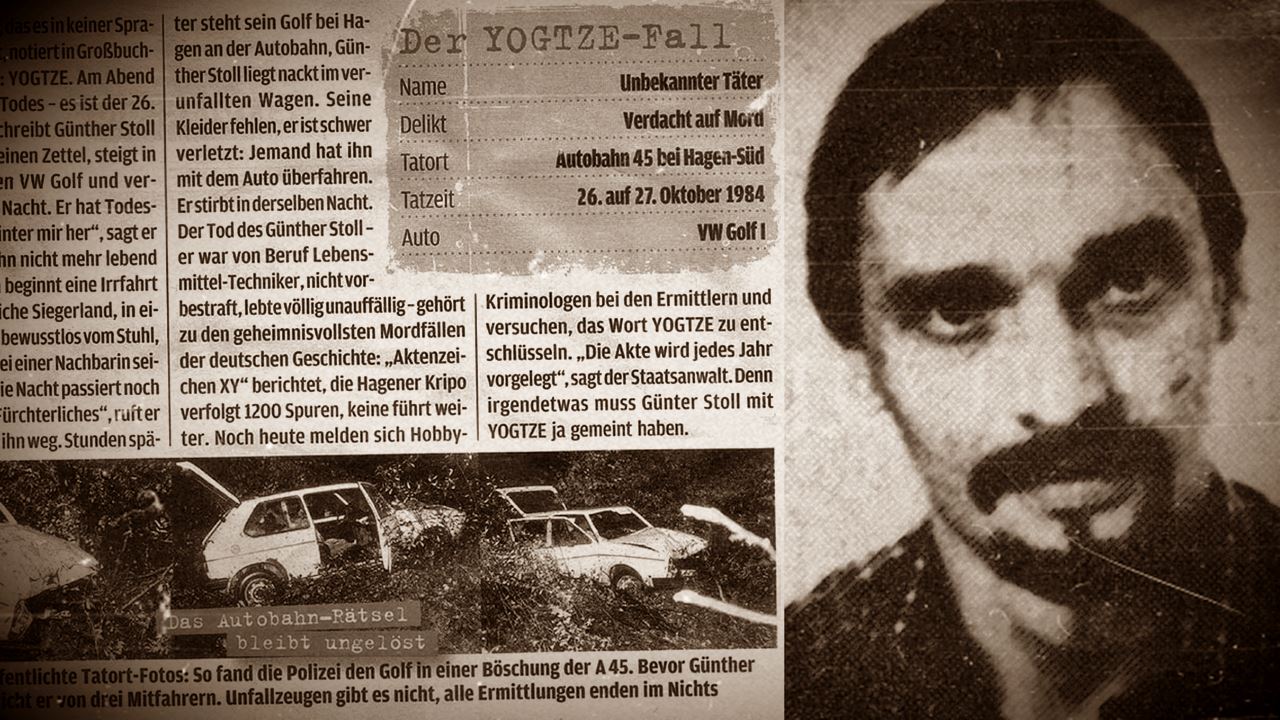
In the autumn of 1984, a supposed murder would occur whose bizarre and eerie details ensured the case’s enduring legacy in the annals of paranormal and conspiracy theory websites, even though there have also been rumors that the crime itself is nothing but an elaborate internet hoax.
The story goes that Günther Stoll, a former food engineer from Anzhausen, Germany, had been having some problems since he’d lost his job. He had been complaining to his wife about an ominous “them,” people he said were threatening to hurt or kill him for some unspecified reason. His wife, apparently, had chalked the whole thing up to paranoia, at least until the evening of October 25th.
On that night, at around eleven p.m., Günther suddenly leaped out of his chair and announced, “Now I’ve got it!” He then proceeded to write a series of letters on a piece of paper that spelled out “YOG’TZE” (or perhaps “YO6’TZE”), before almost instantly scratching out what he wrote.
Günther left the house a short time later, and drove to a nearby pub. He sat on a stool and ordered a beer, but before he even took a sip, he reportedly fell off the stool and bashed his face on the floor, an injury which rendered him unconscious for a brief time.
After he awoke, he left the bar and got back into his VW Golf. He was next seen two hours later in the town of Haigerseelbach, where he had spent his childhood. At one a.m., he allegedly turned up on the doorstep of a woman he had known many years before. She would not open the door to him, due to the late hour and his odd mental state, but she told him to go to his parents’ house. Günther then apparently told her that something horrible was going to happen that night.
Another two hours passed. Then, at around three in the morning, a pair of truck drivers independently spotted a wrecked Volkswagen Golf in a ditch off the side of the Autobahn. One of the truckers ran to the nearest emergency phone, while the other approached the car to see if he could help.
Günther Stoll was still alive, but clearly injured, and most bizarrely, he was completely naked. He told the good Samaritan that there had been four other men in the car with him, but that they were not his friends, though he would not specify who they were. When authorities arrived, Günther was placed in an ambulance, but died on the way to the hospital.
In an even stranger development, it was later determined that Günther had not been wounded in the car accident, but instead had been run over by a different vehicle while naked, and then placed back in his own car, after which the car was driven to the spot where it was discovered.
The truck drivers who had been the first on the scene told police that they had seen a man in a bright white jacket near the car, but that he had vanished into the surrounding landscape shortly before they approached. One of the truckers also claimed to have seen a man hitchhiking on a nearby off-ramp. Neither of these mysterious men was ever identified.
The meaning of the YOG’TZE clue has also stumped investigators for decades, and it is still unknown if the note had anything to do with Günther’s death. Some have speculated that the letters could have been a vehicle license plate, a call sign for a Romanian radio station, a formula for a food additive, or any number of other hypotheses, including the suggestion that the message should actually be read upside down. Everything from industrial espionage to the Dutch drug trade has been bandied about as possible motives for Günther’s murder, though it has also been proposed that perhaps the man suffered from a psychotic break, took off his own clothes, and wandered onto the Autobahn where he was hit by a car. The driver of the vehicle who struck him may then have placed Günther back in his own car and taken off to keep from getting into trouble.
Then again, some have discounted the veracity of the entire case, as the only source of it seems to be a report from a popular German crime show that aired in the spring of 1985.

In late June of 1999, a death would take place in the American Midwest whose details were not excessively remarked upon at the time, though the announcement of a mysterious and still unbroken code discovered on the victim’s person would later launch the case into widespread internet infamy.
Forty-one-year-old Ricky McCormick had been a rather aimless soul throughout his life. A high school dropout who was barely literate and suffered from chronic lung and heart issues, Ricky had spent most of his adulthood living with relatives and bouncing from low-level job to low-level job, even spending some time in prison for statutory rape at one point. In 1999, he was staying with his elderly mother, and possibly unemployed, though some sources have him working part-time at an Amoco gas station in St. Louis, Missouri.
On June 30th, a woman driving along a road off Route 367 in West Alton spotted a dead body lying in a cornfield and reported it to police. The decomposed remains were found to belong to Ricky McCormick, who was believed to have died three days before, although the state of decomposition suggested that he had been dead much longer. Because the body was so degraded, in fact, authorities were unable to determine cause of death, and initially were reluctant to attribute Ricky’s demise to homicide.
A few more strange details about the case surfaced in the days following the discovery. First of all, it was unknown how Ricky had ended up in a field at least fifteen miles away from his last known address; he did not own a car, and no public transportation served the area where his body was found. This bolstered the theory that the victim had been murdered, as it was hypothesized that his assailant might have dumped him there after killing him somewhere else.
Secondly, according to his family—who had never reported him missing—Ricky had been acting a little odd in the days before his death, as though he was afraid someone might be after him. On June 25th, 1999, he had gone to the emergency room at Forest Park Hospital in St. Louis and complained of chest pains and shortness of breath. He spent two days at the hospital under observation, and after his release went to stay with his aunt Gloria.
The following day, he went to another emergency room at a different hospital with the same complaint, and though they released him in under an hour, he reportedly hung around the hospital anyway, sleeping overnight in the waiting room. According to Gloria, Ricky was acting as though he was trying to stay somewhere safe.
Upon looking further into Ricky’s activities in the days before his death, authorities stumbled upon what might have been a motive for the murder. The gas station where Ricky reportedly worked was owned by an alleged drug dealer named Juma Hamdallah, and it was speculated that Ricky might have been acting as a mule for his boss’s operation. According to a statement by Ricky’s girlfriend Sandra, Ricky often took a Greyhound bus to Orlando, Florida to pick up drugs, and that on the trip he took shortly before his death, he may have made some unforgivable mistake that put a target on his back.
Another purported drug dealer named Gregory Knox, who lived in the same housing complex as Ricky, was also investigated, and though this angle seemed very promising, in the end there was not enough evidence to charge anyone with the crime.
Had that been all there was to the case, then it’s likely the murder of Ricky McCormick would have been sadly forgotten. But then, twelve years after the victim’s body was found, the FBI made a public appeal for help. They admitted that they had found two pieces of paper in the pocket of Ricky’s pants, and these notes appeared to be written in code. FBI cryptanalysts had been working on cracking the cipher for more than a decade, but had had no success, hence their desperate plea to find a member of the public who might be able to solve the mystery.
The code, if that was what it was, consisted of two pages of what seemed to be paragraphs, with some lines set apart with parentheses, and some sections separated by something like word bubbles. Standard codebreaking techniques yielded nothing close to a solution, and investigators were frustrated by the fact that the question of who killed Ricky McCormick might be encoded right in front of their faces.
Theories about the encrypted notes abound. While some adhere to the theory that Ricky McCormick wrote the code himself—perhaps as instructions pertaining to his last alleged drug pickup—it was widely reported that Ricky was illiterate, and according to some family members, only wrote in scribbles or couldn’t write anything other than his own name.
However, a few other family members did mention that Ricky was known to write in ciphers ever since he was a child, and the possibility remains that his learning disabilities had encouraged him to develop a kind of shorthand that only he understood. If this is the case, then it’s likely the code will never be solved.
On the other hand, some have surmised that the killer wrote the note, either as a coded set of directions, or just as a weird, meaningless clue to throw investigators off his trail. It’s also plausible that Ricky was simply carrying the coded message from one criminal to another, and personally had no idea what it might have said. Considering that the best minds in the FBI have been attempting to decipher the code since 1999, however, and since amateur cryptographers around the world have been trying their hand at it since it went public in 2011, it seems unlikely that someone hasn’t cracked it by now, if it was indeed a standard type of code.
The FBI established a separate website for those wishing to attempt to decipher Ricky McCormick’s notes, and as of this writing, more than seven-thousand people have submitted possible solutions, and the code remains one of the most notorious unbroken ciphers at the FBI’s Cryptanalysis and Racketeering Records Unit.
 Crime Immemorial