
At a little before eleven a.m. on the morning of November 6th, 2001, a woman pulled into the parking lot of a hair and nail salon in the rural, forested burg of Florence, Montana. The salon, called The Hair Gallery, had once been the town’s post office, but had been serving the community’s beauty needs for quite a while at this point, and was located along the town’s tiny main strip, US Route 93.
The woman arriving at the salon had an appointment for a manicure at eleven a.m. As she was parking her car, however, she noticed something unusual: a narrow-faced man in his late twenties, emerging from the front entrance of the establishment. Regular customers, including this woman, knew that the back entrance was the one most commonly used.
The fact that this man was coming out of the “wrong” entrance wasn’t the only thing that stood out about him, though. He was also dressed rather strangely: in a dark, calf-length trench coat or duster, and sporting a wide-brimmed black hat, similar to a fedora or a top hat.
The man ambled off on foot, and the woman, not really thinking too much about it, got out of her car and made her way toward the back of the salon. Minutes after stepping through the door, however, she realized she had stumbled into a nightmare.
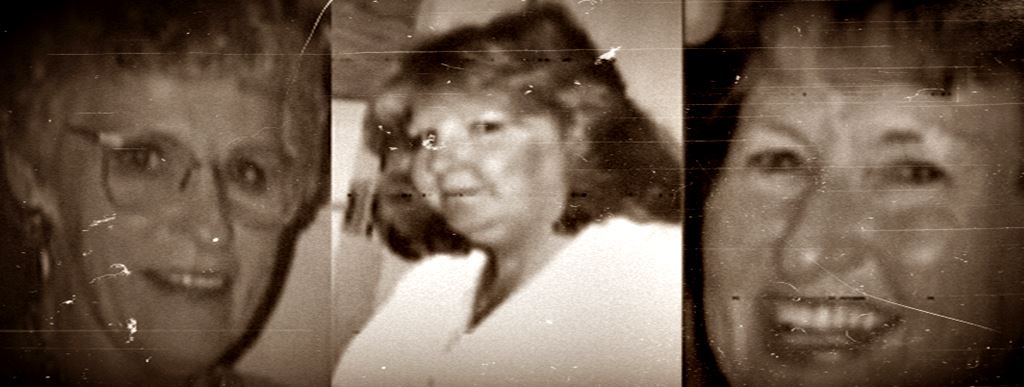
Lying in a pool of blood just inside the back entrance of The Hair Gallery was the salon’s owner, sixty-two-year-old Dorothy Harris. The woman’s throat had been slashed. The horrified customer gingerly stepped over the body in order to reach the shop’s phone, on which she called the police. She then retreated from the premises and waited outside for officers to arrive.
Once inside the establishment, investigators made an even more gruesome discovery: there were two more dead bodies in a utility room at the back of the salon. The throats of these two women had also been slashed, and the walls of the small chamber were painted with blood.
The remaining two victims were identified as forty-four-year-old Brenda Patch, who worked as a manicurist at The Hair Gallery; and seventy-one-year-old Cynthia Paulus, a regular customer who had come in for an appointment. Tragically, it was later discovered that Cynthia usually came in on Fridays, but had come in on this particular Tuesday because she wanted to get her nails done for an event taking place that evening.
Though authorities told the media that all three victims had suffered what they termed “other injuries,” none of the women had been sexually assaulted; and because nothing was stolen from the shop—except for, bizarrely, a couple of cheap plastic hairdressing capes—detectives were completely baffled as to what the motive for this unbelievably violent attack had been.
The only other clues recovered from the scene were an unidentified palm print, and a pair of dark sunglasses which didn’t seem to belong to any of the victims.
As the investigation went on, it was revealed that Dorothy Harris had last been seen making a deposit at her bank, as she usually did on Tuesday mornings, about half an hour before the bodies were found. Since it took Dorothy approximately twenty minutes to drive from the bank back to her business, police speculated that Brenda Patch must have opened the shop and let Cynthia Paulus in for her appointment, after which the killer entered, forced them into the utility room, and slashed their throats. He then murdered Dorothy Harris when she returned from the bank, as soon as she came in through the back entrance.
What’s more, due to the very short window of time at play, the woman who pulled in to the parking lot shortly before eleven o’clock must have arrived only moments after the murders were completed, indicating that the strange man she had seen leaving the premises was undoubtedly the person responsible for the slayings.
Bloodhounds were brought to the scene to try and track the killer’s movements; the dogs were able to follow the man’s scent for approximately four blocks, to a nearby residence, but the man who lived at the home was elderly and physically handicapped, and could not have been the murderer. The trail petered out thereafter.
Understandably, the brutal homicide came as a shock to the less than one-thousand residents of Florence, who were used to knowing their neighbors and not having to lock their doors at night. Police, just as keen to root out the murderer in their midst, brought in the FBI to assist them in compiling a profile of the likely killer, which ended up being far too vague to be of any concrete use.
A few weeks after the murder, though, a promising lead emerged in the form of a small-time drug dealer and meth addict named Brian Walter Weber. Weber was originally from Florence, Montana, but was living nearly four-hundred miles away in Idaho when the triple homicide occurred. However, investigators discovered that Weber had happened to be visiting a girlfriend in Missoula, Montana—less than twenty miles from Florence—right around November 6th.
Apparently, traces of Weber’s DNA had been found inside The Hair Gallery; when investigators questioned him about why this was, Weber claimed he had not been inside the building since it had been a post office years before. He willingly gave authorities a sample of his DNA, and also allowed them to search his van, though it seems nothing significant was found.
Brian Weber was arrested for assault in late 2003; he had reportedly attacked a man named Keegan Strelnick during a drug deal gone sour. Weber was eventually given a plea deal, and served only three years’ probation. Weber’s life of crime wasn’t over by a long shot, though; in the summer of 2004, he was arrested again, this time for felony drug charges stemming from a large-scale meth operation; upon being found guilty of these charges, he received a prison sentence of more than twenty-four years.
In late 2005, police officially named Weber a suspect in the Hair Gallery triple murder, hypothesizing that the crimes had perhaps been carried out as a drug-trafficking-fueled retaliation against a relative of one of the victims. An associate of Weber’s, Lincoln Benavides, was also named as the instigator of the homicide; it was posited that Benavides was the leader of a trafficking ring, and that Weber had been sent to kill the women in an effort to force someone to pay a drug debt.
While no one was arguing that Weber or Benavides were shining examples of humanity, it became apparent early on that there was very little evidence linking either man to the murders of Dorothy Harris, Brenda Patch, and Cynthia Paulus, other than the fact that they both had previous convictions for violent crimes and both had fled the area not long after the crime was committed. Essentially the only compelling testimony to the guilt of the accused were the statements of two prison informants, who claimed that Weber had told them of his involvement in the murders.
In the end, Benavides took a plea deal, in which the three murder charges against him were dropped in exchange for him pleading guilty to two of the federal drug charges. At a later trial, the charges against Weber were likewise dismissed, though he still had to serve the remainder of his sentence for the earlier conviction for meth distribution.
Weber was released from prison in 2012, but wasn’t out long before he was arrested again for violating his probation. In fact, over the following years, Weber was often in and out of jail for numerous offenses, including more drug charges and felony intimidation. His arrest in late 2017 as part of an FBI sting resulted in more jail time, and he is still incarcerated as of this writing.
While many residents of Florence, Montana still believe that Brian Weber and Lincoln Benavides were the men responsible for the triple murder at The Hair Gallery, others are not so sure, and maintain that the dogged pursuit of Weber as the perpetrator may have derailed the investigation and prevented authorities from finding the real killer. The savage homicide is still very much an open wound in the small town, and its senseless brutality makes it a particularly rare and frustrating enigma.
 Crime Immemorial