
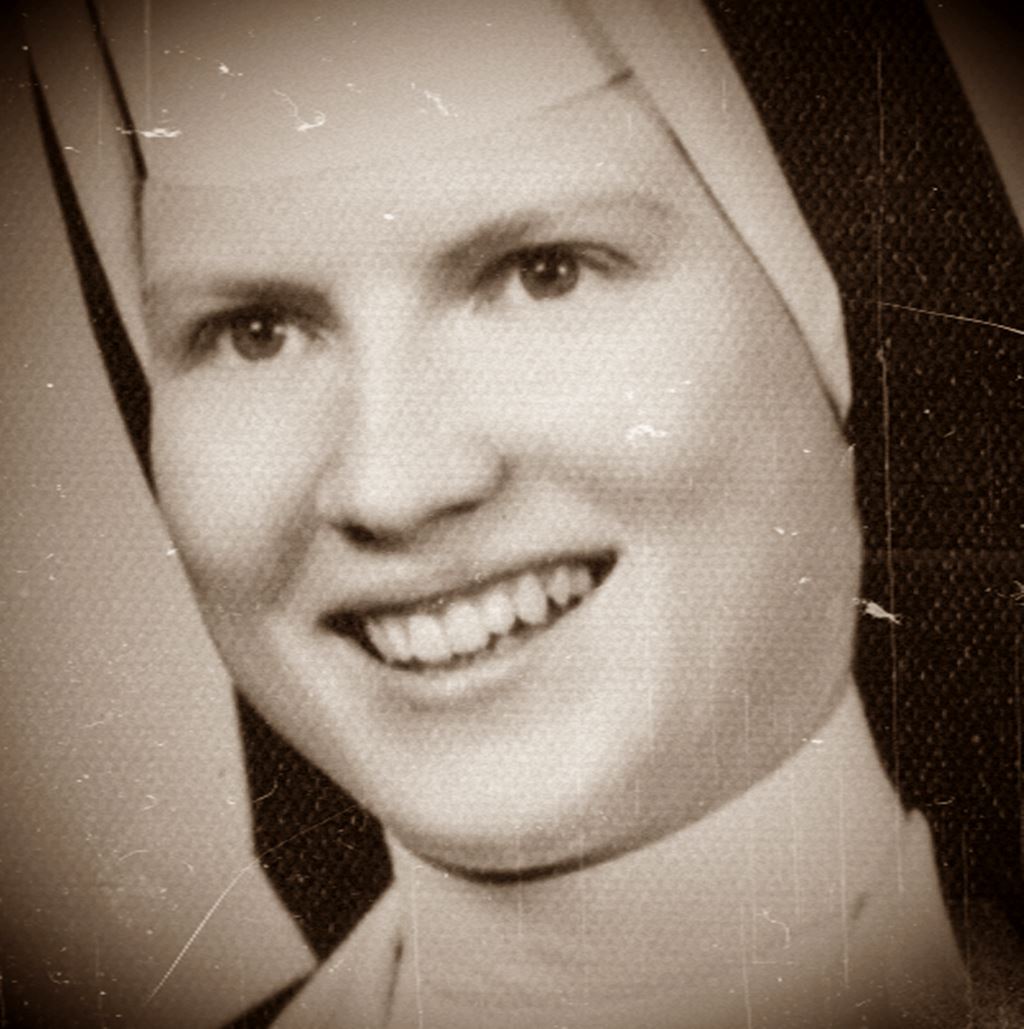
On Friday, November 7th, a young nun in Baltimore, Maryland would go out to run errands and never return home. Though her ultimate fate would not be revealed until early the following year, the mystery of her disappearance and death would resonate right up to the present day, when she was the subject of the 2017 Netflix documentary series, The Keepers.
Twenty-six-year-old Sister Catherine Cesnik, a religious sister and a beloved teacher of drama and English at Archbishop Keough High School, had received her paycheck on that Friday, and shortly after returning to the apartment she shared with her friend and roommate, Sister Helen Russell Phillips, she got into her car and headed out to cash the check and do a bit of shopping. It was about seven-thirty p.m.
Sister Cathy, as she was affectionately known by her students, first stopped at a bank in Catonville and cashed the check, which was in the amount of two-hundred-fifty-five dollars. She then drove to the Edmondson Village Shopping Center, where she purchased a box full of buns from Muhly’s Bakery before proceeding to Hecht’s department store. Her sister had just gotten engaged, and Cathy wanted to buy her a gift to celebrate.
At some point later that evening, the young woman simply vanished.
Back at the Carriage House Apartments, where Cathy lived, roommate Sister Russell was extremely concerned. Midnight had come and gone, and Cathy had not returned, even though the shopping center had been closed for hours. Russell first phoned two friends, Reverend Gerard Koob and Reverend Peter McKeow, who both arrived at the apartment later that night. After a brief discussion, the three of them called police at a little past four-thirty on the morning of November 8th and reported Cathy missing.
Soon after phoning police, Rev. McKeow went outside to wait and noticed that Cathy’s green Maverick was crookedly and illegally parked across the street from the apartment building. When officers arrived, they stated that they had received a handful of complaints about the strangely parked vehicle, starting from about ten-thirty p.m.
Upon examination, the car was found to be unlocked, and the outside was spattered with mud. The bakery box was still on the front seat. In addition, the inside of the car was littered with leaves and small branches, and there was also a broken twig caught on the vehicle’s antenna. This led investigators to surmise that the car might have been driven through Leakin Park, which was only a mile away from the apartment.
The park was thoroughly searched by officers and a K9 unit, but no trace of the young woman was discovered. Authorities released a description of Sister Cathy to the public and began to undertake a massive missing persons investigation.
While authorities had no idea where the nun could have gone, they so far had no reason to believe that she had been kidnapped and murdered, as they had—up to this point—found no evidence of violence.
However, on November 11th, another young woman in Maryland vanished under very similar circumstances, leading investigators to speculate about a possible link.
Twenty-year-old Joyce Malecki worked as an office assistant at a liquor distribution company in Baltimore. On Tuesday evening, she went shopping in Glen Burnie, Maryland, after which she was planning to go out with a man who was stationed at the nearby Fort Meade Army base. She never arrived to meet her date.
The following day, while her brother was out scouring the area for her, he came across Joyce’s abandoned car in the parking lot of an out-of-business gas station. Like Sister Cathy’s vehicle, the car was unlocked, and bags of groceries that Joyce had bought in Glen Burnie were still inside. Joyce’s glasses were also found in the car, and the keys were still in the ignition.
The day after that, November 13th, the body of Joyce Malecki was discovered by two hunters in the Little Patuxent River, near a Fort Meade training area. Joyce’s hands had been tied behind her back, and though she had been stabbed in the throat, the cause of death was determined to be strangulation or drowning. Scratches and bruises on her body indicated that she had put up a vicious struggle against her attacker.
Because Joyce Malecki’s remains had been found on federal land, the FBI became involved, and immediately began investigating a link between Joyce’s murder and the disappearance of Sister Cathy Cesnik. The two crimes, after all, had only occurred four days apart, and were in many ways eerily alike: both Cathy and Joyce had disappeared after an evening shopping trip; both their cars had been found abandoned and unlocked; and both women were of a similar age, build, and religious background.
Most intriguingly, a mysterious pair of black shoes found in the river near Joyce’s body—shoes which evidently did not belong to the victim—appeared of a similar type as those worn by Sister Cathy on the night she went missing.
But discovering a solid connection between the crimes would prove more difficult than anticipated, and until Sister Cathy was found, the inquiry would more or less remain in limbo. Only three days into the new decade, though, the two-month-old missing persons case involving the Baltimore nun would sadly be ramped up to a murder investigation.
On Saturday, January 3rd, 1970, a father and son were out hunting in Landsdowne when they spotted what appeared to be a half-naked body, partially buried in a snowy embankment. When the badly decomposed remains were examined, they proved to be those of the missing Sister Cathy.
The body was in too poor a condition to determine whether she had been raped, but what was certain was that she had been killed by having her skull fractured with a blunt object. Authorities theorized that Sister Cathy had been either carried to the area or forced to walk there by her killer, as there was no way that a car could have reached the spot at which the body was discovered.
The inquiry into the death of Sister Cathy Cesnik, as well as the possibly related murder of Joyce Malecki, remained dishearteningly stalled throughout the entirety of the 1970s and 1980s, despite the best efforts of the Baltimore police and assists from the FBI.
But then, in the early 1990s, the case blew wide open with new allegations of widespread sexual abuse at Archbishop Keough High School, and rumors that Sister Cathy had been targeted for death because she had been planning to report the abuse to the authorities.
Catholic priest Father Joseph Maskell, school chaplain and counselor at Archbishop Keough at the time Sister Cathy was murdered, was in 1992 accused of sexual abuse by two of his former students. The women alleged that when they attended the school as teenagers, Father Maskell would call them into his office and rape them, or force them to perform oral sex. He would sometimes reportedly offer them to other priests, such as his purported accomplice, Father Neil Magnus, as well as police officers and local politicians.
Pending the investigation into the abuse, Father Maskell was removed from his then post as pastor of the Holy Cross Church in South Baltimore. Later in 1992, he underwent a psychiatric evaluation at a hospital in Hartford, Connecticut, where he stayed until spring of 1993, when the archdiocese dismissed the sexual abuse charges. Father Maskell was then transferred to another church in Elkridge, and served as pastor there until the summer of 1994, when more alleged victims began coming forward and accusations started to pile up.
Perhaps the most chilling of these charges stemmed from one of Sister Cathy’s former students, Jean Hargadon Wehner, who told authorities that back in November of 1969, a few days after the nun had vanished, Father Maskell had driven her to Landsdowne and showed her Sister Cathy’s dead body, telling her that this is “what happens when you say bad things about people.”
Though Jean Wehner’s recovered memories were the only evidence of this particular incident, police did note that details she remembered about the crime scene were accurate, and consisted of information that had not been released to the public. Jean Wehner also accused Father Maskell of sexually assaulting her on several occasions, and recalled another priest she only knew as “Brother Bob,” who supposedly claimed involvement in Sister Cathy’s murder.
In spite of the mounting tide of suspicion, the sexual abuse allegations ultimately went nowhere, as the court ruled that the statute of limitations had expired. And though Father Maskell was questioned at length about the murder of Sister Cathy Cesnik, investigators were not convinced that the priest was involved in the crime.
However, in early 1995, Father Maskell was relieved of his priestly duties. He moved to Ireland, and continued to practice psychology. There were two accusations of sexual abuse lodged against him during his stint overseas.
Father Maskell returned to the United States in 1998, and proclaimed his innocence of all charges until his death in 2001. It was later discovered that the Baltimore Archdiocese had paid out nearly half a million dollars to sixteen of Father Maskell’s professed victims, even though the priest was never formally charged with any wrongdoing.
The case of Sister Cathy Cesnik’s murder was revitalized again in 2017, upon the announcement that Netflix was producing a seven-episode documentary series called The Keepers that would examine the possible link between the nun’s murder, the killing of Joyce Malecki, and the sexual abuse allegations against Father Maskell brought by several of the students at Archbishop Keough.
Significantly, it is almost certain that Joyce Malecki was also acquainted with Father Maskell, as she had attended his church for several years, and had gone to confession with him on numerous occasions.
In February of 2017, Father Maskell’s body was exhumed to obtain a DNA sample to compare with one recovered from Sister Cathy Cesnik’s remains. The DNA was not a match, though it remains possible that Maskell might have hired someone to carry out the deed.
The documentary series also introduced a few other persons of interest who may or may not have been involved with the killing. These included Sister Cathy’s neighbor, Billy Schmidt, who allegedly confessed to his sister-in-law that he had participated in the murder with his brother and a man he was dating, known only as Skippy. Schmidt supposedly spiraled into an alcohol-fueled depression after the murder and eventually committed suicide a few months later.
Notably, Schmidt smoked Salem brand cigarettes, a butt from which was found near Sister Cathy’s body. The sister-in-law also claimed that her husband had come home on the night of the nun’s disappearance with blood all over him.
Another possible suspect who also reportedly arrived home that night covered in blood was Edgar Davidson, accused of the murder by his first wife, who had long claimed that he was abusive. Davidson also had a criminal record, including charges that he often attempted to lure young girls into his vehicle.
Mrs. Davidson became even more suspicious of Edgar when she received a necklace from him for Christmas which bore a wedding bell pendant with a gem that was not her birthstone. Some researchers have speculated that this necklace had perhaps been the engagement gift that Sister Cathy had bought for her sister at Hecht’s department store on the night she disappeared.
Additionally, Edgar Davidson was known to drive with both feet, which investigators believed the killer did as well. He also phoned a radio station shortly after the body was found, claiming to know where Sister Cathy’s lost rosary was, and often made strange jokes about the crime to his wife.
Though Edgar Davidson was extensively interviewed on camera for the documentary, he stringently denied involvement in Sister Cathy’s death.
Authorities in Baltimore are still actively investigating the murder of Cathy Cesnik, and still trying to establish an ironclad connection between her death and that of Joyce Malecki. Several subsequent murders in the Baltimore area—including those of Pamela Conyers in October of 1970, Grace Montanye in October of 1971, and Danny Crocetti in March of 1975—would also bear significant similarities, though a definite link has never been established.
 Crime Immemorial