
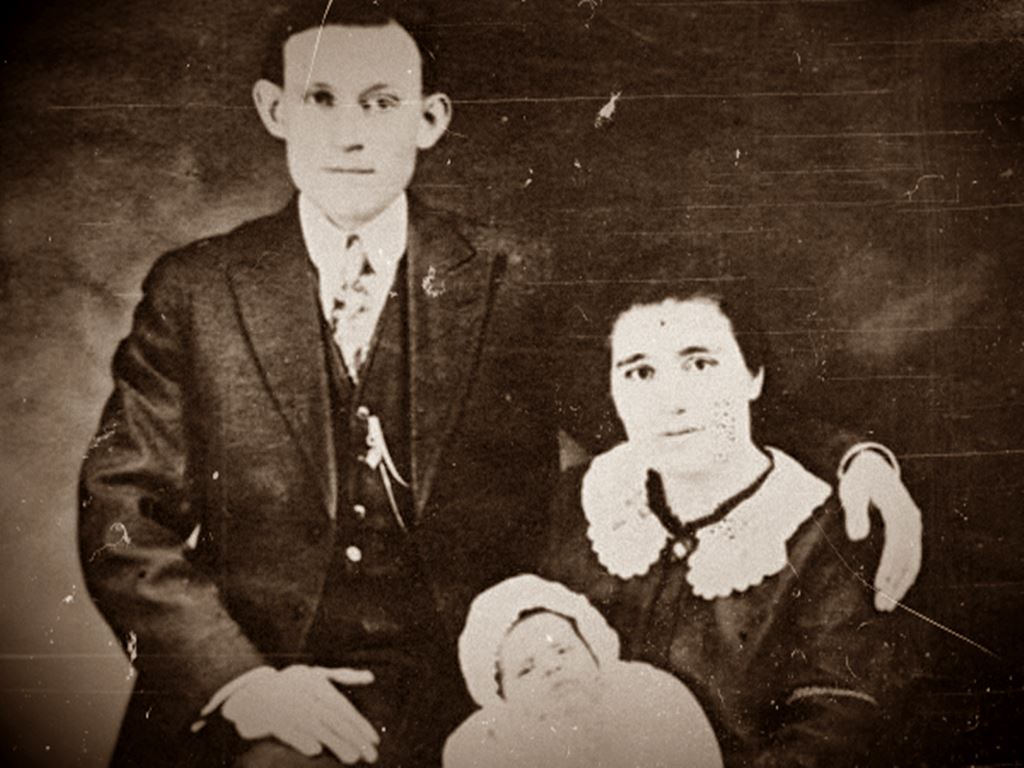
Benny Evangelist was something of a polarizing figure in Detroit, Michigan, to say the least. Carpenter by day, cult leader by night, Benny had actually been born Benjamin Evangelista in Sicily before immigrating to the United States in the early years of the twentieth century. He and his wife Santina had four children—Angeline, eight; Margaret, six; Jeanne, four; and Mario, eighteen months—and lived in a pretty, cream-colored house at 3587 St. Aubin Street.
Since 1906, after he claimed he’d had a vision from God, Benny had been billing himself as a healer and a mystic, and headed a small religious sect called the Union Federation of America. Benny had even written the cult’s holy book, a two-hundred-page tome titled The Oldest History of the World: Discovered by Occult Science. The beliefs of this sect were a strange mixture of Christian and pagan ideas, with some voodoo thrown in for good measure. Benny, in fact, had constructed a bizarre altar in the basement of his family’s home that consisted of a huge eye that lit up, and several wax effigies that supposedly represented celestial bodies.
Though Benny apparently made a decent living with his carpentry, the side gig as a cult leader nicely supplemented the family’s finances: Benny offered healing services to his followers at $10 a session, which amounts to more than $140 in 2017 money. Perhaps it was the failure of one of these high-priced mystical interventions that sent one of his followers into a murderous rage, or perhaps it was something else entirely, but whatever the case, the Evangelist family would not live to see the end of the summer.
On the evening of Tuesday, July 2nd, 1929, Benny stopped by a house in the neighborhood that was due to be razed the next day. He spoke to the watchman there, and told the watchman that he had arranged to purchase all of the lumber left over from the demolition. He would come to the site in the morning to meet the truck, he said, and he would bring the money to pay for the wood. With that, he returned to his home on St. Aubin Street. It was the last time he would be seen alive.
The following morning, Benny did not arrive at the demolition site as scheduled, but oddly enough, neither did the men who were supposed to load up the wood. While the absence of the lumber crew remained a mystery, the reason for Benny being a no-show would soon become clear.
Real estate agent Vincent Elias had an appointment with Benny that Wednesday morning concerning a farm that Benny had been planning on purchasing. But when Vincent arrived at the St. Aubin Street house on July 3rd, he discovered that Benny would not be buying any farms except for metaphorical ones: he and his entire family were dead.
Cult leader Benjamin Evangelista was found sitting at his desk with his hands folded in his lap. His severed head was discovered sitting in a nearby chair. In a bed in the same room were the bodies of his wife Santina, who had also been nearly decapitated, and their eighteen-month-old son Mario, whose skull had been crushed. In the room across the hall, the couple’s three daughters had also been brutally slain, their heads obliterated by the swing of an axe blade. It was theorized that the family had been murdered at around midnight, while most of them had been sleeping.
Detroit police immediately mobilized to try and track down the killer, though clues were fairly thin on the ground. Bloody fingerprints were found on the front door latch of the St. Aubin Street house, but although a reward was offered for information, no matches or serious suspects could be discovered. A man named Angelo Depoli, who neighbors claimed had visited the Evangelistas on several occasions, was arrested on July 3rd while carrying a bloody knife, but he was released after investigators could find no definite connection to the family.
The only really solid lead concerned the lumber crew who had somehow known not to show up at the demolition site that day. Also suspicious was the fact that the cash that Benny had on hand to pay the crew was not found in his home after the murder, leading investigators to speculate that one or several of the workers had conspired to rob the family. Unfortunately, police were never able to identify the name of the company that had been in charge of the demolition, and failed to discover the names of anyone on the crew, so their one promising lead turned up absolutely nothing, and the case very quickly went cold.
Whether the massacre of the Benny Evangelist family was carried out by thieves, disgruntled religious followers, a rival cult leader, or a random wandering maniac is still unknown. It should be noted, however, that the area of Detroit where the Evangelista family lived saw a rash of strange, occult-inspired killings taking place between 1929 and 1931, and it’s possible that Benny and his family became caught up in these nefarious circles.
In fact, almost two months after the slaying of the Evangelistas, a woman named Rose Veres, known as the Witch of Delray, was arrested on suspicion that she had murdered at least ten men who had boarded in her home. Though the evidence against her seemed damning, mostly stemming from the life insurance policies she had taken out on all of her deceased renters, she proved difficult to convict, largely because her neighbors believed she possessed powerful black magic and were terrified to testify against her. She was eventually convicted and sent to prison, but was exonerated in 1945.
The house on St. Aubin Street where the Evangelistas met their end was eventually torn down, and nothing but a grass lot remains, though rumors circulate that the area is still haunted by a headless specter.
 Crime Immemorial