
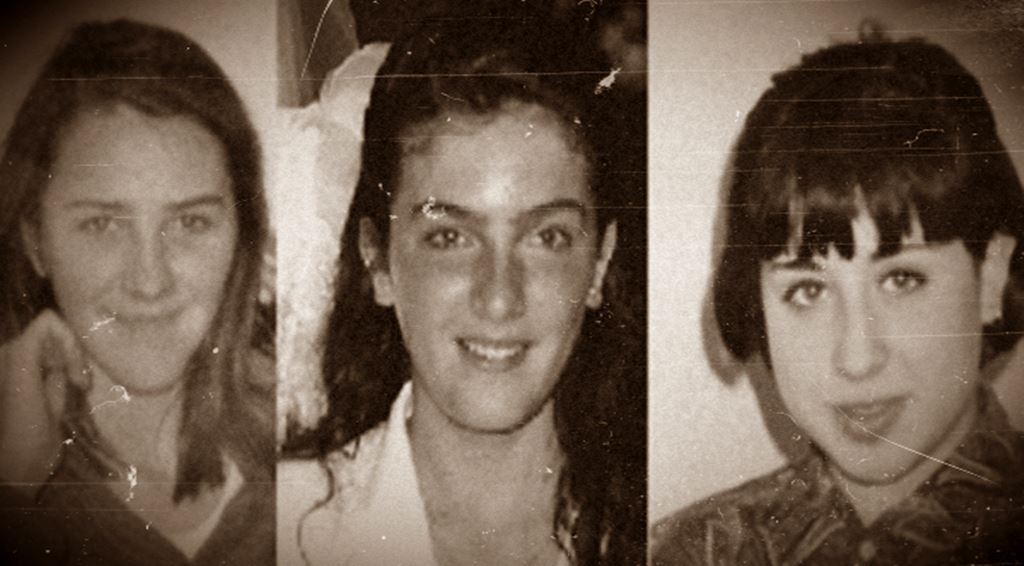
It was the afternoon of Friday, November 13th, 1992, and three friends—sixteen-year-old Antonia Gómez Rodriguez, better known as Toñi; fifteen-year-old María Deseada Hernández Folch, better known as Desirée; and fifteen-year-old Miriam García Iborra—met up at the home of a fourth friend, a girl named Esther Diez, in the town of Alcàsser, in Valencia.
Toni, Desirée, and Miriam were planning to attend a fundraising party that night at a club called Coolor, which was located in the next town over, Picassent. Esther had come down with the flu the day before, and so opted to stay home; incidentally, Miriam’s father Fernando was also suffering from the same malady, which meant that he could not give the three girls a ride to the party as he had planned to. Undaunted, the girls decided to hitchhike, which they had done countless times before.
According to Esther, they left her home at around eight o’clock p.m. Approximately fifteen minutes later, they were spotted by an acquaintance of theirs, Francisco Hervas, who was driving by with his girlfriend Maria Garcia. The pair offered to give the three girls a lift part of the way, as Francisco was heading to an auto repair shop to get a fuel tank leak looked at. According to him, he dropped the girls off a few blocks away from the Coolor nightclub, and this sequence of events was corroborated by another witness who saw them a little further down the street several minutes later.
Toni, Desirée, and Miriam never arrived at the club. The only other sighting of them came from an elderly woman by the name of Maria Soria, who later told authorities that she had seen the girls walk by her house in Picassent and then witnessed them getting into a white sedan, possibly an Opel Corsa, which contained three or four men.
The three girls vanished at some point thereafter, and would not be found until early into the following year. On January 27th, 1993, a pair of beekeepers were checking out their hives in a remote, hilly area known as La Romana when one of them spotted something shiny glinting at him from a ditch. Upon closer examination, this object was found to be a watch, which was worn on the skeletal wrist of a corpse.
When authorities arrived and surveyed the site, they discovered the stacked and decomposed remains of the three girls—sixteen-year-old Toñi Gómez, fifteen-year-old Desirée Hernández, and fifteen-year-old Miriam García—who had vanished two-and-a-half months before while hitchhiking to a party at the Coolor nightclub in Picassent. Their bodies lay roughly a half-hour drive away from where the three girls had last been seen.
It appeared that the victims had undergone unimaginable torture and various indignities both before and after their deaths. The girls’ wrists were all bound together with rope, two of the victims had been beheaded, and one had her hands removed. Later evidence would suggest that all had been raped, sodomized, and beaten severely, and Desirée had had her right nipple amputated, perhaps with a pair of pliers. In addition, it looked as though Miriam had had a sharp object inserted into her vagina, though it was not clear if this happened pre- or post-mortem.
Among the objects recovered from around the crime scene were a single nine millimeter shell casing, a man’s glove, and a Social Security outpatient pamphlet bearing the name Enrique Anglés.
Though Spanish police would later be raked over the coals by the press and the public for their seemingly lackadaisical approach to collecting forensic evidence—failing to photograph items found at the scene, for example, and sealing some pieces of damp evidence into plastic bags for hours, leading to mold growing on them— they had enough presence of mind to realize that the name of Enrique Anglés immediately rang a bell. For though Enrique didn’t have much of a rap sheet, his brother Antonio most certainly did.
Antonio Anglés, in fact, had a long and storied criminal career, beginning with relatively minor charges related to receiving stolen property and drug trafficking, and eventually escalating to armed robbery. But in 1991, he had kidnapped a woman named Nuria Pera, who had stolen heroin from him, and chained her to a post in the back room of his family home, where he beat her savagely.
A handful of Antonio’s friends and family members were charged with aiding and abetting Antonio in this crime, though in the end, only Antonio was convicted, and sentenced to six years. Only one year later, however, he was released on a furlough and simply never returned to prison. Significantly, at least in the eyes of the authorities, he was still running around loose when Toñi , Desirée, and Miriam were abducted in Picassent.
Police descended on the Anglés home, ultimately arresting Antonio’s brothers Enrique, Mauricio, and Ricardo, along with his sister Kelly and her boyfriend. Also taken into custody was a friend of the family named Miguel Ricart, who investigators focused their attention on almost immediately, as he owned a white Opel Corsa similar to the vehicle that a witness had seen the three Alcàsser girls getting into prior to their disappearance. Miguel had also been charged in the earlier kidnapping case involving Antonio and victim Nuria Pera, though he was subsequently cleared.
Under questioning, Miguel Ricart at first denied knowing anything about the murders or the current whereabouts of Antonio Anglés, and claimed that he himself had been in prison on the night that the Alcàsser girls were taken. When police attempted to corroborate this story, they found that they could not; Miguel had indeed been in jail throughout most of December of 1992 on a charge of car theft, but prison officials couldn’t find a record that he was incarcerated on the night of November 13th. Miguel was thereafter officially charged as an accomplice in the triple homicide.
Approximately twenty-four hours after his arrest, Miguel began to open up about what had allegedly happened to the three girls from Alcàsser. He initially claimed that he and Antonio had picked up the girls at a gas station near the Coolor nightclub, and that the three girls had come along with them willingly on the drive out to La Romana. He stated that he had consensual sex with Desirée once they arrived at their destination, and that Antonio went off to have sex with Toñi and Miriam.
Miguel then said that he had heard three gunshots from a distance, implying that Antonio had killed Toñi and Miriam out of his view. This is where his confession got confusing, however, because he didn’t say who had killed Desirée, or if she had been murdered at the same location as the other two victims. He simply asserted that he and Antonio had then dug a pit into which they deposited the bodies of the three girls.
But hours later, after a second autopsy was performed on the bodies that revealed the extent of the appalling violence that had been visited upon the young women, Miguel changed his story somewhat, maintaining that actually, he and Antonio had lured the three girls into their vehicle under false pretenses, after which Antonio had pistol-whipped them into silence when they started to scream. He further said that the two men had then driven out to an abandoned house near the remote area of La Romana, where they had raped and tortured the three girls before forcing them to walk to a pit they had dug. According to this account, Miguel and Antonio had then shot the girls and hastily buried the bodies in the pit, after wrapping them in a greenish-brown rug.
Whichever of these accounts was true—if indeed either one of them was—Miguel would later recant his entire testimony, claiming that his confession had been coerced. To many outside observers who have looked into the case, in fact, it appears that Miguel would change his story whenever a new autopsy was performed or a new piece of evidence in the case would turn up; for example, in a later iteration of his account, he stated that even though he had been present at La Romana, he had nothing to do with raping or killing the girls, an act which he claimed had been entirely perpetrated by Antonio, his brother Mauricio, and a third teenager known only as El Nano. Miguel had not mentioned these latter two individuals in any previous statement. This constant evolution of Miguel’s narrative has led some to speculate that he was being railroaded by the police.
Miguel Ricart would stand trial for the crimes in 1997. Before the trial began, though, Fernando García, the father of victim Miriam García, requested that the proceedings be delayed, as he did not think the police had been diligent in their investigation and were guilty of ignoring or manufacturing evidence. García further believed that there was insufficient cause to try Miguel; while he was not certain if Miguel or Antonio was guilty, he surmised that there might have been more people involved, and that the scope of the investigation should perhaps be widened.
There were some later developments in the case that seemed to bolster his assertions; witnesses came forward and stated that they had seen Miguel at a restaurant in another town on the night the Alcàsser girls were abducted, for instance, and DNA analysis on several pubic hairs found at the scene did not match the profiles of Miguel Ricart, Antonio Anglés, or any of the other named suspects.
Despite this, Miguel Ricart would ultimately be sentenced to one-hundred-seventy years in prison for his part in the murders of the Alcàsser girls. He was released in 2013, after a new European Union ruling that deemed sentences over thirty years to be cruel and unusual punishment. After his release, he went off the grid for several years, but came to the attention of police again in 2020 when he was caught buying drugs in Madrid.
Authorities would continue to search for the elusive Antonio Anglés, who was spotted numerous times in the ensuing years, and whose whereabouts are still unknown. He remains on Interpol’s list of most wanted fugitives. One of the most persistent rumors concerning Antonio Anglés is that he leaped to his death from a ship crossing into Dublin, though this tale has never been substantiated.
In the time since the murders, numerous theories about what really happened to the Alcàsser girls have been splashed all over the media. Some believe that several prominent individuals, such as politicians and wealthy businessmen, were complicit in the killings, and that Miguel Ricart was simply used as a scapegoat. Conspiracy theories of this type were only strengthened by the Spanish government’s refusal to test further DNA evidence discovered on the rug used to wrap the bodies, and their banning of a book co-authored by Fernando García and late criminologist Juan Ignacio Blanco in which the writers named specific individuals who they believed knew what really happened. There has also been ongoing strife between the parents of all the victims, some of whom still allege that Miguel Ricart was nothing but a patsy, and others who simply want to be left alone to put the entire tragedy behind them.
Though with the conviction of Miguel Ricart, the murders are officially considered solved, so much controversy exists concerning the case that it is likely the truth may never come out. The labyrinthine details of the investigation and its profound impact on the nation of Spain were the subject of a Netflix miniseries in 2019, titled The Alcàsser Murders.
 Crime Immemorial