
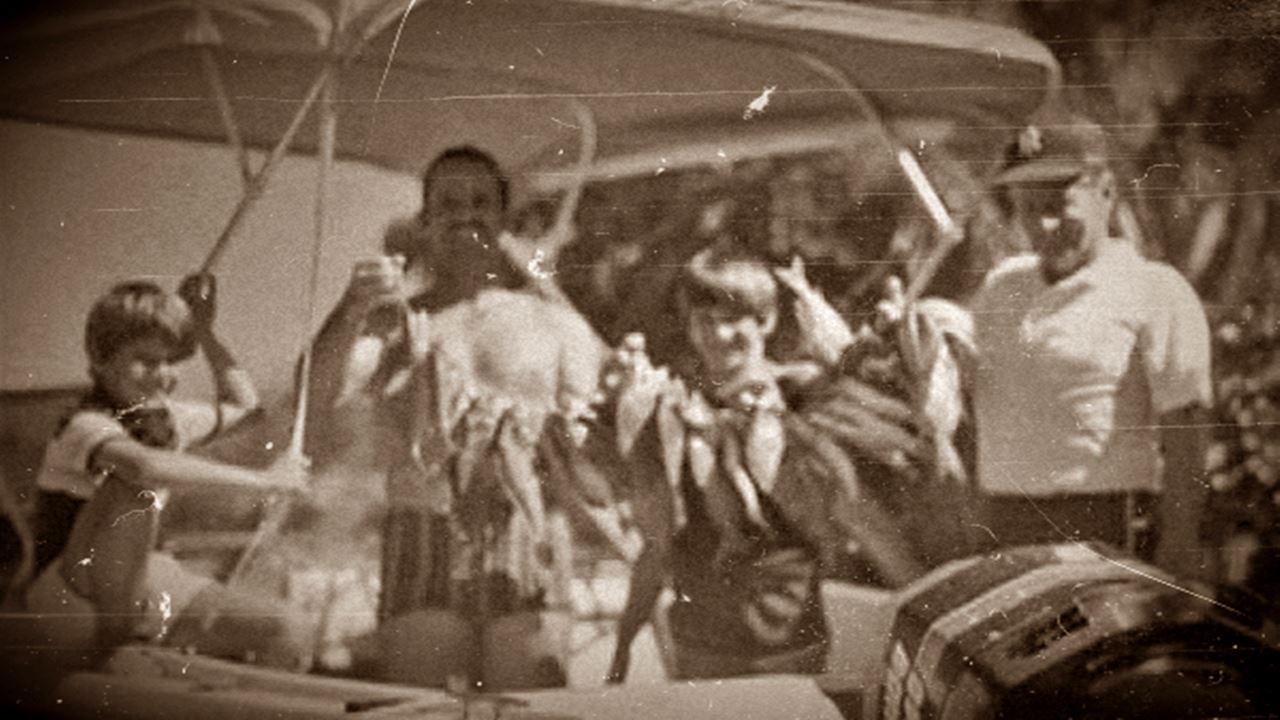
In the summer of 1980, the Dumois family was heading out for a vacation from their residence in Tampa to a rented cottage on Anna Maria Island, a beautiful seven-mile stretch of land off the west coast of Florida. Forty-seven-year-old Dr. Juan Dumois, a pediatrician, was accompanied by his wife Maria and the couple’s four children, and the family was planning a relaxing, two-week holiday full of sunbathing, boating, and fishing.
This latter activity, in fact, was the order of the day on Friday, August 1st, which happened to be the last day of the vacation. At approximately nine a.m., Dr. Dumois, his brother-in-law Raymond Barrows, who was visiting from Miami, and two of the Dumois children—thirteen-year-old Eric and nine-year-old Mark—loaded up their boat and headed for the Kingfish Boat Ramp. Maria and the other two children—nineteen-year-old Juan III and sixteen-year-old Anna—stayed behind at the cottage.
The fishing in the Gulf of Mexico was apparently very good that day, and the group returned to the ramp late that afternoon with a cooler full of fish. Dr. Dumois hitched the boat to the back of his 1977 Oldsmobile Vista Cruiser, and began the short drive back to the vacation house.
Moments later, though, a man pushing a bicycle emerged from a copse of trees near the boat ramp and flagged the car down. This individual was a white male, lean and well-muscled, standing about six feet tall, with green eyes, a cleft chin, and thick brown hair combed back off his forehead; he also wore short sideburns. He appeared to be in his mid to late thirties, was clad in a white tennis outfit with red and blue trim, and reportedly spoke with what was possibly a New England accent.
When Dr. Dumois asked what he wanted, the man replied that he had hurt his ankle while riding his bike, and would appreciate a ride to the condominium complex around the corner. Dr. Dumois affably agreed, even helping the man load the ten-speed into the boat. The stranger then climbed into the back seat of the Oldsmobile next to Eric and Mark.
Then, as Dr. Dumois began driving once again, the hitchhiker pulled out a gun and began shooting.
Dr. Dumois was apparently shot first, then Raymond Barrows, though sources differ on this point. The killer then targeted each boy with a bullet to the head in quick succession. Subsequently, the stranger grabbed the wheel of the vehicle and steered the car off the road into the grass. The killer then exited the car, retrieved his bike from the boat, and rode off toward the parking lot of a nearby Foodway supermarket.
As it turned out, the entire sequence of events had been spotted by a witness, sixty-year-old Robert Matzke, a retired Air Force lieutenant colonel who had been in the front yard of his condominium at Westbay Cove North, and had seen the Oldsmobile coming to a halt. He was unaware that anyone had been shot, but thought the car had perhaps been in an accident. He told his wife Mary to call the police and report the incident, then got in his own vehicle and set off after the man on the bicycle.
Evidently, Robert pulled up alongside the stranger, at which point the man again produced a .22 and shot Robert in the back of the head, causing his vehicle to veer off and hit a parked car in the supermarket lot. A woman who had been in the grocery store believed she had witnessed another car crash, and reported it to police at a little past five p.m. Though like Robert Matzke, she did not realize that anyone had been shot, she was able to tell police that the man on the bicycle had loaded it into the back of a dark brown Chrysler with a tan roof that may or may not have been driven by another individual. This vehicle then sped away from the scene.
Another witness to the event was island resident and amateur photographer John Toth. As he was leaving the TV repair shop he owned on the island, he spotted Dr. Dumois’s vehicle swerving off the highway onto the roadside, and saw the killer emerge from the car. Just as in all the other cases, John was also unaware that he had just witnessed a shooting, but was intrigued enough to start photographing the scene with the camera he always had close to hand. Though the photographs he produced did capture an image of the murderer, unfortunately John had, in his haste, forgotten to turn on the auto focus, and the pictures were far too blurry to identify the individual in question.
Though Raymond Barrows would ultimately survive his injuries, Dr. Dumois, his two sons, and Robert Matzke would all die as a result of the shooting. And because the crimes were initially reported to authorities as two separate automobile accidents, arriving officers did not realize they were investigating a murder scene, and not only failed to secure the area, but allowed numerous volunteers to assist in extricating the victims from their cars. Adding insult to injury, the Oldsmobile had also happened to come to a stop near a sprinkler, which drenched the vehicle with water and wiped away valuable evidence.
Despite a massive search of the island and the nearby mainland, no trace of the killer or the getaway car was ever found. Detectives struggled to come up with a motive for the apparently random attack, investigating leads pertaining to Dr. Dumois’s escape from Castro’s Cuba in 1960; possible links to the Mafia or the drug trade; and speculations that a disgruntled parent of one of his juvenile patients had perhaps murdered him for reasons of retributive justice. It was also hypothesized that Raymond Barrows could have been the actual target of the execution, engendered by a hit man hired by a cocaine cartel.
None of these avenues of inquiry yielded any progress, though the killing did bear many of the hallmarks of a professional assassination: the use of a .22, for example; and the fact that the killer had lain in wait for his victim and had executed the killing efficiently in public, where there would be confusion and the ability to melt back into the crowd. It was also possible that he had an accomplice who drove the getaway car and met him at a preplanned location.
While over one hundred persons of interest were eventually questioned, there were two particularly compelling suspects who were considered in the wake of the quadruple homicide. One of these was thirty-four-year-old Richard Lee Whitley, a native of Chicago who had been picked up in Tampa shortly after the Kingfish Boat Ramp murders and was wanted by the FBI in conjunction with the gruesome stabbing death of his sixty-three-year-old neighbor, Phoebe Parsons, that had taken place on July 25th, 1980 in Falls Church, Virginia. Whitley had stolen the victim’s car following the slaying, and it was found in Okeechobee, Florida on the same day as the Kingfish Boat Ramp murders; the suspect had also allegedly used the woman’s credit cards in Tampa on July 28th and 29th.
Though Whitley was never charged in the Dumois family slaying, survivor Raymond Barrows did tell police that Whitley closely resembled the man who had shot him. But Whitley was also purportedly seen at the Lighthouse Gospel Mission in Tampa, about sixty miles away from the scene of the Kingfish Boat Ramp murders, between fifteen minutes to an hour after the shooting occurred, which would seem to rule him out as a suspect.
Richard Lee Whitley was afterward extradited to Virginia for the previous murder of Phoebe Parsons, and was eventually convicted. He was executed in July of 1987.
The other serious suspect was William Peter Kuhlman, who had recently been charged but acquitted of the murder of a Bradenton, Florida woman that was undertaken with a .22 caliber handgun.
In January of 1981, the Holmes Beach Police Chief, Tom Shanafelt, requested that the fingerprints of an unnamed Polk County murder suspect be compared to the partial print recovered from the Kingfish Boat Ramp crime scene. This suspect was being held in conjunction with the shooting death of a Polk County sheriff’s deputy, as well as a cab driver and another man. At least one of these shootings was also effected with a .22 caliber handgun.
There have also been some attempts to connect the Dumois family shooting with a few other seemingly random, unsolved murders in Manatee County. Thirty-three-year-old Diane Love, for example, was shot and killed by an unknown assailant while standing in a Christmas tree lot in Bradenton with her husband and daughter on December 12th of 1974. And years later, in April of 1977, a man named Harry Wolfe was likewise shot, his body discovered on the floorboard of a gold Chevy pickup truck in the parking lot of an Albertson’s grocery store.
Raymond Barrows, the sole survivor of the shooting, died of natural causes, possibly a heart attack, in 1982. The case fell into an uneasy obscurity not long afterward, and remains unresolved more than forty years later.
 Crime Immemorial
AS AN OLD FRIEND OF THE DOCTOR I WOULD LOVE TO SEE THIS CASE REOPENED