
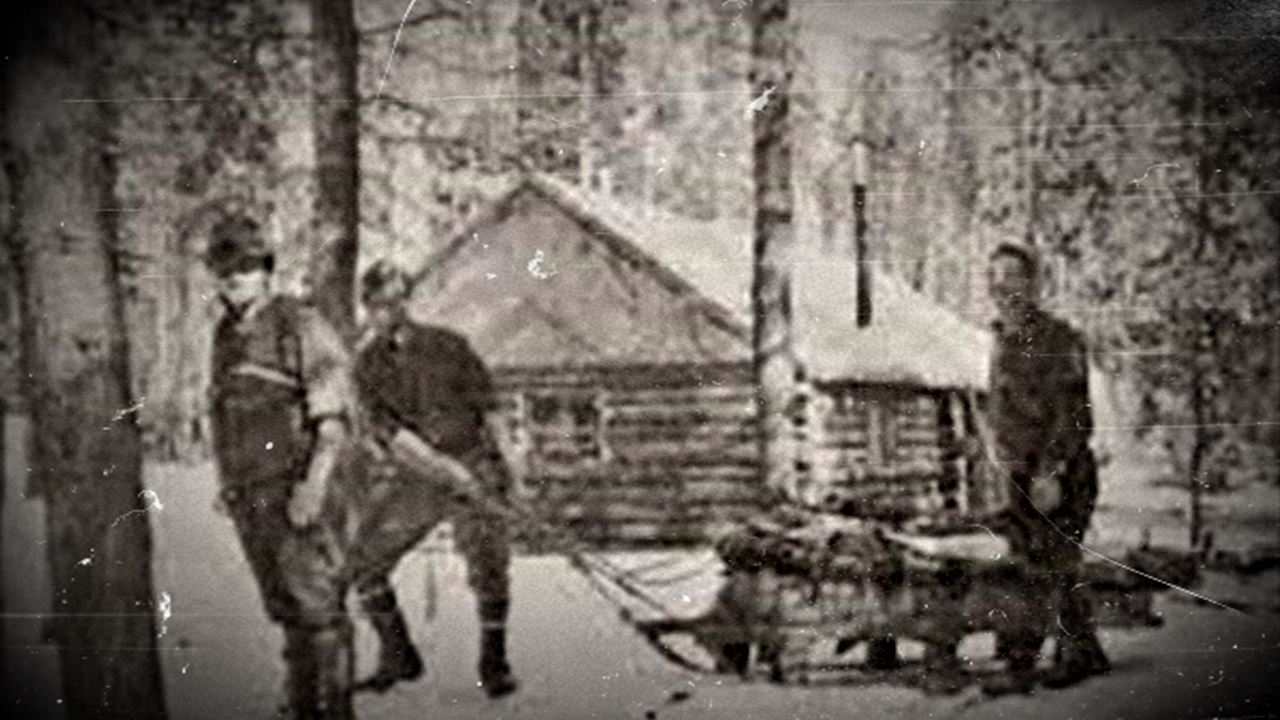
It was the late fall of 1923. Three men, Edward Nickols, Roy Wilson, and Dewey Morris, were heading out from their homes in Bend, Oregon to spend the winter fur trapping at a cabin near Little Lava Lake. The cabin was owned by a logging contractor named Edward Logan, who had agreed to let the men stay there over the winter in exchange for them taking care of his five prize foxes, who were housed in a pen located about a hundred feet behind the cabin.
All seemed to be going well for the men at first. The trapping was apparently very good, because a week before Christmas, Edward Nickols came down to Bend with a huge sled-load of furs to sell. According to locals he spoke to, he seemed in very high spirits, and was clearly looking forward to a productive remainder of the winter.
Also a witness to the genial mood among the men was Allen Wilcoxen, who visited the trio on January 15th, 1924. Allen owned a resort at Elk Lake, and was snowshoeing up there when he decided to stop by the cabin at Little Lava Lake to stay the night with the trappers. He reported that the cabin was warm and cozy, that everything around the area was well looked-after, and that the men were welcoming and cheerful, pleased at the good fortune they had encountered in their trapping so far. Allen spent a pleasant evening with the three, and went on his way the following morning.
But sometime after January 16th, something went appallingly awry, though the results of the tragedy were not discovered until months later.
That April, Innis Owen Morris, Dewey’s brother, realized that he hadn’t had any news from the cabin since the past Christmas. He had also noticed, on a recent pass through the surrounding area, that the mink traps set out by the men had not been maintained, which was very unusual; Edward, Roy, and Dewey were known to be quite conscientious, and were diligent about keeping up their traps.
Pearl Lynnes, superintendent of the nearby fish hatchery, had also become suspicious, and she and Owen gathered a search party to go up to Little Lava Lake to search for the men.
An uncanny scene greeted them when they arrived at the cabin. The three men were nowhere to be found, but the table had been set for dinner, and there was burned food languishing in the pots on the stove.
Outside of the cabin, searchers noticed that the trappers’ large sled was missing, as were Edward Logan’s five valuable fur foxes from the pen out back. Additionally, the men’s traps still contained several frozen, months-old carcasses, including those of martens, foxes, and one skunk.
Most sinister of all, a bloodied claw hammer was found in the far corner of the fox pen. The search party immediately contacted the police.
The next day, Deschutes County sheriff Clarence Adams arrived at the cabin and began an investigation. He and the searchers headed toward Big Lava Lake, about a quarter of a mile away, and they eventually discovered the trappers’ missing sled, which was stained with blood, near the banks of the lake. Investigators also found a depression in the snow at the edge of the lake, which suggested that a hole had been cut into the ice at some point and had then frozen back over.
The party fanned out to search the surrounding area, and one searcher came across a further, chilling clue: a patch of snow that was marred by pools of blood. Digging down a little, he also discovered a clump of hair and a human tooth.
Later that evening, the lake ice had thawed enough to allow Innis Morris and Clarence Adams to set out into the lake in a rowboat, and they almost immediately sighted three bodies bobbing in the water. The men grimly tied the corpses together with rope and towed them back to the shore, fastening the ropes to the shelf ice for the night. Sheriff Adams then put on his snowshoes and started the trek back to Bend to bring backup. More investigators as well as several locals arrived in subsequent days and helped to pull the bodies from the lake and carry them back to town.
Upon forensic examination, multiple wounds were discovered around the heads and upper bodies of the victims, suggesting that all three men had been shot by both a rifle and a pistol, as well as beaten with a hammer. Edward Nickols, in fact, had had the lower portion of his face nearly blown off by a shotgun blast, and likewise, Roy Wilson’s right shoulder had been completely shot away.
Police theorized that at least two of the men had probably been lured away from the cabin before being murdered. Initially, suspicion fell on a woodsman named Indian Erickson who occupied a cabin nearby, but he was quickly dismissed after supplying an airtight alibi.
A much more promising lead, however, came from Edward Logan, the owner of the cabin on Little Lava Lake. He told police that the previous winter, Edward Nickols had worked with another trapper named Lee Collins, and that at some point the two men had got into an altercation about a supposedly stolen wallet, after which Collins had evidently threatened to kill Nickols.
Authorities discovered that Lee Collins was actually the pseudonym of a man named Charles Kimzey, who had been arrested in Bend, Oregon in 1923 for robbery and attempted murder. His victim had been a stagecoach driver named W.O. Harrison; Kimzey had hired Harrison to take him to Idaho, but then robbed him and thrown him down a well to die before taking off in the stolen coach. Harrison survived, and Kimzey was detained, but eventually skipped town before the case could come to trial.
Further, Kimzey had a long history of shady criminal activities, having been arrested several times and even at one point incarcerated in the Idaho State Prison, from which he subsequently escaped. It was also known that Kimzey had worked as a trapper for the government, and was a crack shot with both a pistol and a rifle.
And there was even more damning evidence linking Kimzey to the murders of the trappers. An officer who had been directing traffic in Portland on January 24th claimed that a man had approached him and asked where he could go to sell some furs. The man carried a sack over his shoulder, and closely matched Charles Kimzey’s description. The officer directed the man to the nearby Schumacher Fur Company.
Certain that Kimzey was their killer, police began an intensive manhunt, offering a reward of $1,500 for information leading to his arrest. For years, though, no trace of the elusive Kimzey could be found, though authorities were tireless in their search, following up on every lead, however small. Eventually the trail went cold, and national attention focused elsewhere, leaving the murder frustratingly unresolved and forgotten by nearly everyone except the local police and the families of the slaughtered trappers. The case, in fact, would not see any further developments for nine long years.
But in February of 1933, a man walking down a street in Kalispell, Montana recognized Charles Kimzey and summoned the police. Kimzey was taken back to Oregon to be questioned about the Lava Lake slayings. Though it seemed that enough circumstantial evidence existed to try him for the triple murder, the police’s case unfortunately fell through when the fur dealer at the Schumacher Fur Company could not positively identify Kimzey as the man who had sold him the suspicious pelts.
Kimzey did not get away scot-free, however. Since he was also wanted in conjunction with the attempted murder of stagecoach driver W.O. Harrison in Bend in 1923, police charged him with that instead, and for this crime, he was convicted and sent to serve out a life sentence at the Oregon State Penitentiary. It is still unknown whether he was responsible for the deaths of the three trappers at the cabin on Little Lava Lake.
In 2013, author Melany Tupper wrote a book about the case titled The Trapper Murders, and in it, she put forward the theory that not only was Kimzey the killer, but that he hadn’t acted alone. His accomplice, she hypothesized, was a man named Ray Jackson Van Buren, who over the years became known as Oregon’s “Angel of Death,” due to his suspicious proximity to several similar murder cases, in which he ostensibly aided the authorities in their investigations by providing “helpful” information.
Some of these crimes included the murders of merchant J. Creed Conn in Silver Lake in 1904; homesteader Julius Wallende in the same town in 1907; and father and son Ira and Harold Bradley, murdered in May of 1930 and December of 1929, respectively. All of these victims, comparable to the men at Lava Lake, were shot and beaten severely in the face.
An alleged girlfriend of Van Buren’s, Emma Dobkins, also died under mysterious circumstances in March of 1910, though her official cause of death is listed as angina.
Van Buren himself died at the age of 68 in February of 1938 of an apparent suicide. Author Melany Tupper puts forward a compelling case that he may have been a serial killer, though the extent of his involvement in the Lava Lake Murders in particular may never be known.
 Crime Immemorial