
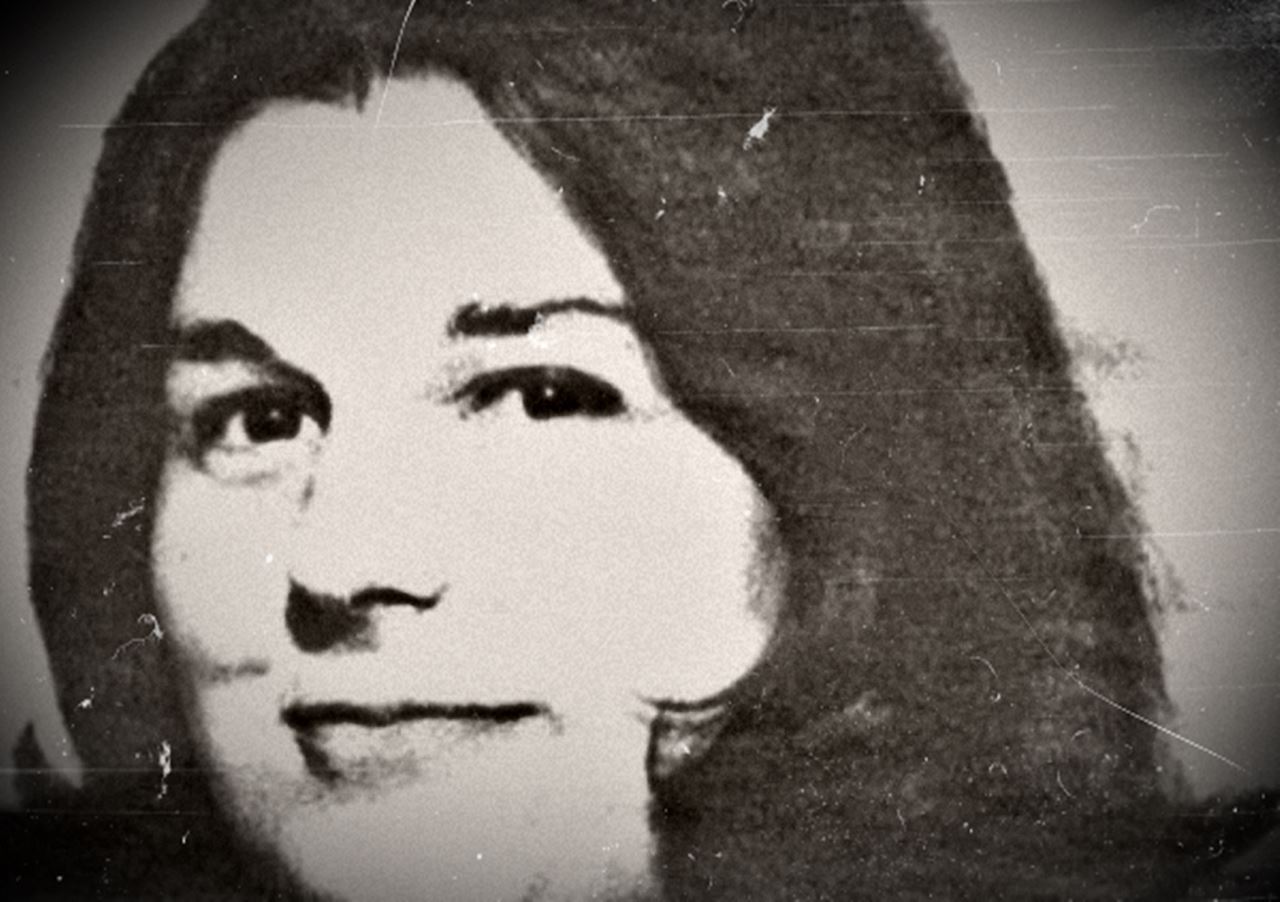
In September of 1973, a free-spirited young woman would meet a grisly end in a cemetery in small-town Derbyshire, England, and her murder would lead to what was initially considered to be one of the longest miscarriages of justice in Britain’s legal history, though complications have arisen in the case in the years since.
Thirty-two-year-old Wendy Sewell, a secretary at the Forestry Commission in the tiny hamlet of Bakewell, had something of a reputation among the townsfolk, to put it mildly, although this reputation may have been undeserved and largely fabricated by later (and possibly unreliable) sources. Though she was married, her relationship with her husband David was complicated, and she apparently made no secret of the numerous sexual affairs she engaged in. Unflatteringly dubbed “The Bakewell Tart” in the press, Wendy was said to leave a porch light burning to alert lovers when her husband was away, and allegedly had three different men claiming paternity of the son she eventually put up for adoption.
Evidently, she also enjoyed lunchtime trysts with her various boyfriends, and had a predilection for outdoor sex. So when Wendy received a phone call at the office at around noon on September 12th, 1973, coworkers knew the score, even before she openly told them that she was going out to meet her latest paramour. She was seen by a witness entering Bakewell Cemetery at approximately twelve-fifty p.m.
Ten minutes later, seventeen-year-old groundskeeper Stephen Downing left the cemetery to return to his mother’s house for his own quick lunch break. He later informed police that he had seen Wendy Sewell walking around behind the chapel, though he didn’t think much about it at the time.
A little less than half an hour later, Stephen rushed up to the graveyard gatehouse and banged on the door, telling the man within that a woman had been attacked inside the cemetery. Both Stephen and the other man, as well as three workmen who arrived at the scene at around the same time, quickly found Wendy Sewell, half-naked and covered in blood, but still alive. As they approached her, she got to her feet and then stumbled, hitting her head on a gravestone and knocking herself unconscious.
An ambulance arrived in short order and transported Wendy to Chesterfield Royal Hospital, but the young woman succumbed to her injuries only two days later. While initial reports suggest that Wendy had been raped and beaten in the head with the handle of a pickaxe, some later evidence exists to suggest that she may have been partially strangled as well.
Groundskeeper Stephen Downing was immediately suspected of the attack, mostly due to the fact that some of her blood was found on his clothes and hands. He initially told police that the blood had simply splashed on him when Wendy shook her head as he was trying to help her. But after Stephen was taken into custody and grilled for nine hours, he eventually signed a confession claiming that he had indeed raped Wendy, though at this point the victim was still alive, and he was charged only with assault. There was no solicitor present during the questioning, though Downing’s parents were apparently in attendance, and told him didn’t need one. Downing himself was mentally disabled, having the reading level of an eleven-year-old.
Once Wendy Sewell died from her injuries, the charges against Stephen Downing were elevated to murder, and at that point, Downing retracted his confession, claiming he was at home when the attack occurred. At his ensuing trial, though, he again freely admitted to the rape, but denied killing the victim, although he also conceded that he had been in possession of the murder weapon—the pickaxe handle—because he’d been using it to break up firewood. In his version of events, Wendy Sewell was already lying on the ground injured when he came across her, and he decided to take advantage of her in her vulnerable state. He also stated that he had only confessed the crime to the police because he didn’t think the victim would die.
After only an hour of deliberation, the jury found Stephen Downing guilty of murder, and he was sentenced to an indefinite term in prison, with a minimum of seventeen years, and no eligibility for parole.
In October of 1974, though, Downing applied for an appeal. He had found a new witness, a fifteen-year-old girl, who asserted that she saw Wendy Sewell alive and well after Downing had left the cemetery. However, the Court of Appeal found the girl’s testimony not credible; for one thing, the spot where she said she had been standing did not have an unobstructed view of the area where she claimed she saw Wendy, and what’s more, the witness later admitted that she was short-sighted. The Court of Appeal was also skeptical because the girl had been questioned shortly after the murder had first occurred, and at that point, she had not conveyed this information to police, and had no good reason as to why she had waited so long after Downing’s conviction to come forward. The appeal was rejected.
Stephen Downing subsequently spent the next twenty years in prison before his parents, in 1994, solicited the help of Don Hale, the editor of the local weekly newspaper The Mercury Matlock, to assist them in a campaign for Stephen’s release. It was this media push that cemented the idea of Wendy Sewell as “The Bakewell Tart” in the public mind, adding an unsavory stink of victim-blaming to the whole affair. Hale also found the murder weapon on display at a museum in Derby, and had it tested, making much of the fact that although Stephen Downing’s fingerprints weren’t on it, the palm print from an unknown individual was. However, since the pickaxe handle had been moved around for twenty years and touched by numerous people during that time, this so-called evidence didn’t really prove much.
Despite the flimsy nature of this new information, though, Downing’s case was referred to the Criminal Cases Review Commission in 1997, and in 2001, Downing was actually released on appeal, after having served twenty-seven years in prison. He was treated as something of a celebrity upon being freed, and received compensation totaling £750,000.
In 2002, his original conviction was overturned, with the decision of the Commission stating that Downing’s confession had been unreliable and perhaps somewhat coerced; that he had not had a solicitor present at his interrogation; and that he had not been formally cautioned about any statements he made being used against him. The Commission also cast some doubt on the blood evidence, using more modern forensic techniques, though some of the experts who gave testimony still believed that the blood spatter pattern suggested that Downing had indeed attacked Wendy Sewell. In his decision to overturn the conviction, however, The Rt Hon. Lord Justice Pill stated that the purpose of the Commission was not to determine whether Downing was innocent of the crime, but whether the original conviction was fair, which in his opinion it was not.
Following the overturning of Downing’s conviction, the Derbyshire police reopened the investigation, interviewing more than a thousand witnesses and persons of interest, many of whom were put forward by Don Hale. During the inquiry, twenty-two possible suspects—including Stephen Downing’s father Ray—were looked into, but all were subsequently eliminated. Stephen Downing was the only remaining suspect who could not be eliminated, in fact, though he refused to be interviewed.
New forensic evidence suggested that Downing may have been guilty of the crime after all, and he had also allegedly confessed to the murder three times since his release: twice to his father, and once to his then-girlfriend, who had actually captured the confession on tape. But because of the double jeopardy laws then in place, Downing would not have been able to be tried again for the same crime, so after an independent committee found that the police investigation had been rigorous and fair, the case was deemed closed, as all suspects barring Downing had been eliminated, and Downing could not be retried. Police also considered bringing charges against Don Hale for inaccurate information he had put forward in the media and in his book Town Without Pity, but in the end, they decided against it.
In late 2007, Downing’s father Ray, then seventy-three years old, was convicted of raping a mentally disabled seventeen-year-old girl, and was sentenced to eight months in prison. Ray Downing, it turns out, had a history of this type of behavior, comprising thirteen counts of indecent assault against three grown women and three teenage girls in incidents taking place between December of 2000 and February of 2003. He died in 2008 while awaiting trial on an attempted rape charge.
In 2004, meanwhile, Stephen Downing was arrested on charges of intimidating a witness in his own murder case. A year later, the double jeopardy law was changed, and police considered reopening the Wendy Sewell homicide and putting Stephen Downing back on trial. In the end, though, despite the pleas of Wendy’s widower David, authorities decided there was insufficient evidence to charge the suspect again.
In 2008, Stephen Downing was again arrested, this time for impersonating a police officer, a crime for which he paid a fine of £1,062.
Over the years, some researchers have put forward the theory that Stephen Downing was innocent of the murder, and that Wendy Sewell was in fact a victim of notorious serial killer Peter Sutcliffe, better known as the Yorkshire Ripper. Derbyshire police, however, discount these claims entirely, and reiterate that Stephen Downing is the only suspect in the crime who has not been ruled out.
The brutal rape and murder of Wendy Sewell, therefore, remains officially unsolved.
 Crime Immemorial
One thought on “Wendy Sewell”