
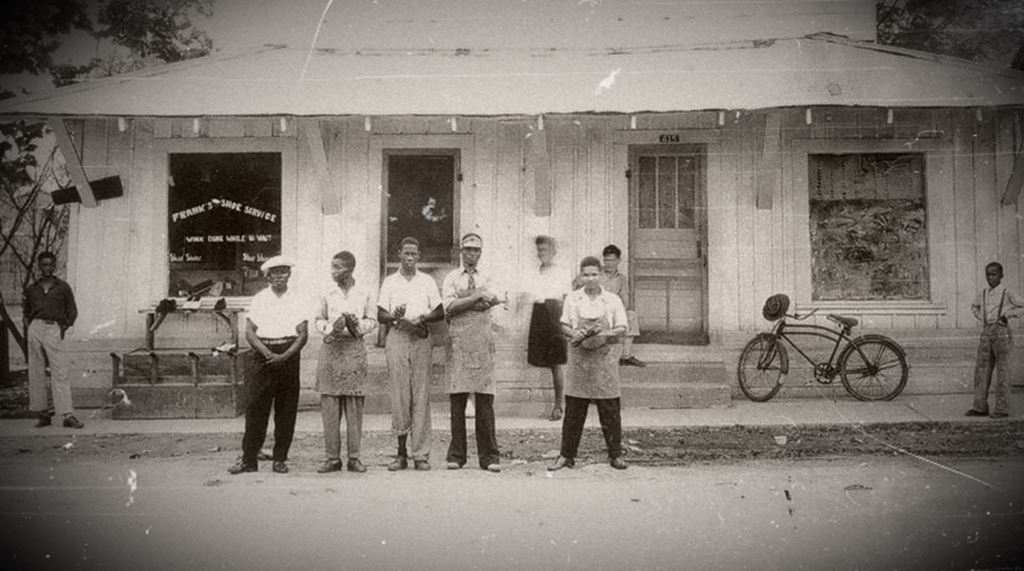
Fifty-one-year-old Frank Morris owned a shoe repair and dry goods shop in the poverty-stricken town of Ferriday, Louisiana, and also lived in a small room in the back of the store. He was a well-liked and respected businessman in the area, catering to both black and white customers who appreciated his fine handiwork and his pleasant and professional manner. In addition, he also hosted his own gospel radio program.
Between one and two a.m. on the morning of December 10th, Frank was awakened by the sound of glass breaking, and went to the front of the business to investigate. Once there, he was confronted with the terrifying sight of two white men standing outside of his shop; one of them was pointing a single-barreled shotgun at him.
As Frank watched, the two perpetrators proceeded to break all of the shop’s windows and pour gasoline all around the perimeter of the building. Frank tried to make a break for the door, but the man with the gun forced him to stay put, saying, “Get back in there, nigger.” The men lit matches and tossed them through the windows while Frank was still trapped inside. The store subsequently exploded, and the attackers ran off.
Frank managed to escape through a back door, but not before he was severely burned over the entirety of his body. When police officers arrived, they found Frank Morris with his hair and clothing still ablaze and his skin peeling off, leaving bloody footprints as he struggled to distance himself from the scene.
Frank was rushed to the nearest hospital, where he languished in agony for a few days. Police officers and FBI agents questioned him several times about the attack, but he claimed he only vaguely recognized the men, and that they may have worked in Natchez, Mississippi. He described them as small, between thirty and thirty-five years old, and wearing khaki pants. One of them, he said, had grayish hair, despite looking rather young.
Sadly, Frank Morris succumbed to his injuries on the evening of December 14th, having provided no further information to authorities.
Investigators questioned local residents, employees and customers of Frank’s shop, as well as several known KKK members in the vicinity. They also conducted extensive searches of the murder site, analyzing whatever physical evidence they came across, which included part of Frank Morris’ finger. Apparently, none of the evidence collected proved to be of any use in apprehending a suspect.
Though Frank Morris had not been involved in any sort of civil rights activities that might have made him a particular target of the Klan, the FBI was still operating under the assumption that one or more Klan members were likely responsible for the murder. There were even allegations that the two police officers who had responded to the fire were in on the murder conspiracy, and deliberately did not show up until the conflagration was already burning out of control.
After several months passed and no progress was being made, the FBI closed the case.
Significant developments prompted the investigation to be reopened some time later, however, as the FBI attempted to link Frank Morris’ death with the car bombing that killed Wharlest Jackson in 1967, a crime that took place in Natchez, Mississippi. According to FBI records, a source named O.C. Poissot informed them that four members of the Ku Klux Klan—E.D. Morace, Tommie Lee Jones, Thor Lee Torgerson, and James Lee Scarborough—had participated in the murder of Frank Morris. A fifth man, Deputy Frank DeLaughter, was also named in FBI documents.
Though two other anonymous witnesses supposedly came forward and corroborated the allegation that at least one of the men, E.D. Morace, had admitted to his part in the killing, all four men denied involvement under questioning by the FBI, and since investigators had no physical evidence linking them directly to the crime, they were never charged with any wrongdoing.
The murder of Frank Morris, along with many others, was reopened in 2007 in response to the passage of the Emmett Till Unsolved Civil Rights Crimes Act. However, by this time, all five of the suspects named in the earlier investigation were deceased, and at that point, the FBI petitioned to close the matter once and for all.
However, independent organizations such as the Civil Rights Cold Case Project, consisting of journalists, lawyers, and other interested parties, have attempted to keep the case of Frank Morris and others alive by pursuing their own investigations. Journalist and editor Stanley Nelson, in 2011, announced that he had uncovered another compelling—and as of 2011, still living—suspect in the crime, a Klansman named Arthur Spencer. Spencer was apparently given a polygraph in the late 1960s which indicated that he was being deceptive, and an unnamed source told the FBI that Spencer had participated in the arson along with the previously named O.C. Poissot. Both men denied the accusations.
Further, in 2016, Nelson published a book titled Devils Walking: Klan Murders along the Mississippi in the 1960s, in which he detailed the theory that Deputy Frank DeLaughter was the man who had organized the arson, alleging that the police officer lied about his whereabouts at the time of the crime. Another Ferriday officer, William Howell Harp Jr., stated that Frank Morris had been selling drugs and bootlegging out of his shop, though the evidence that pointed to this may have been planted. Some residents of Ferriday speculated that Frank Morris had been murdered because he freely spoke to white women and may have been having an affair with a married white woman, though again, these were local rumors. The City of Ferriday looked into these later leads, but got nowhere, and the case died on the vine once again.
Suspect O.C. Poissot passed away in 1992, and Klansman Arthur Spencer died in 2013, before any further investigation into their involvement could be performed. The arson and murder of Frank Morris, therefore, remains another unresolved tragedy of the civil rights era.
 Crime Immemorial
One thought on “Frank Morris”