
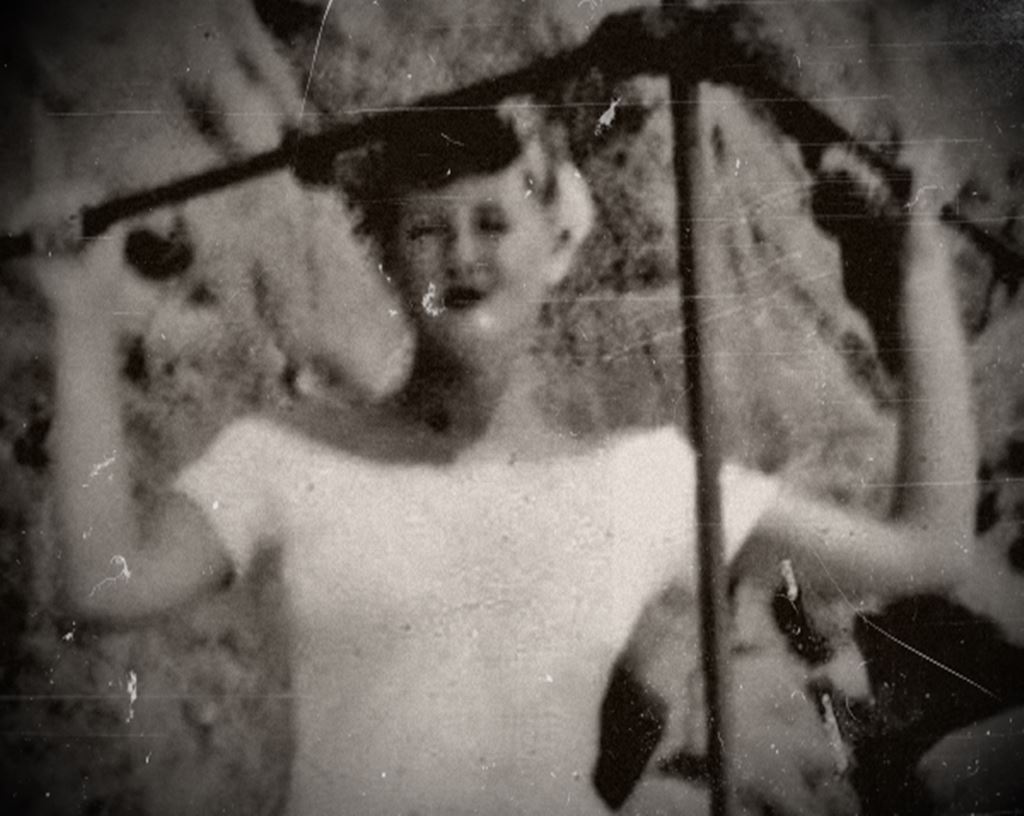
As the summer of 1954 faded into early fall, England would see a young woman fall victim to a faceless assailant in the night-time city streets. Jean Townsend was twenty-one years old, and worked as a costumer for many of the theaters around London’s famed West End. On the evening of September 14th, Jean had been at a party with some friends in the theater district, and left the function well before midnight in order to catch the last train back to South Ruislip, Middlesex, where she lived with her parents.
Witnesses reported seeing Jean disembark from the train at Ruislip station at around eleven-forty-five p.m., and subsequently saw her begin the walk down Victoria Road toward her home on Bempton Drive. She would never be seen alive again.
The following morning, a workman discovered the body of Jean Townsend lying on a patch of waste ground near the intersection of Victoria Road and Angus Drive. Like Olive May Bennett the previous April, Jean had been strangled with her own scarf. Though her underwear was found to be missing, a later examination would determine that she had not been sexually assaulted, leading authorities to speculate that perhaps she had been killed during the course of an attempted rape, though her outer garments did not appear to be disordered.
During the course of the investigation, neighbors claimed that they had heard a woman crying for help shortly before midnight, and that they had also heard two male voices arguing, one of which was said to have an American accent. Suspicions arose that the attacker was an American serviceman stationed at the South Ruislip Air Station, which was only a short distance away. Because the USAF was perceived by the locals to be stonewalling when police approached them to aid in the investigation, rumors began to circulate that someone at the Air Force base had an idea who the killer was, but was reluctant to give him up.
A handful of other women came forward in the ensuing days to claim that they themselves had been approached or attacked by a suspicious man with an American accent and an American-style automobile; interestingly, all of these women separately described a man with a “high forehead.” There was also some speculation that the perpetrator might have been the same man who had murdered a London prostitute named Ellen Carlin only a few weeks previously; the last time Ellen Carlin was seen alive, she was reportedly accompanied by a man in a United States Air Force uniform.
Despite a massive investigation and a plethora of promising leads, the case soon hit a wall, and no further progress was made on what the press deemed the “Pyramid Girl Murder” until decades later. In 1982, a series of anonymous phone calls to the Metropolitan Police prompted the Jean Townsend case to be reopened, and though no arrests were made as a result of the supposed new evidence, authorities did report that as a result of investigating the phone calls, they were confident that the killer was not an American serviceman, though they did not elaborate as to why they had come to believe this.
Some later investigators who looked into the case also speculated that Jean Townsend might have been a victim of notorious Scottish serial killer Peter Manuel. Though there was no evidence linking him directly to the crime, it was almost certain that he was in the South Ruislip area at around the time that Jean was murdered. Peter Manuel was convicted of seven murders and executed in 1958, though he was a suspect in several more killings across Scotland and England.
 Crime Immemorial
One thought on “Jean Townsend”