
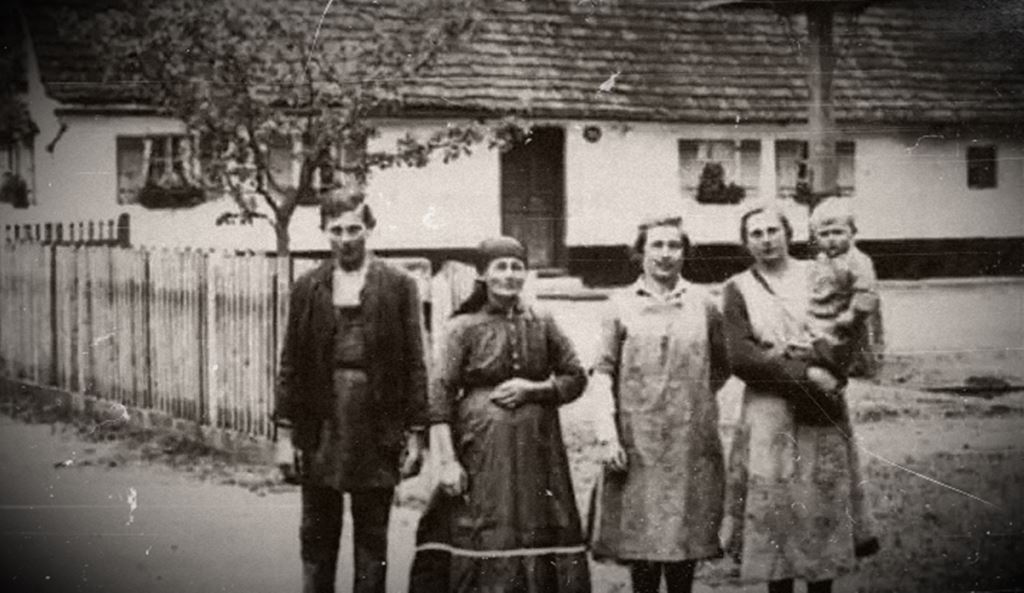
In the spring of 1922, a shocking crime occurred that would capture the public imagination for decades to come, mostly due to its deeply unsettling details that were seemingly ripped straight out of a horror movie.
On a remote Bavarian farmstead known as Hinterkaifeck, forty-three miles north of Munich, lived the Gruber family, consisting of father Andreas, his wife Czilia, their widowed daughter Viktoria Gabriel, and Viktoria’s two children, seven-year-old Czilia and two-year-old Josef. The Grubers were fairly affluent, and well-known around their small community, though not for particularly admirable reasons. Andreas Gruber, it was rumored, routinely beat his wife, and allegedly had an abusive and incestuous relationship with his thirty-five-year-old daughter Viktoria. It was whispered that Andreas—and not Viktoria’s husband, who had been killed in World War I—was Josef’s biological father.
A few months prior to the crime that would make their farmstead famous, the family’s housemaid had abruptly quit, stating that she believed the farm was haunted. She came to this conclusion because she often heard furtive footsteps up in the attic, and found that sometimes objects were moved from their regular places when no one had been around to move them. The Grubers apparently had not noticed anything strange going on around the house, and felt that the maid was likely imagining things.
In March of 1922, however, the family members themselves started to get a taste of what the maid had been talking about. Andreas Gruber told a couple of his neighbors that he had also been hearing footsteps in the attic, but that no one was up there when he went to investigate. Even more chillingly, he had seen footprints in the snow that led from the woods to the back door of the house, but could see no corresponding footprints leading back out to the woods.
He had also found a newspaper in the kitchen which no one in his family had purchased, and noted that the lock on the shed outside appeared to have been tampered with. Further, the house keys had mysteriously gone missing.
As odd as all this was, the Grubers apparently were not alarmed enough to contact the authorities, which in hindsight would prove to be a grave mistake.
On Friday, March 31st, the new maid that the family had hired finally arrived. Her name was Maria Baumgartner, and upon arriving at the farm, she wasted no time in getting her bearings and setting herself up in her quarters. But unbeknownst to Maria, her first day on the job was also to be her last.
Townsfolk didn’t become suspicious until the following Tuesday, April 4th, when they realized that they hadn’t seen any of the Grubers for several days, and that little Czilia had failed to show up for school. The police were summoned, and they walked into an unbelievably gruesome scene.
In the livestock barn, investigators discovered the bodies of Andreas and his wife, along with Viktoria and her daughter Czilia. They had all been bludgeoned with a mattock, an implement similar to a pickaxe. It also appeared that Czilia had actually survived the initial attack, for clumps of her own hair were found clutched in her fists, as though she had torn it out in anguish as she lay in the barn alongside the corpses of her mother and grandparents.
Inside the main house, police also found new maid Maria Baumgartner and the two-year-old Josef battered to death with the same weapon. It was assumed that the killer had somehow lured four of the Grubers out to the livestock barn and killed them one by one before retreating to the house and killing the maid and the little boy while they slept. Forensic evidence suggested that the murders had taken place on Friday night.
Naturally, robbery was suspected at first, but investigators found substantial sums of money and valuables left untouched in the home, making that motive unlikely. Even more bizarre than the apparent purposelessness of the crime was the fact that the perpetrator had apparently remained around the farmstead over the weekend: neighbors reported that the cattle had been fed, the dog had been let out, and smoke had been seen coming from the chimney long after the Grubers were dead. Police also found evidence that someone had prepared and eaten a few meals in the kitchen in the days following the slayings.
Since neighbors remembered Andreas telling them of the mysterious footprints and newspaper found around the home, and since it was thought that the former maid had quit because of the footsteps she constantly heard in the attic, investigators wondered if whoever had murdered the Grubers had actually been lurking around the farm, or perhaps even secretly living there, for quite a while. If that was the case, though, they were baffled as to why this elusive boarder had suddenly snapped and massacred the entire family.
The police questioned dozens of suspects, including vagrants, traveling salesmen, and locals alike, but despite their best efforts, they got no closer to finding the culprit. For a time, it was even hypothesized that Viktoria’s husband Karl Gabriel had not actually been killed in the war and was in fact responsible for the horrific crime. However, although Karl’s body was never found, there were enough witnesses to his death in battle that this theory was considered fairly unlikely. No other reasonable suspects were ever brought to light.
The Hinterkaifeck farm was later torn down and a memorial put in its place. Over the ensuing decades, numerous people have attempted to crack the case, and at one point the victims’ skulls were even sent to a psychic to see if any useful information could be obtained, but it was all to no avail. The grisly slaughter of the Gruber family remains one of the eeriest unexplained crimes of the twentieth century.
 Crime Immemorial