
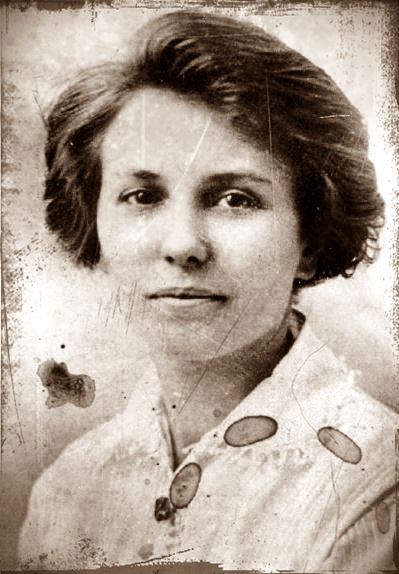


In the early fall of 1922, a scandalous case in New Jersey would gin up all the tabloid fodder an eager public could possibly wish for: a double murder, a salacious affair, and the possible involvement of a wealthy and jealous spouse. In fact, prior to the Lindbergh kidnapping of the 1930s, this particular case was easily the biggest media sensation in the United States, and to this day, it’s known simply as the Hall-Mills Murder.
On September 16th, 1922, a couple was out for a stroll in a field in Somerset, New Jersey when they stumbled across a shocking tableau: two dead bodies lying in the shade of a crab apple tree. Both victims lay on their backs, and both had been shot in the head.
The man had a hat poised over his face and a calling card propped against the bottom of his shoe. The woman had a brown silk scarf tied around her neck. Whoever killed the pair had grotesquely posed them, with the man’s hand resting tenderly on the woman’s neck, and the woman’s hand lightly touching the man’s right thigh. Pieces of torn love letters were scattered between the corpses.
Soon enough, the victims were identified as Episcopal priest Edward Wheeler Hall, and a singer in the church choir named Eleanor Reinhardt Mills. Both were married, but the fact that they had been having an affair for quite some time was apparently an open secret around the town of New Brunswick, New Jersey, where they both lived.
News of the murders traveled fast, and curious locals were soon trampling all over the crime scene and hampering the investigation. Despite the circus, authorities were able to determine that Edward Hall had been shot once in the head with a .32 caliber pistol, while Eleanor was shot three times in the head and face with the same weapon. Eleanor’s throat had also been cut, and the presence of maggots in the wound demonstrated that the couple had been killed more than twenty-four hours before their bodies were discovered. During a later autopsy, it was also found that Eleanor’s tongue and larynx had been cut out.
Because of the nature of the crime, and because someone had torn up Edward and Eleanor’s love letters and scattered the fragments between the bodies, the motive was immediately thought to be jealousy on the part of one of the lovers’ spouses. Unfortunately, forensic evidence at the scene had been compromised by onlookers, some of whom went so far as to carve their initials into the crab apple tree under which the corpses had been found. The calling card at Edward’s feet had also been passed from hand to hand, making any identification of the killer’s fingerprints impossible.
While Eleanor’s husband James certainly could have been a suspect, it appears that police believed Edward’s wife, Frances Noel Stevens Hall, was the true culprit. She was seven years Edward’s senior, and it was perceived around town that he had simply married her for her considerable fortune. Investigators theorized that Frances had recruited her brothers Henry and William Stevens into her plot to get rid of her husband and his young paramour once and for all.
Strengthening this hypothesis was the testimony of Jane Gibson, on whose hog farm the bodies had been found. Unflatteringly dubbed “Pig Lady” by the press, Jane Gibson told police that on the night of September 14th, she had overheard two men and two women arguing in a parked car on her property, then afterward heard gunshots and a woman’s voice screaming, “Henry!”
Though the media had an absolute field day with all the sordid details, covering the crime with the same breathless drama that would be a tragic hallmark of the stories surrounding the Lindbergh kidnapping a decade later, when the Hall-Mills murder case came before a grand jury, no indictments resulted.
In fact, it would be four more years before there would be further developments in the investigation. In 1926, a man named Arthur Riehl, whose wife Louise Geist had once worked as a maid in the household of Edward and Frances Hall, told police that Louise had overheard Edward’s plans to run away with Eleanor Mills and had subsequently taken a bribe of $5,000 to keep quiet about a planned plot by Frances Hall and her brothers and cousin to murder the illicit lovers.
Frances Stevens Hall and her two brothers stood trial in early November of 1926. Frances’s other alleged co-conspirator, her cousin Henry de la Bruyere Carpender, was scheduled to be tried separately at a later date.
Among the star witnesses was the Pig Lady herself, Jane Gibson, who was by then suffering from cancer and gave testimony from a hospital bed that was wheeled into the courtroom. However, neither the jury nor Jane’s own mother, who was also present at the trial, found the ill woman terribly credible, and of course it didn’t help that any definitive evidence that might have been left at the scene had been tainted by the carnival atmosphere at the time the bodies were discovered.
It only took five hours for the jury to acquit Frances and her brothers, while cousin Henry never stood trial at all. Thereafter, the case passed into the category of the “officially unsolved.”
Most researchers who have studied the case believe that Frances Hall likely was responsible for murdering her husband and his mistress, though a few other suspects have been put forward over the years, including Jane Gibson herself. In 1964, attorney William Kunstler surmised that Edward and Eleanor had actually been murdered by the Ku Klux Klan as a sort of indictment of immorality in general, though this hypothesis seems farfetched, and hinges almost entirely upon the KKK being particularly active in that area of New Jersey at the time.
The Hall-Mills murder case went on to inspire several novels and films, and may have even been the inspiration for the murder that took place in F. Scott Fitzgerald’s classic novel, The Great Gatsby.
 Crime Immemorial