
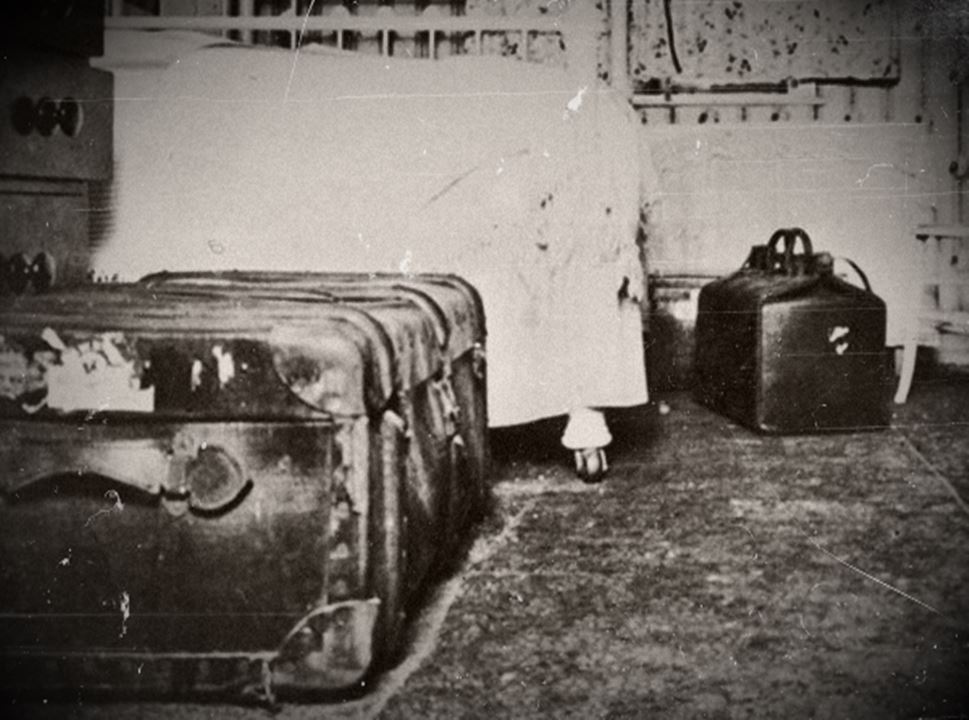
In England in the 1920s and 1930s, there was a small but horrific trend in a very particular type of crime, in which murder victims were dismembered and stashed inside trunks, some of which were discovered at train stations. Though these murders were ultimately found to be unrelated, the bizarre series gave the seaside town of Brighton the temporary but dubious distinction of “The Queen of Slaughtering Places,” even though the first crime in the set actually took place about fifty miles away, in London.
On May 10th, 1927, the first homicide in the so-called Brighton Trunk Crimes sequence would occur and serve as something of a template for the handful of crimes to follow. On that late spring day, workers at the Charing Cross train station in London were alerted to a foul odor emanating from a large, black trunk in the unclaimed luggage department. Upon opening the trunk, staff members discovered to their horror that it contained the remains of a dismembered woman, whose body parts had all been separately wrapped in brown paper and tied with string. The victim’s purse and shoes were also found with the body, along with some other items of clothing.
Forensic pathologist Sir Bernard Spilsbury was brought in to perform the post-mortem on the remains. Spilsbury, as it happened, was already well known in investigative circles for consulting on the infamous 1910 case of murderer Dr. Hawley Harvey Crippen, who was hanged for poisoning his wife and concealing her body beneath the floor of his basement. According to Spilsbury, the woman in the trunk at the Charing Cross station had likely been dead for approximately two to three weeks by the time she was found. He further concluded that the victim was probably in her thirties, and had been suffocated to death.
A laundry tag on one of the pieces of clothing found inside the trunk led police to the Chelsea residence of a woman named Mrs. Holt, who informed investigators that the body in the trunk belonged to a woman who had once worked for her as a cook. This woman went by the name of Mrs. Rolls, though her real name was found to be Minnie Alice Bonati. Mrs. Holt went on to say that Minnie had left her Italian husband sometime before, and made ends meet by working as a domestic servant and supplementing her income through prostitution. Minnie had been living with a man named Mr. Rolls and had been using his name.
As detectives looked into these claims, they ended up in Westminster, and particularly focused on a thirty-five-year-old man named John Robinson, who rented two rooms on a street called Rochester Row. Robinson had been operating as an estate agent out of these rooms but had told his landlord that he had gone bankrupt and subsequently left his offices on May 9th, the day before Minnie Bonati’s dismembered body was discovered.
According to a taxi driver, John Robinson had hired a cab to carry a trunk to Charing Cross station from his office on May 6th, 1927, and a shop owner also confirmed that John Robinson had purchased a large, black trunk from his store right around the same time period.
Upon a search of Robinson’s rental, police found that the entire flat had been scrupulously cleaned, but a closer examination uncovered a small amount of blood on a matchstick in the garbage can. Further heightening the investigators’ suspicions was an item of clothing that had been found in the trunk with the body; this was a duster-type coat that bore a label reading Greyhound. Robinson’s wife worked at a Hammersmith hotel called the Greyhound. John Robinson was brought into Scotland Yard and questioned about the murder of Minnie Bonati.
Not too long into the interrogation, Robinson confessed that he had picked up a woman at Victoria Station and taken her back to his rooms on Rochester Row. He told police that the woman had demanded a large sum of money from him, but that after he refused to give it to her, she violently rushed at him. Robinson then claimed he had shoved the woman in self-defense and that she had consequently fallen and struck her head on a chair. Believing she had only been knocked unconscious, he left her there, but upon returning the following day, found that she was dead. Not sure what else to do, and thinking that no one would believe that the death was “accidental,” he bought the trunk and a knife, cut up her body, placed it in the trunk, and abandoned it at the Charing Cross station.
Bernard Spilsbury thought Robinson’s claims unlikely, arguing that Minnie Bonati could not have died from a fall against a chair as the suspect claimed, but had probably been strangled or smothered. He pointed particularly to bruises found on the victim’s chest, which indicated that someone had possibly knelt on top of her while forcing the life from her body. Police agreed with Spilsbury’s assessment, and John Robinson was arrested on May 23rd and charged with murder. He was ultimately found guilty, and hanged on August 12th, 1927.
Although this particular slaying—known in the annals of crime as the Charing Cross Trunk Murder—was quickly solved, the next similar incident would have a much more ambiguous outcome, and remains unresolved to this day, though the investigation into it would result in the discovery of yet a third trunk-related killing.
On June 17th, 1934, a cloakroom clerk at the Brighton railway station named William Vinnicombe noticed an unpleasant smell originating from the unclaimed luggage room. Following his nose led him to a plywood trunk that had been abandoned at the station eleven days previously. He contacted the police to deal with the matter.
Much like the Charing Cross case from seven years earlier, detectives opened the trunk and discovered the torso of a young woman, wrapped and tied with a cord, and concealed beneath bloodied layers of paper and cotton batting. Hoping to locate the rest of the body, authorities contacted other train stations across the country, asking them to check for any suspicious unclaimed baggage. At the King’s Cross station, workers discovered a suitcase containing a pair of legs that were found to correspond to the dismembered torso. Unfortunately, despite a thorough search, the woman’s arms and head were never found. Shortly following the discovery of the second trunk, the press dubbed the victim “The Girl with the Pretty Feet,” and speculated that she might be a dancer.
It was quickly determined by pathologist Sir Bernard Spilsbury that the woman in the trunk was about twenty-five years old, stood around five-foot-two, and had been five months pregnant at the time of her death. The only other clue to the possible identity of the woman or her killer was a piece of paper in the trunk containing her torso, which simply read, “Ford.”
Because of the victim’s pregnancy, Chief Inspector Robert Donaldson suspected a local abortionist by the name of Massiah, and had the man placed under surveillance. Massiah, however, was never charged with any crime, and eventually retired in Trinidad in 1952. Bernard Spilsbury, for his part, did not seem to subscribe to the abortion angle, as he saw no evidence that the victim’s pregnancy had been tampered with. He further noted that the dismemberment had not been very skillfully executed, and wouldn’t necessarily have required anyone with specialized medical knowledge to perform.
In later years, some researchers put forward the theory that the unidentified victim was murdered by George Everard Shotton, who was the prime suspect in the 1919 disappearance of his wife Mamie Stuart in a case known as the Chorus Girl Mystery. Mamie’s body wasn’t found until 1961, by which time her husband was already dead, though he was posthumously found guilty of her murder in December of that same year.
The meager leads in the first Brighton trunk crime, meanwhile, soon dried up, and not only was this murder never solved, but the dismembered woman’s identity was sadly never established. In an almost unbelievable coincidence, however, the investigation into the unknown woman’s death actually uncovered another murder whose victim was stuffed in a trunk, though this case had a somewhat more concrete resolution.
In their quest for information about the torso in the trunk, police were searching all the houses within a few miles of the Brighton railway station, and on July 15th of 1934, in the house located at 52 Kemp Street, they noted an unmistakable odor coming from a bedroom. Tracing the smell to a trunk at the foot of a bed, investigators opened the lid, only to discover the dead but still intact body of a woman.
It didn’t take long for the victim to be identified as forty-two-year-old Violette Kaye, a dancer and sex worker who lived in Brighton with her much younger lover, twenty-six-year-old Toni Mancini. Mancini, who worked as a bouncer and waited tables, had a criminal record for minor charges such as loitering and theft. He’d also operated under several different aliases, such as Jack Notyre, Tony English, and Hyman Gold. His real name, detectives discovered, was Cecil Louis England. He and Violette had lived as a couple since 1933, at various addresses.
When investigators began delving into his relationship with Violette, numerous red flags began to appear. According to witnesses, the pair’s romance was rocky, and on May 10th of 1934, there had been a violent argument between them that took place in front of the Skylark café, where Mancini worked as a waiter. Violette, who was reportedly drunk, accused Mancini of having an affair with a teenage coworker named Elizabeth Attrell; after this altercation, Violette was evidently never seen alive again.
Even more suspiciously, on the following day, Toni Mancini told several acquaintances that Violette had left him and gone to Paris. Mancini even gave some of Violette’s belongings to Elizabeth Attrell, and wrote a postcard to Violette’s sister-in-law that simply read, “Going abroad. Good job. Sail Sunday. Will write. —Vi.” It was later established that this postcard had been written after Violette was already dead.
Before Violette’s body was found in the trunk, Toni Mancini had been questioned about her disappearance and had subsequently attempted to skip town. He was picked up in South East London in short order, however, and once Violette’s remains were discovered at the Kemp Street address where Mancini had been living, he was charged with the murder. It turned out that Mancini had simply thrown a cloth over the trunk containing the body and had been using it as a coffee table for two months, despite the overwhelming stench causing complaints from guests who visited him.
Toni Mancini was put on trial on December 10th of 1934. Mancini’s lawyer argued that Violette Kaye had been an alcoholic and a heavy morphine user, and could have fallen in a drunken stupor, after which Mancini unwisely decided to conceal her body rather than report her “accidental” death to authorities. Though this explanation seemed a tad farfetched, it apparently introduced enough reasonable doubt in the minds of the jury, and Mancini was acquitted only four days after the trial began.
Decades later, in 1976, a then-sixty-eight-year-old Mancini came forward and confessed that he had killed Violette, but that he had done so inadvertently during a particularly violent argument in which Violette had been the instigator. Since it was ruled that he could not be tried for the crime again, he remained a free man and died not long after making this pronouncement. His guilt or innocence was never established with any certainty, and no evidence was ever uncovered linking him with the earlier trunk murder of “The Girl with the Pretty Feet,” whose murder has never been solved.
The fact of three unrelated murders coming to light due to the weirdly specific circumstances in which the bodies were found is certainly a fascinating historical anomaly, and probably unprecedented in all of the records of British crime. Incidentally, there was a much earlier Brighton trunk crime that had been all but forgotten until the 1930s murders brought it back into the spotlight. In that case, which occurred in 1831, a man named John Holloway murdered his wife Celia, who worked as a painter on the Chain Pier, then stuffed her body into a trunk which he then buried in Preston Park. Holloway was ultimately found guilty, and hanged in December of 1831.
 Crime Immemorial
The picture used is actually from the bungalow where Emily Kaye was murdered and dismembered by Patrick Mahon in April 1924. It was near Pevensey. I have seen the original photograph and it is clearly labelled as such. Violet’s real surname was Saunders and she was 41 on death. Mancini sent the telegram to Violet’s sister (not sister in law) Olive Watts.