
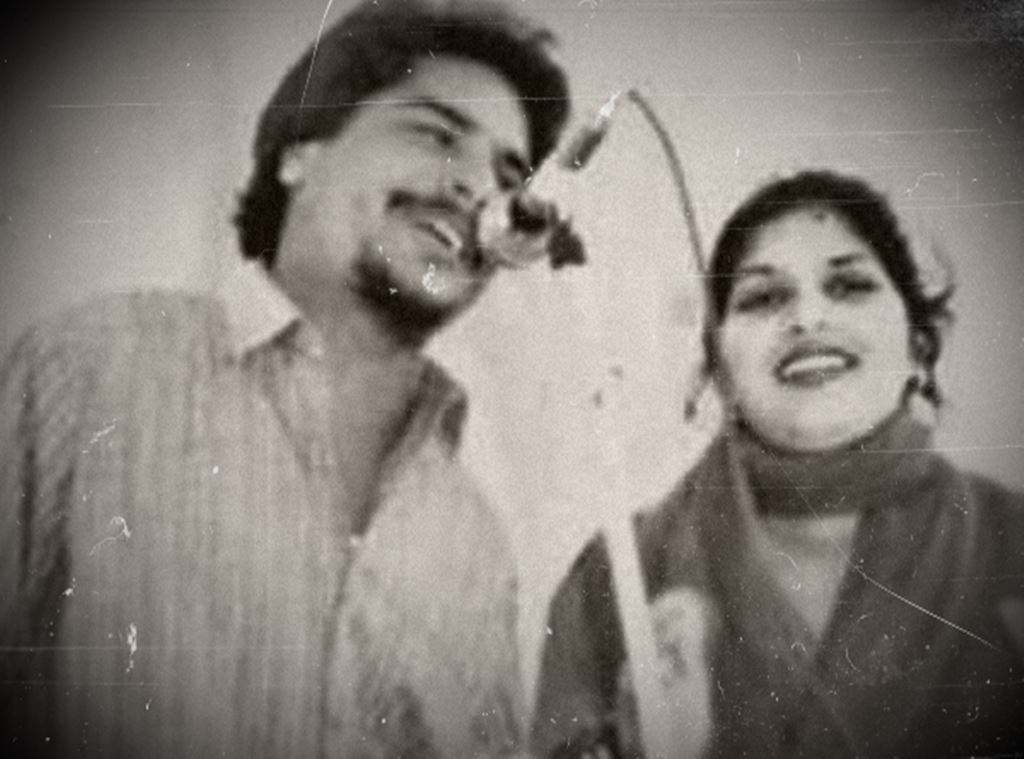
In March of 1988, in northern India, a crime took place in broad daylight on a crowded street and claimed the lives of four people, including one of the most famous singer-songwriters to ever emerge from Punjab.
It was around two p.m. on the afternoon of March 8th, 1988, and Amar Singh Chamkila, his wife and singing partner Amarjot Kaur, and their entourage arrived by van for a performance in the village of Mehsampur in Jalandhar. Amar, who had been born Dhanni Ram and had originally wanted to become an electrician before going into music, had a meteoric rise to fame in the early 1980s, writing and singing dozens of songs and duets; touring Dubai, Bahrain, Canada, and the United States; releasing several best-selling folk albums; performing up to three live shows a day at times; and having his music appear in several Punjabi films.
Though much of the popular music of the region during this period was still based around traditional themes, Amar broke the mold and sang about more down-to-earth topics, delving into the problems of drug abuse and alcoholism, extra-marital affairs, and the sometimes toxic masculinity of Punjabi culture. His lyrics were considered rather bawdy and full of double entendres, which more conservative interests did not approve of in the slightest. The youth at the time ate it up, though, easily relating to Amar’s soulful voice and heartfelt lyrical examination of day-to-day life; the singer is still widely known, in fact, as “The Elvis of Punjab.”
His popularity, though, clearly had its downside, and indeed might have been one of the factors that ultimately put a target on his back. The early 1980s were a time of great strife in the Punjabi region, with the Khalistan movement of Sikh separatists agitating for their demands and sometimes perpetrating assassinations and terrorist-style attacks; honor killings and murders undertaken by police officers were also fairly commonplace. Amar Singh Chamkila had received regular death threats throughout his career, mostly down to the so-called objectionable nature of his lyrical content, as well as his far-reaching fame.
On March 8th, it seemed that whatever powers were conspiring against Amar finally had their revenge. As he, his wife, and his band members exited their van in Mehsampur in front of the venue where they were set to perform, a gang of youths on motorcycles sped by and began firing at them with AK-47s. Twenty-six-year-old Amar was struck in the chest and died at the scene, as did his wife and duet partner Amarjot, another musician in Amar’s band, Harjit Singh Gill, and one other member of the couple’s entourage. According to survivors of the massacre, several fans who had been waiting to enter the venue for the show attempted to chase down the killers on foot, but were unsuccessful.
Over the years, the appalling quadruple homicide has been the subject of much debate, and several conspiracy theories have emerged as to who could have perpetrated the slaughter. Some have proposed that Amarjot’s family was responsible, and that their motivation stemmed from their shame that Amarjot had married someone of a lower caste. Others have speculated that either Khalistani militants or Punjabi police engineered the assassination, as they harshly disapproved of the subject matter of Amar’s songs. Yet a third hypothesis holds that rival musicians or disgruntled music promoters might have had it in for Amar due to jealousy or professional rivalry, and may have taken extreme measures to address their grievances. Despite all the conjecture, however, the case remains cold.
A strange mockumentary about the murders, directed by Kabir Singh Chowdhry and called Mehsampur, was released in 2018, winning the Grand Jury Prize for Best Film at the Mumbai Film Festival.
 Crime Immemorial