
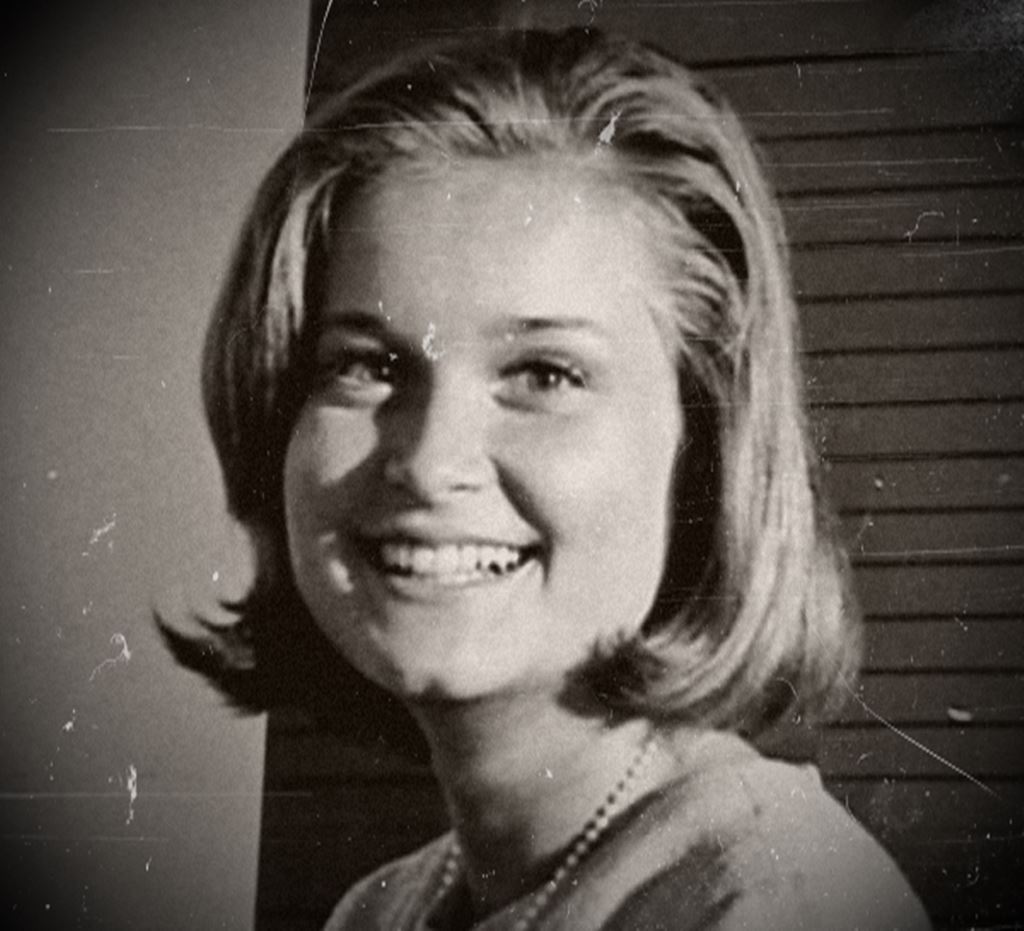
It was very early on the morning of September 18th, 1966. All was quiet in the posh, stately Kenilworth home of the Percy family, occupied by Bell & Howell executive and U.S. Senatorial candidate Charles Percy, his second wife Loraine, and his five children, three of whom were a product of his first marriage to Jeanne Dickerson, who had died in 1947.
At around five a.m., Loraine was awakened by what sounded like moaning coming from the bedroom of her twenty-one-year-old stepdaughter Valerie, a Cornell University graduate who was also, incidentally, the manager of Charles Percy’s Senatorial campaign. Loraine got out of bed without waking her husband and crept down the hall to check out the noise.
Upon opening the door of Valerie’s bedroom, she was terrified to see a shadowy figure hunched over Valerie’s supine form, shining a flashlight onto the bed. When the intruder realized that Loraine was standing in the doorway, he turned the flashlight beam toward her face, partially blinding her. Panicked, Loraine ran back to the master bedroom, hitting the lights and a rooftop fire alarm along the way, and screaming at her husband that there was someone in his daughter’s room. As Loraine was alerting the household, she heard rapid footsteps descending the staircase.
Loraine quickly called the police and then returned to Valerie’s room, along with her husband. At this stage, it seemed as though Valerie might have still been alive; in her statement, Loraine claimed that the young woman was still moaning and had a weak pulse, but appeared very pale. Loraine wiped at her stepdaughter’s face with a pillow, perhaps to clear away blood or mucus.
Meanwhile, Charles Percy contacted a friend and neighbor, Dr. Robert Hohf, who had been awakened by the siren alarm on the Percys’ roof. Charles Percy told the doctor to come to the house right away, as Valerie had been “injured.” A police officer picked up Dr. Hohf at his home and they all arrived at the Percy house only a few minutes later, but by the time they got there, Valerie was dead.
The murder was a particularly gruesome one. The left side of Valerie’s skull had been fractured, she had been stabbed fourteen times, and her face was so disfigured that Dr. Hohf later testified that he had not recognized her at first. There were also some strange abrasions on her fingers that suggested that the killer had bitten her. Though her nightgown was rolled up around her rib cage, there was no indication of sexual assault.
A great deal of physical evidence was found at the scene, including several bloody handprints on the banister of the staircase, a black glove lying in the yard, and a trail of footprints leading to a nearby beach. A raggedly broken French door was believed to be the point of entry, and it was determined that the killer had first scored the glass with an X before breaking the pane.
Because the Percys’ dog had not barked, investigators theorized that the murderer could have been someone known to the family and familiar with the house. Robbery was quickly ruled out as a motive, as nothing appeared to have been stolen.
Loraine had been the only person to get a look at the perpetrator, though because she had been blinded by the flashlight, she was only able to tell police that the man was about five-foot-eight and one-hundred-sixty pounds, had dark hair, and wore a checkered shirt. She also made insinuations that a member of the Percys’ household staff might have been responsible, though it is unclear why she thought this, or if this line of inquiry ever produced any substantial clues.
Charles Percy suspended his political campaign for a short time after the murder of his daughter, but eventually returned to the race, and won, defeating Democratic Senator Paul Douglas. Percy served in the U.S. Senate from 1966 until 1985.
Three days after the murder, a military-style bayonet was found in Lake Michigan not far from the Percy home. This was presumed to be the murder weapon, though no definitive connection to the case could be proven.
Despite the evidence left behind and the prominence of the family involved, the case went cold very quickly, though thousands of leads were doggedly followed. Many investigators at the time speculated that the murder had perhaps been a crime of passion, due to its brutality, but no solid suspects along this line could be discovered, and no arrests were ever made.
Several years after the killing, a man named Harold James Evans, an imprisoned member of a prominent gang of cross-country robbers, stated that the leader of the gang, Freddie Malchow, had killed Valerie Percy, apparently targeting her at random. Another member of the gang named Francis Hohimer also believed that Malchow was the killer. However, police were unable to validate these statements, as Freddie Malchow had died in 1967 following a prison break, though they were able to prove that Malchow had been in the Chicago area on the night of Valerie’s death.
A retired Illinois police investigator named Robert Lamb, who believed that Malchow was indeed the killer, pointed out that the summer before Valerie was murdered, there had been a break-in at another Kenilworth house, whereby the perpetrator had gained entry by scoring a glass door with an X before breaking it.
The case received a media boost in 2011 when the written statements of Dr. Robert Hohf, made three days after the killing, were discovered in a filing cabinet, and it was then revealed that the doctor, despite being one of the first people to arrive at the crime scene, had never been interviewed by police. The doctor had passed away in 1993.
Further, new suspicions arose because of some vague comments Dr. Hohf had made in this statement, the most intriguing of which was an insinuation that “much had happened before I arrived,” which some took to mean that the family or their servants had partially cleaned or otherwise tampered with the crime scene before police got there.
Then, in 2013, a writer named Glenn Wall—who had lived only a mile away from the crime scene in 1966, though he had at the time been only three years old—published a thoroughly researched book about the case titled Sympathy Vote: A Reinvestigation of the Valerie Percy Murder. In it, he put forward a compelling case that Valerie had in fact been murdered by a man named William Thoresen III, a neighbor in Kenilworth with a history of mental health problems and a troubling criminal history.
Wall notes in his book that another Kenilworth family had contacted the police about Thoresen in 1950, when he was thirteen years old; the adolescent was known to break into his neighbors’ houses on numerous occasions. His parents eventually placed him in a mental health facility, but he escaped and made his way back to his home, where he barricaded himself in his room with a firearm and threatened to kill anyone who interfered with him.
Several years later, he was charged with assault on a male neighbor, and a few years after that, his own mother filed assault and battery charges against him. Subsequently, he tried (and thankfully failed) to stage a murder-suicide in his own home, planning to kill his mother and himself and blame his father for the crime. His father, William Thoresen II, had founded Great Western Steel in Chicago.
And as if all of that wasn’t alarming enough, Thoresen III also came under federal scrutiny after moving to San Francisco, where authorities discovered seventy tons of munitions stockpiled in his home. The weapons found included several bayonets, which investigators had speculated might have been the weapon used to kill Valerie Percy.
Furthermore, according to Wall’s research, Thoresen’s wife Louise claimed that he had actually confessed to her that he had killed three people, including his younger brother, who had died of a single gunshot wound to the head in 1965. Notably, however, he did not confess to the Valerie Percy murder. Louise went on to state that Thoresen had been physically violent with her during the course of their marriage.
Though it isn’t clear if William Thoresen was in the Chicago area at the time of Valerie Percy’s murder, Glenn Wall believes that he is not only responsible for that crime, but might also be a strong suspect for the Zodiac, a case he lays out in another book, Zodiac Maniac: The Secret History of the Zodiac Killer, which was published in 2019.
Interestingly, in 2016, a New York City attorney named John Q. Kelly sued to have the case files released to the public, but a judge ruled that doing so would hamper the ongoing investigation into the murder, and the files remained sealed.
The case remains open as of this writing.
 Crime Immemorial
was DNA found and properly stored?