
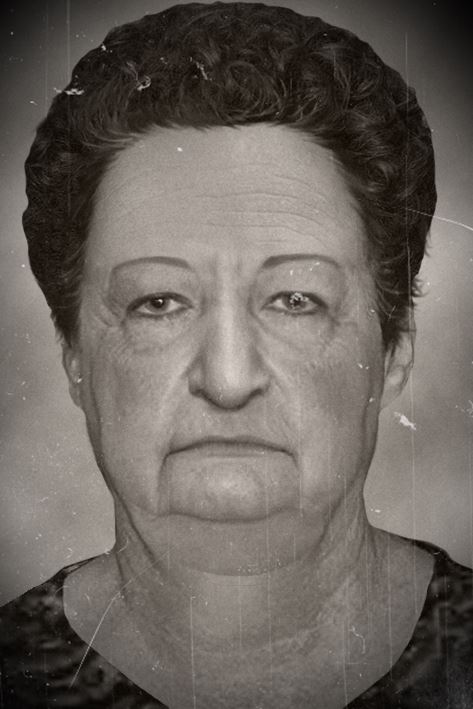
In the late spring of 1984, in the Midwest, a woman would be found murdered alongside a highway. On the night of May 4th, three teenagers driving along Old Line Road near Westby, Wisconsin happened upon a set of remains lying a short distance off the side of the road. The victim had been so savagely beaten about the head that her face was nearly unrecognizable, and both of her hands had been severed at the wrist and removed, presumably to make identifying her even more difficult.
The woman, eventually christened Vernon County Jane Doe, was white, and thought to be between fifty and sixty-five years old, with blue eyes and permed brown hair that was beginning to go gray at the temples. She stood about five-foot-five, weighed around one-hundred-fifty pounds, and wore dentures, which had been broken in the attack and were discovered lying near the body. A man’s Seiko watch was also recovered not far away.
The cause of death was blunt force trauma to the head; the victim’s eye socket and jaw had been shattered, and there was also a wound near her left ear, possibly the result of a stabbing. The coroner estimated that the victim had died between twenty-four and forty-eight hours prior to being found, and was likely bludgeoned elsewhere before being dumped at the side of the road.
Jane Doe was fully clothed, wearing a black dress with a blue and white paisley print, a light blue turtleneck, a multicolored coat with a pink and purple lining, a pair of nylons rolled down to her knees, and tan slip-on shoes. Some of the clothing appeared to have been handmade, though none of the articles contained brand tags of any sort, indicating that her killer had removed them, again to possibly forestall identification.
After news of the discovery went public, two witnesses came forward and claimed they had seen a bright yellow compact car, possibly a Datsun, pulled over at the side of US Highway 14—approximately three miles from the dump site—at around nine-forty-five p.m. on May 4th. They further stated that they had seen a man walking around the car from the passenger side to the driver’s side. A composite sketch was produced from the couple’s description.
Police examined the site where the car had been seen, and found tire tracks indicating that someone had recently made a quick u-turn at the spot. Authorities theorized that the man had been intending to dump the body at this location, but was frightened off by the couple driving by, at which point he got back into the car, turned around, and sped off to discard the body elsewhere.
One promising lead in the case emerged in the form of an organized group of criminals who had been writing fraudulent checks from the account of a missing Amherst, Wisconsin woman. Though this woman had disappeared right around the same time as Vernon County Jane Doe was discovered dead, detectives suspected that the unknown murder victim was probably not a local.
The remains were exhumed in 2015 in order to update the facial reconstruction images and to obtain a DNA profile. The woman’s clothing was also later sent for further forensic testing, which eventually confirmed that the victim had not been from Wisconsin, but had likely originated from somewhere in Arizona or New Mexico.
The fact that the assailant had made numerous attempts at disguising the woman’s identity—by removing the victim’s hands and cutting tags out of her clothing, for example—it seems probable that the perpetrator knew the victim and could be linked back to her.
In 2023, the forensic evidence in the case was transferred to a different genetic genealogy service. But as of this writing, investigators still have no inkling of who the woman is or who might have murdered her.
 Crime Immemorial