
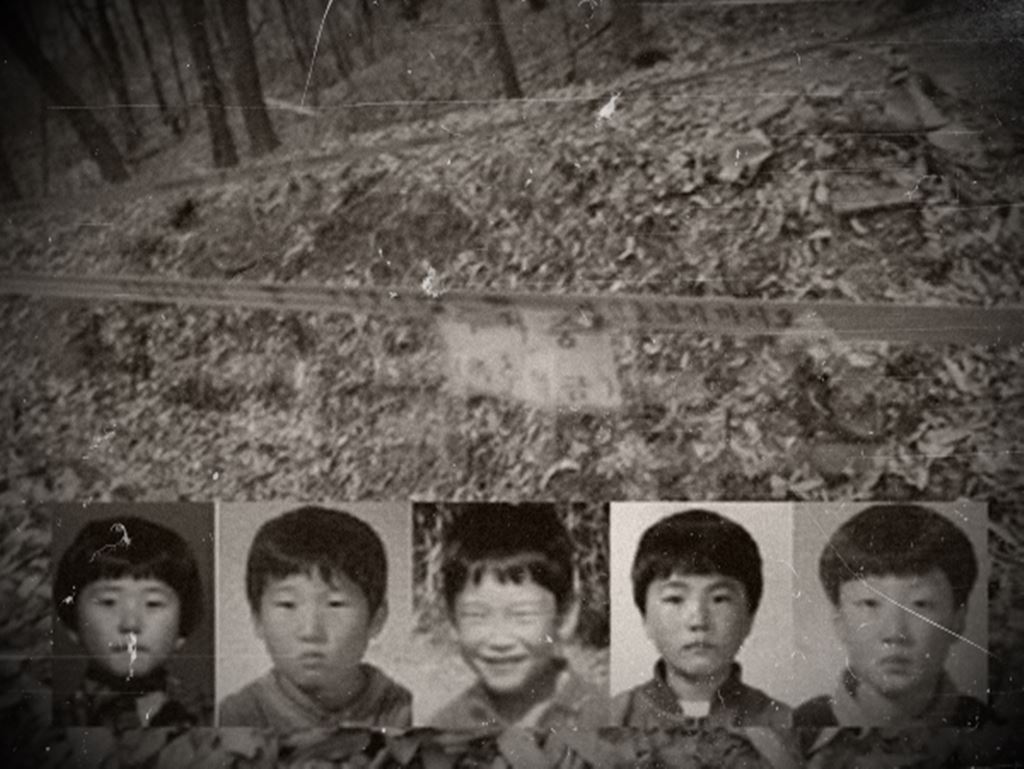
It was Tuesday, March 26th, 1991 in Daegu, South Korea, and due to local elections, schools and many workplaces were closed for the day. Six young boys, who were all students at Seongseo Elementary School—nine-year-old Kim Jong-sik, ten-year-old Park Chan-in, ten-year-old Kim Tae-ryong, eleven-year-old Kim Yeong-gyu, twelve-year-old Jo Ho-yeon, and thirteen-year-old U Cheol-won—decided to take a hike out to nearby Mount Waryong to look for salamander eggs.
At the last minute, Kim Tae-ryong was called back home by his mother to finish his breakfast, so he told his friends he would catch up with them later. The remaining five boys went on their way, carrying walking sticks and tin cans to hold any eggs they might find. They were never seen alive again.
When evening began to fall and the boys had not returned home, their worried parents began scouring the area for them, but could discover no sign. Police officers were called in, and authorities soon marshalled a massive search for the missing children, utilizing thousands of officers, volunteers, and tracking dogs. But still, no trace of the boys could be found.
Months went by, and though there were hundreds of false leads and reported sightings of the children—who would come to be known as the “Frog Boys,” as it was later mistakenly believed that they had gone out hunting for frogs rather than salamander eggs—no progress at all was made on the shocking case. One man even phoned the police anonymously and said that he had kidnapped the boys and was starving them until he was paid a ransom, but this confession was found to be fraudulent.
The disappearance of the Frog Boys became a national sensation throughout South Korea, with the children’s photographs appearing on posters, milk cartons, the sides of buses, and even candy wrappers. Several of the boys’ parents quit their jobs in order to search for the boys full time. But despite everyone’s best efforts, the location of the missing children remained unknown.
Then, in late September of 2002—more than a decade after the disappearance—two men out searching for acorns on Mount Waryong came across some children’s clothing and shoes lying in the leaves on the mountainside. After a more thorough search of the site by police investigators, the bodies of all five boys were unearthed from a shallow grave, only a little more than a mile away from their homes.
Because the bodies had been discovered entwined together, authorities initially speculated that the children had simply become lost and had died of hypothermia after attempting to huddle together for warmth. However, the boys’ parents were immediately suspicious of this scenario, as the area where the bodies were found was not only close to their homes, but also close to another village that all the boys were very familiar with, the lights of which would have been perfectly visible from the mountainside.
When a more thorough examination of the remains was undertaken, the parents were vindicated: three of the boys’ skulls showed signs of blunt force trauma, though the implement used to administer the blows is still unknown, but was perhaps a work tool such as a screwdriver. Most sources also report that one of the skulls contained what appeared to be two bullet holes, probably from shotgun shells, and two of the skulls also had traces of blood on them. In addition, the boys’ clothing was tied in knots, leading some to suggest that the children had been bound together before being murdered.
One of the stranger aspects of the discovery of the bodies was the fact that the area of Mount Waryong where the skeletons were eventually found had been searched more than five-hundred times in the ten years since the Frog Boys vanished. It seemed bizarre that the remains had not been revealed much earlier, leaving open the possibility that the killer had perhaps moved the bodies from their initial location. Forensic examination of mold found inside the skulls, however, seemed to suggest that the remains had been there the entire time.
After the bodies of the Frog Boys were found, numerous theories began to swirl about what had become of them on that sunlit mountain excursion in 1991. One of these theories held that a man at the shooting range nearby had accidentally shot one or more of the boys, then killed the others to avoid having to fess up to the crime. Although the shooting range had been closed on the day the children disappeared because of the election day holiday, it was hypothesized that perhaps someone had been using the site illegally. The shooting range had been closed permanently in 1994.
Another supposition was that the children had been murdered by a group of lepers who believed the common superstition that the livers of children could cure their disease. And yet another rumor held that perhaps one of the boys’ fathers had killed his own son, and also murdered the other boys to keep from drawing attention to himself. This particular hypothesis, put forward by a criminal psychologist, was investigated, but found to have little merit, as there was no evidence to suggest that any of the children’s parents were involved in the deaths.
In South Korea, the statue of limitations on murder is fifteen years, and so the case of the Frog Boys was closed in 2006 with no resolution. However, in 2015, this particular statute was waived, meaning that investigation of the slayings may still go forward, though as of this writing, there have been no further developments.
Two films about the crime have been made, one of which—titled Come Back, Frog Boys—was released only a year after they disappeared. The other was simply called Children and came out in 2011. There was also a novel published in 2005 titled The Boys Never Went to the Mountain, which is a fictionalized retelling of the famous case.
 Crime Immemorial