
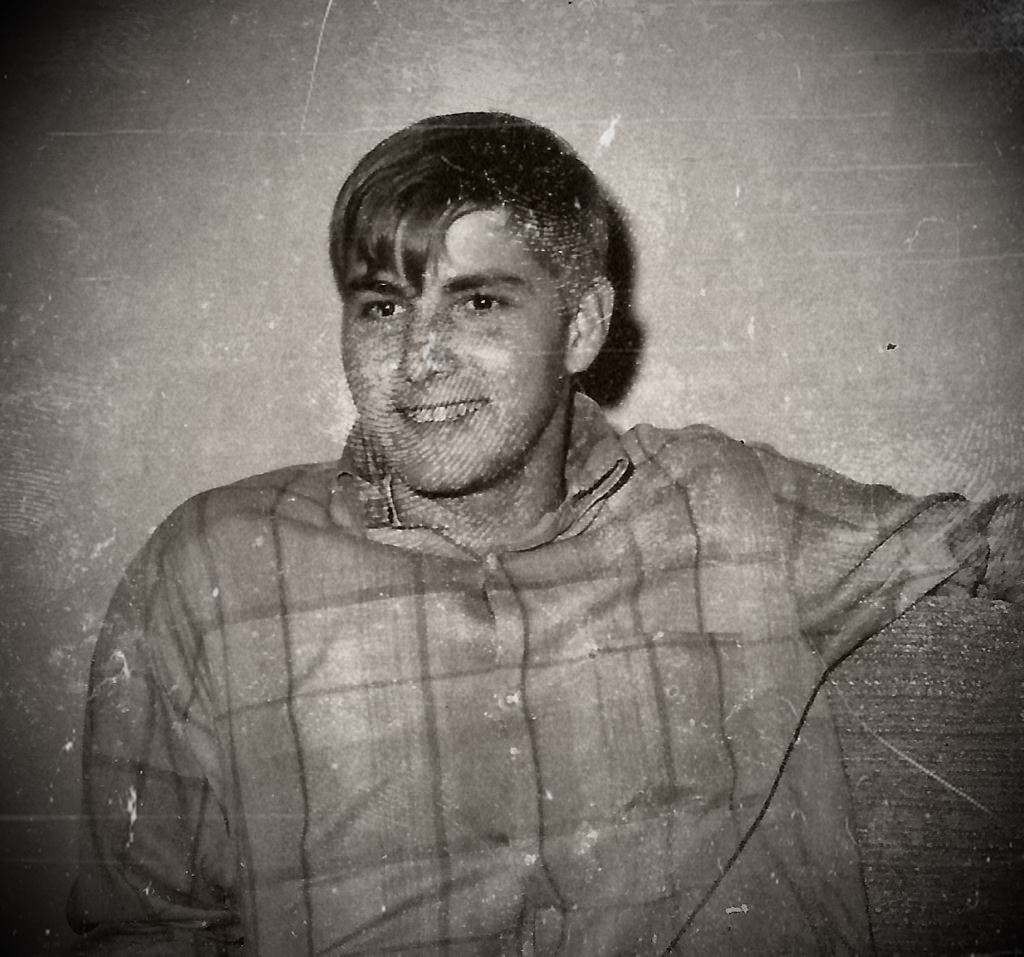
In Iowa, the first week of March 1968 would see a bizarre missing persons case that bore eerie similarities to the 1962 murders of Christine and Julie Louise Maps in Pennsylvania, though the two crimes were almost certainly unrelated.
Twenty-year-old Gary Eugene Sebek shared an apartment in Hamburg, Iowa with his young wife Shirley and their two-year-old daughter Lisa. Shirley was pregnant with the couple’s second child, and due to deliver any day.
At dawn on Monday, March 4th, Gary’s coworker Paul Bashaw picked him up at home, and both men subsequently traveled to their place of employment, the Crown Line Plastic Company in Nebraska City, Nebraska, where they arrived at a little before six a.m.
Gary was only on the job for an hour or two before his wife Shirley and her sister Janice Holland showed up at the factory and informed him that Shirley was in labor. Gary accompanied the two women and little Lisa to the nearby St. Mary’s Hospital, where Shirley soon gave birth to a healthy baby boy, who the couple named Patrick.
The day was somewhat bittersweet for the Sebeks, it seemed, because at some point during the afternoon, Shirley’s adoptive father Victor Moyer turned up at the hospital and started an argument, insisting that Patrick had actually been fathered by Victor himself, and not Gary.
Shirley Sebek, it should be noted, had long had problems with her father, who had adopted her at a very young age and had inappropriate sexual feelings toward her, not to mention a violent temper that was often directed at Gary. Moyer had, in fact, bullied Shirley into divorcing her husband shortly before Patrick’s birth, and openly threatened Gary’s life on multiple occasions. The couple feared Moyer intensely and had been making plans to secretly remarry and move to Florida to escape his controlling behavior.
Despite the horrific family drama marring what should have been a happy event, Gary stayed at the hospital with his wife and newborn son until about ten-thirty p.m., at which point he was given a lift home by friends Bill and Dena Siddens, who had also been visiting Shirley. After the Siddens’ dropped him off in front of his apartment complex at eleven p.m., though, Gary Sebek mysteriously vanished off the face of the earth.
On Tuesday morning, Paul Bashaw stopped by the apartment in Hamburg to pick up Gary for work as usual, but there was no answer to his knock. Finding the kitchen door unlocked, Paul went inside and called out for his friend, but soon realized that no one was home. The only sign of Gary, in fact, was his half-smoked pack of cigarettes on the kitchen table. Unnerved, Paul got back into his car and drove to the plant by himself.
As the day wore on, Shirley also became concerned when Gary never showed up to the hospital to visit her. Later that night, at around nine-thirty p.m., her sister Janice and friend Dena went to the Sebeks’ apartment to see if they could locate him.
Inside the residence, they didn’t find Gary, but they did discover some rather sinister clues. The only lights left on in the house, for example, were those in the basement, and it appeared that someone had recently mopped the kitchen floor and left the mop pail near the basement door.
Additionally, in the living room, Janice and Dena noted that two chairs were moved from their regular places, and even more alarmingly, the sofa and throw pillows were stained with what appeared to be blood.
Fearing the worst, the women phoned their husbands for assistance, and then contacted police at around ten-thirty p.m. Upon arrival, Fremont County Sheriff James Findley also discovered small flecks of blood staining the wall in the breakfast nook. Gary Sebek was classified as a missing person, and an all-points bulletin was issued.
Janice Holland and Dena Siddens were morbidly certain who was to blame for Gary’s disappearance, and on March 6th, they decided to undertake an investigation of their own. Since they knew that Shirley’s father Victor Moyer would not be home that afternoon, the two women drove out to his residence and examined his 1958 Sunbeam Rapier, which was parked in a shed on the property. After discovering what appeared to be bloodstains in the trunk and on the bumper, the two women fled and reported their findings to police.
Later that same day, authorities questioned Victor Moyer about the blood, and though at first he claimed that he must have cut his finger, when asked to show the cut he walked back this statement. Police gathered further forensic evidence at the scene, but did not arrest Moyer at that time.
On the evening of March 6th, the Hollands reported that Victor Moyer was at the hospital visiting Shirley, and that he seemed nervous when they told him that investigators had found blood on the kitchen wall of the Sebeks’ apartment.
The following day, police questioned Moyer again, at which point he said that the blood in his car had perhaps come from Shirley, but that he didn’t know for sure. He also initially seemed open to taking a polygraph test, but then stated that he would be too nervous and refused to go through with it without consulting his attorney first. It appears that this was the last time that Moyer was interviewed, and evidently detectives were unable to gather sufficient physical evidence to link him with Gary Sebek’s disappearance, for he was never charged.
Over the ensuing months, more strange details began filtering out about the case. Shirley Sebek herself agreed to take two polygraph tests, in which she was found to be truthful when she insisted that she believed her husband had been murdered by Victor Moyer and that she feared he might kill her as well.
That spring, Shirley also received a peculiar series of letters and postcards purporting to be from someone named Caroline, who made the outlandish claim that she had been having an affair with Gary, that he was now living with her, and that Patrick had not been fathered by Gary, a claim that had previously been made by Victor Moyer. Perhaps unsurprisingly, both the handwriting on the postcards and the typewriter used to type the letters were found to belong to Moyer.
A little more than a year after Gary’s disappearance, Shirley Sebek was finally able to get away from her adoptive father, moving to Arkansas and later marrying again. And at around the same time as Shirley’s escape, police conducted an extensive search of Moyer’s two-hundred-forty-acre property, but turned up nothing of note.
Rumors circulated for many years that Moyer had had two accomplices in the murder of Gary Sebek, and had disposed of the body by dropping it into the Missouri River from his private plane. One of the alleged accomplices, Moyer’s best friend Gordon Gill, Jr., later committed suicide after writing a letter which seemed to refer to details about the Gary Sebek disappearance.
And in November of 1974, a friend of Moyer’s named Melvin Price would mysteriously turn up dead on the side of Iowa Highway 42 only one day after Moyer allegedly spotted him kissing Shirley’s sister Janice. Though the cause of death was ruled unknown and thought to be a hit-and-run, the witness who discovered the body disputed this claim, stating that he thought Melvin Price had been beaten to death with a crowbar.
The body of Gary Sebek was never found, and though it seems likely that his father-in-law was responsible for his death, Victor Moyer was never charged with the crime, and died a free man in 2014, at the age of ninety-four.
 Crime Immemorial