
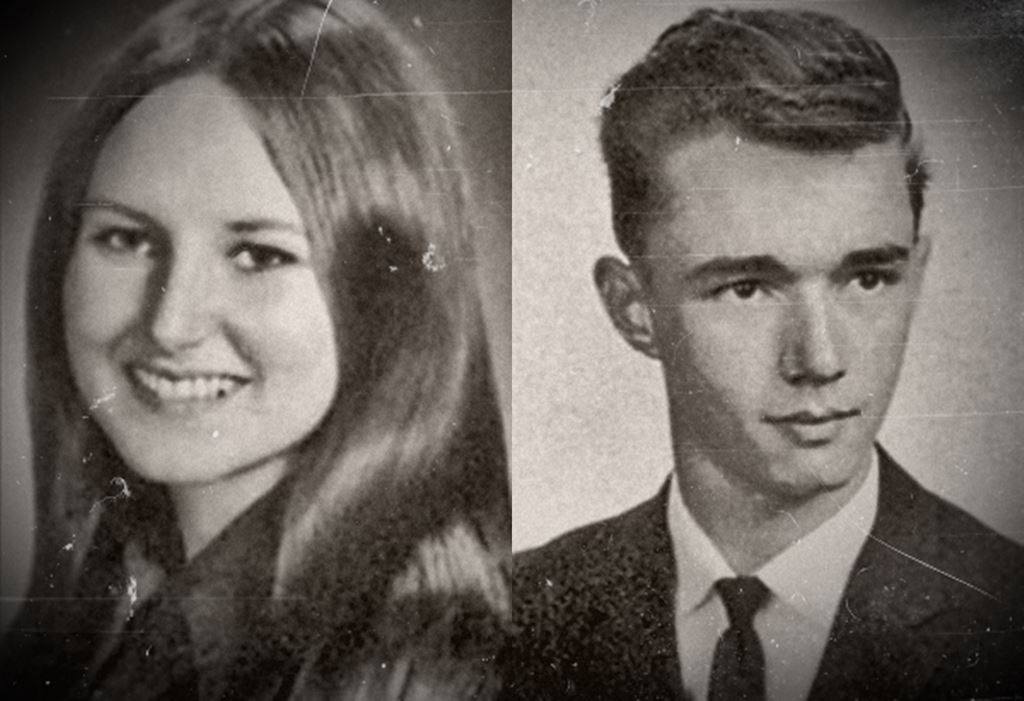
At a little after six a.m. on the morning of August 9th, 1976, trucker Martin Durant noticed the fully-clothed dead bodies of a man and woman sprawled alongside a remote unpaved track between Interstate 95 and Lynches River Road in South Carolina. Each victim had been shot three times with a .357 caliber revolver: once in the neck, once in the chest, and once in the back.
Because of the notable clothing, jewelry, and dental work evident in one or both of the victims, police quickly formed a theory that this couple had perhaps been traveling around the United States on vacation, and might have hailed from affluent families in some undetermined country.
The male victim—dubbed “Jock Doe” because of a witness who allegedly claimed the man had told him he was French Canadian and was named Jacques—was a tall, slender, olive-complected white man between the ages of eighteen and thirty, though probably older than twenty-seven. He had brown eyes, brown shoulder-length hair, and thick, bushy eyebrows. His skin also bore several minor scars, presumably resulting from some former involvement in contact sports.
Due to the expensive reconstructive dental work that had been undertaken on the man’s teeth, authorities surmised that he was likely quite wealthy, and had probably obtained most or all of the surgery outside of the United States. Further evidence of the victim’s affluence was the expensive watch and sapphire ring he wore, the latter of which bore engraved initials reading JPF.
Because Jock was clad in a promotional t-shirt from a Sebring, Florida car race, and because the pocket of his jeans contained a box of matches from a chain of truck stops with locations only in Nebraska, Idaho, and Arizona, detectives hypothesized that he and his companion had been traveling around the United States for some time prior to their murder.
The female victim, Jane Doe, was also white with an olive complexion; in fact, before DNA tests definitively ruled out the possibility, authorities believed the pair might have been siblings, as they looked so much alike.
The woman was thought to be between eighteen and twenty-five years old, standing about five-foot-five-inches tall and weighing approximately one-hundred pounds. Her eyes were blue-gray or hazel, her hair was reddish-brown and cut to shoulder-length, and she had two moles near the left side of her mouth.
Like her companion, she also wore some distinctive jewelry, though her three rings were all sterling silver and appeared to have originated in Mexico or the Southwestern United States.
Both victims were described as clean and well-groomed, though investigators found it unusual that neither individual was wearing underwear. It appeared that both had eaten fruit and ice cream shortly before their deaths.
Though no one ever came forward to identify Jock and Jane Doe, police did have a few leads to follow. The first of these came from a man who stated that he had seen the couple being dropped off by a vehicle on the dirt road where their bodies were eventually found. The witness, unfortunately, had been too far away to get a decent look at the make or model of the vehicle in question.
A mechanic in York, Nebraska also told authorities that he had worked on a van driven by a couple matching the description of the murder victims. The vehicle, he said, had Washington or Oregon plates. Interestingly, the town of York, Nebraska also housed one location of Grant’s Truck Stop, the name of the establishment on the box of matches found in Jock Doe’s pocket.
Another witness who told authorities that he had actually spoken to the couple claimed that the male victim was a teacher named Jacques, that he had come from Canada with his girlfriend, and that his father was a prominent and wealthy physician. Following up on these tantalizing leads, however, got detectives no closer to solving the enigma of their identities, or who might have wanted them dead.
In 1977, investigators received a possible break in the case when they pulled over a man named George Henry for drunk driving in Latta, South Carolina and found him to be in possession of a .357 revolver, which was later determined to be the firearm that had been used in the murders of Jock and Jane Doe. Significantly, the serial numbers on the revolver had been partially filed off.
Although Henry was held for questioning and results of a polygraph test were inconclusive, he was never charged, as police were unable to establish whether he had been in possession of the weapon when the crime was committed, or whether he had obtained it later on. Henry claimed that he had received the gun as a gift from his brother Jim, and there were also hints that the weapon had been stolen at some earlier date in Raleigh-Durham. Henry also stated that he had been visiting his sick wife in a North Carolina hospital at the time of the murders. He died in the early 1980s without ever being linked to the double homicide.
In 2007, DNA profiles were extracted from both victims, at which point it was conclusively proven that Jock and Jane Doe were not genetically related to one another. Though the profiles were entered into a nationwide database, the victims remained unidentified for many more years.
In the vacuum caused by lack of progress on the case, internet dabblers attempted to get to the bottom of the conundrum. One commenter on the popular Web Sleuths forum noted that the couple bore a striking resemblance to two individuals—Maria Marta Vasquez and Cesar Lugones—who disappeared from Argentina in May of 1976, during that country’s notorious “dirty war,” in which approximately 30,000 people were “vanished,” presumably by South American governments.
Photographs of Maria and Cesar did look eerily similar to post-mortem photographs of Jock and Jane Doe, and it did seem intriguing that the pair went missing from Argentina only months before the bodies were found in South Carolina. The fact that they were perhaps fleeing from political strife might have also explained why their families never came forward to identify them.
However, it was noted that Maria Vasquez was thought to have given birth to one son prior to her disappearance, and was reportedly pregnant again when she vanished. According to the autopsy performed on the unidentified Jane Doe, the victim had never been pregnant.
Other individuals who went missing at around the time of the murders and bore resemblances to the victims included American couple Michael and Cordelia McMinn, believed to have been highjacked while on their boat off the coast of Washington State in June of 1976; and Canadian couple Ron and Terry Yakimchuk, who vanished in 1973.
Other theories that swirled around about the mystery pair had them involved in a drug smuggling ring and getting on the wrong side of the mob. Circumstantial evidence for this hypothesis included the fact that the International Motor Sports Association, responsible for the Sebring car race advertised on Jock Doe’s t-shirt, came under fire in the 1980s when it was discovered that several racing teams and IMSA officials were connected to a massive international drug smuggling cartel with ties to organized crime.
All of this wild speculation was brought to a close in January of 2021, when authorities announced that the victims had been identified as twenty-four-year-old Pamela Buckley, originally from Redwood County, Minnesota; and twenty-nine-year-old James Freund, originally from Fitchburg, Massachusetts. James Freund had last been seen alive on Christmas Day of 1975, in Lancaster, Pennsylvania. Pamela Buckley had been reported missing in the same month from Colorado Springs, Colorado.
The identity of the person who gunned down the couple is still unknown.
 Crime Immemorial