
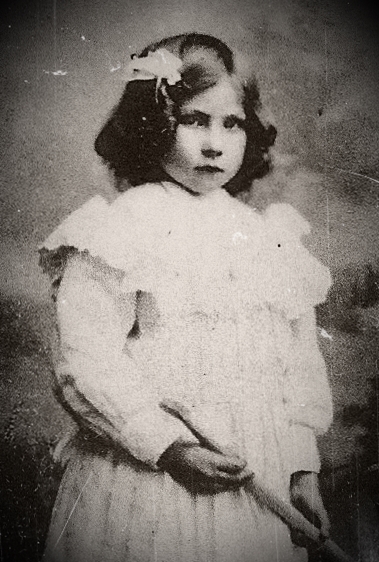
It was the cold winter evening of February 7th, 1906 in Brussels, Belgium, and eight-year-old Jeanne Van Calck set out from her grandparents’ house at about six-thirty p.m. to visit her mother, as she did for a few hours every evening. Jeanne had lived with her grandparents for some time, since her father had abandoned her mother.
Normally, Jeanne’s grandfather would have walked with her to her mother’s house on the corner of Baudouin Boulevard. But for the first time, she was allowed to go alone, as her grandfather was working and wasn’t able to accompany her. Sadly, her first time walking alone would also be her last.
Several hours later, at around eleven-forty-five p.m., a local machinist and his son noticed a suspicious package sitting on the doorstep of 22 Rue des Hirondelles. They called the police to deal with the matter. When officers gingerly undid the hemp cord and pulled aside the thick paper, they initially saw a checkered dress and a blue pea coat, but upon moving the clothing aside, they were horrified to discover the dismembered remains of a little girl, minus the legs. The clothing corresponded to that worn by Jeanne Van Calck.
According to the coroner, the girl had died from asphyxiation on her own vomit after having a large quantity of alcohol forced down her throat. The child had also been dreadfully abused before her death. It was also the coroner’s opinion that the killer was likely a doctor or a butcher, given the expert nature of the dismemberment of the body.
Authorities began scouring the area for the monster who had perpetrated the crime, and offered a reward of 20,000 Belgian francs for information. On February 15th, a pair of child’s boots was discovered on Stuyvenbergh farm, and the following day, two long packages containing Jeanne Van Calck’s legs were found not far away.
Though several arrests were made, no convictions resulted, and there was widespread outrage among the public for the perceived incompetence of the police. One witness, a seven-year-old girl who was friends with Jeanne, told investigators that she had seen Jeanne near her grandparents’ house at approximately seven o’clock on the night she was killed, accompanied by a man she seemed to know. The girl further stated that Jeanne and the unknown man had walked off in the opposite direction from Jeanne’s mother’s house. Because this statement came from a child, however, police failed to follow up on it adequately.
The gruesome murder of Jeanne Van Calck was never solved, and in December of 1907, a six-year-old girl named Annette Bellot would be raped and strangled in nearby Anderlecht, Belgium. Her killer was likewise never caught, and some believe the two crimes are connected. More than a century has passed since the children’s deaths, however, and it seems unlikely that either case will ever be closed.
 Crime Immemorial