
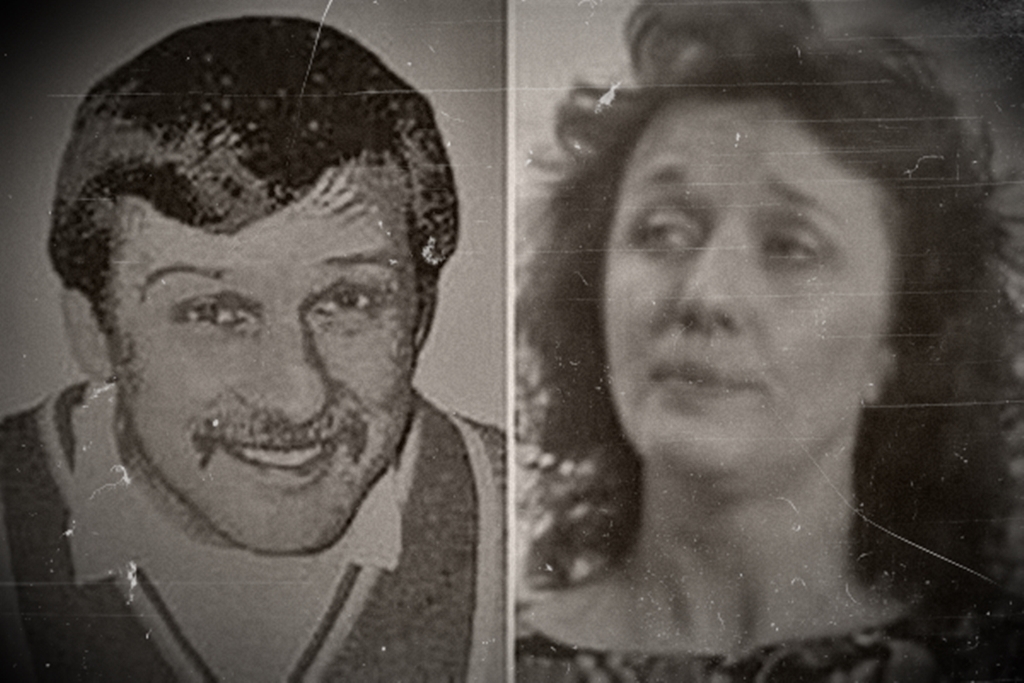
Easter Monday of 1991 fell on April 1st. Forty-three-year-old quantity surveyor Alan Leppard was at home with his wife Brenda Long in Monkton, Kent, England.
A knock came at the door, and when Alan answered it, he was immediately shot in the chest with a 12-bore shotgun. Brenda, hearing the gunshot, rushed to see what was wrong, but by the time she got there, the perpetrator had fled. Alan lay dying in a pool of blood just outside the cottage.
Police initially had very little to go on. Witnesses reported seeing an unfamiliar large, white, American-style car, possibly a Cadillac, driving around the village in the days prior to the murder. Some villagers also claimed that two men were in the local White Stag pub asking about Alan three weeks before his death. E-fit images were produced of the two men, which were broadcast on the Crimewatch TV show, but neither individual was ever found.
Because the crime had the definite flavor of a contract killing, investigators looked into Alan Leppard’s background, but strangely, could find absolutely nothing that tied either him or his wife to any type of criminal activity. Everyone who knew Alan was shocked at the manner of his death, claiming he was a completely normal man with nothing shady or nefarious about him whatsoever.
The inquiry continued over the ensuing months, with Brenda Long helping the police as best she could. But then, less than nine months after Alan Sheppard’s slaying, there was a bizarre twist in the case.
After her husband’s murder, Brenda had moved to a flat in Whitstable. She saw her sister on Christmas Day and spoke to her on the phone on December 26th. Some later witnesses also claimed to have seen her on the same day with a former boyfriend known as Mr. Hibbert.
But two days after that, on December 28th, forty-two-year-old Brenda was found dead in her bathtub at her flat. An empty pill packet was found floating in the bathwater alongside her, and there was a suicide note nearby.
Initially, her death was believed to be just as it appeared, but considering how her husband was killed, investigators were suspicious. After the post-mortem, these suspicions were confirmed: Brenda had been drugged into unconsciousness with diethyl ether, then drowned in the tub. Bruising around her mouth suggested the drug had been administered on a cloth that had been pressed to her face.
Again, detectives were baffled as to who would want to kill the friendly, popular Brenda, who like her husband seemed to have no whiff of scandal around her. Police were doubly upset by Brenda’s murder because she had been aiding them in their investigation and they had hence been spending a great deal of time communicating with her, but it had never occurred to them that she might be in any danger herself.
More than thirty years later, no suspects have been identified, and the mysterious and tragic double murder remains unsolved.
 Crime Immemorial