
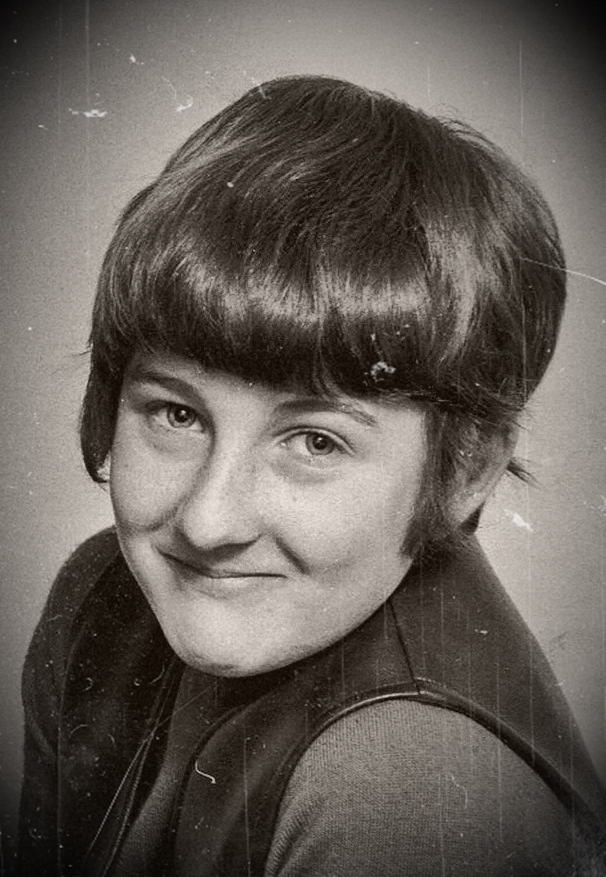
Fourteen-year-old Judith Roberts was a pretty, intelligent schoolgirl who lived with her family in the village of Wigginton, in Staffordshire, England. On the early evening of June 7th, 1972, she had a minor argument with her parents and decided to go out for a ride on her bicycle along Comberford Lane. She set out around five-thirty p.m.
Only a few hours later, her lifeless body was discovered in a field near the road. She had been beaten in the head with a blunt object, and her remains were stashed underneath a pile of hedge clippings, fertilizer bags, and an asbestos sheet.
Authorities immediately launched a massive investigation, going house to house and questioning thousands of residents. During this inquiry, police asked soldiers residing at the barracks in Whittington to account for their movements at the time Judith was slain. One seventeen-year-old soldier, Andrew Evans, claimed that he had spent the entire evening at the barracks with three other soldiers who could vouch for his presence. However, detectives found that two of the named soldiers had not been at the barracks at the time Evans stated, and the third was never able to be tracked down.
Subsequently, officers went to Evans’s grandmother’s house to question the young man again. It turned out that the day that Judith Roberts was killed was only a day before Evans was due to be discharged from the military for health reasons: he suffered from severe asthma, and had been put on medication for depression.
The morning after the second interview, Evans himself showed up at the police station, asking to see a photograph of Judith Roberts. He explained to police that he’d had a dream in which he saw what he described as “a hazy combination of images of women’s faces,” and had begun to fear that he may have killed Judith without remembering it. “I keep seeing a face,” he told police. “I want to see a picture of her. I wonder if I’ve done it.”
Investigators began questioning Evans more intensely, and he eventually confessed that he had dragged Judith off her bicycle and engaged in a struggle with her. However, when asked if he was the killer, he said that he didn’t know, and what’s more could not remember if he had even been in Tamworth, where the murder occurred.
At first, police were skeptical of Evans’s confession, believing he was simply delusional, but after three days of further questioning, they became convinced of his guilt, and then got him to sign a formal confession. He was officially charged with murder and placed on trial in June of 1973.
By the time of the trial, though, Evans had recanted his confession, and there was some suspicion that a so-called truth serum called Brietal that he’d been given during the interrogation may have implanted false memories. A psychiatrist who spoke in his defense concluded that Evans was likely suffering from hysterical amnesia, and may have witnessed the murder, but later cast himself as the killer after failing to help the victim.
There was no physical or eyewitness evidence at all linking him to the crime; the only argument presented for his guilt lay in the fact that he had confessed and that his alibi couldn’t be verified. Despite the flimsy case against him, however, he was convicted, and sentenced to life in prison.
Evans was told that he had no grounds for an appeal, and therefore resigned himself to his fate, even though he still maintained his innocence. After spending more than two decades behind bars, though, his case came to the attention of the media in 1994, and eventually, he was granted a new hearing in 1997.
At the hearing, the judges concluded that Evans’s medical and psychological state at the time he was questioned had not been taken into consideration and that he had not had a doctor or a solicitor present while he was in custody. It was further argued that not only was Evans suffering from hysteria and extreme anxiety at the time he was accused, but that there was absolutely no forensic evidence at all connecting him to Judith Roberts’s murder. In fact, the single unidentified fingerprint found on Judith’s bicycle did not belong to Evans.
At last, Evans was released, after having served a quarter century behind bars. He was not bitter about his long imprisonment and simply said he wanted to enjoy what remained of his life. A few years after his release, he was compensated approximately one million pounds. Evans’s case would constitute the longest miscarriage of justice in Britain until 2001, when Stephen Downing was finally released after twenty-seven years, after having been wrongfully convicted of the murder of Wendy Sewell in 1974.
If Evans didn’t kill Judith Roberts, though, then who did? Sadly, police stated that they have no plans to reopen the investigation unless compelling new evidence comes to light, but other experts are keeping the case alive. In 2014, former Norfolk Police detective Chris Clarke and investigative journalist Tim Tate published a book titled Yorkshire Ripper: The Secret Murders, in which they argued that Peter Sutcliffe was responsible for killing Judith Roberts, as well as four other victims of unsolved slayings: Barbara Mayo, the aforementioned Wendy Sewell, Rosina Hilliard, and Caroline Allen.
And in 2019, historian and friend of the Roberts family Sarah Clark backed up this assertion, pointing out that not only was a car similar to Sutcliffe’s spotted in the area at the time Judith was murdered but Judith had reportedly been seen talking to a man who resembled Peter Sutcliffe not long before her body was found. The manner in which she was slain—bashed in the head and then hidden under an asbestos sheet—was very similar to a known 1978 Sutcliffe murder, that of sex worker Helen Rytka.
The Yorkshire Ripper was known to have killed at least thirteen women and attempted to murder seven more between 1975 and 1980, but is suspected of several other crimes. He died in 2020 while still serving a life sentence. It is not known whether he is the man who killed Judith Roberts, but hopefully, her murder will one day be solved.
 Crime Immemorial
One thought on “Judith Roberts”