
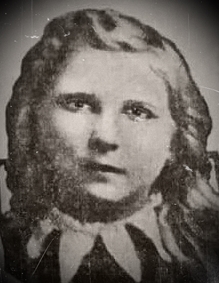
It was Monday, February 25th, 1924, and eleven-year-old Vera Hoad was spending time with a friend in the afternoon. She had a music lesson that day, as she did every Monday, so at some point she bid goodbye to her friend and went to keep her appointment. She did her lesson as usual, leaving the premises at six-thirty p.m. and heading back toward her home in St. Pancras. She was never seen alive again.
A massive search for the child was undertaken, but for three days, there was no sign of her. Then, on February 28th, a deaf and mute patient at Graylingwell psychiatric hospital in Chichester, West Sussex, England found the girl’s body in a field near the farmhouse where he worked. Vera had been savagely raped and then strangled. Her remains were frozen to the ground so thoroughly that police had to use a blowtorch to extract her.
The only clue discovered at the scene was a torn piece of fabric from a man’s shirt. Authorities questioned soldiers at a barracks near the crime scene, as well as patients and staff at the hospital, but no leads emerged from their efforts.
Some researchers have suggested that Vera Hoad may have been a victim of prolific American serial killer and necrophile Earle Leonard Nelson, also known as the Gorilla Man, who is believed to have murdered between twenty-two and twenty-nine victims across nine U.S. states and parts of Canada. Nelson’s victims tended to be older women, usually landladies, though he is known to have raped and murdered at least one fourteen-year-old girl, Lola Cowan, in Winnipeg, Manitoba in June of 1927. It remains unclear whether Nelson ever traveled to England and committed any crimes there, though he is reportedly also suspected of killing a girl named Nancy Clarke in Birkenhead. He was ultimately captured and hanged in Winnipeg in 1928.
As of this writing, it has been one hundred years since Vera Hoad’s murder and the perpetrator is surely dead. Sadly, the length of time that has passed all but ensures that this horrific crime will remain forever unsolved.
 Crime Immemorial