
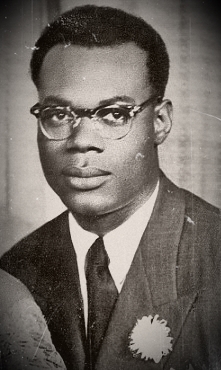
Thirty-two-year-old Kelso Cochrane was originally from Antigua, and at some point in his youth moved to the United States to marry. After that marriage failed, however, he was deported back to his home country. In 1954, though, he decided to move to England, where he eventually ended up living in the Notting Hill neighborhood of London. Kelso worked as a carpenter and was trying to save up enough money to eventually pay for law school.
On May 16th, 1959, Kelso broke his thumb at work and went to Paddington General Hospital to get it seen to. He left the hospital shortly after midnight on May 17th and began walking home, but at the intersection of Southam Street and Golborne Road, he was attacked by a group of young white males, who stabbed him repeatedly with a stiletto knife.
At the approach of three other men, the attackers ran off, and the three men took Kelso back to the hospital. Sadly, though, medical personnel could not save him, and he died of his injuries only an hour later.
Because Notting Hill was at the time a hotbed of far-right and white supremacist activity, having witnessed several race riots and the prevalence of the neo-Nazi-affiliated White Defence League and Sir Oswald Moseley’s fascist Union Movement, it was believed by many that the murder had been racially motivated. Authorities seemed reluctant to publicly acknowledge this, however, preferring to stick with the story that Kelso’s slaying had been a robbery gone wrong, even after a member of the Union Movement claimed another member of the group had been responsible for the murder.
There was some criticism of the police, both at the time and in later years, for their alleged complacency in investigating the true motive behind the crime. Some researchers suggest that the authorities were simply trying to calm the already-simmering tensions in the community, but others attribute more sinister motives, claiming that the police knew who the killers were but refused to arrest them, and quashed any witness reports identifying the perpetrators.
In 2011, the suspects were publicly named, but no arrests were ever made, and the murder remains unsolved.
Kelso Cochrane’s death did have the tragically hopeful effect of uniting the community somewhat, as thousands of people both white and black attended his funeral, and the government formed a committee to investigate race relations. The crime is also credited with drastically reducing support for Sir Oscar Moseley, who had been planning a return to politics but saw his polling numbers significantly diminished.
In 2009, on the fiftieth anniversary of his death, a plaque was erected near the spot where Kelso was attacked, and in 2023, a building in North Kensington was named in his honor.
 Crime Immemorial