
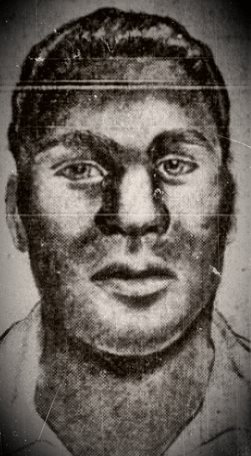
Over the course of one year in the late 1950s and early 1960s, a terrifying killer roamed the streets of Los Angeles, California, targeting older women in a series of brutal, sexually motivated crimes. His identity remains a mystery to this day, and though he goes by many names, his most common appellation is the Bouncing Ball Killer.
On the afternoon of Thursday, May 28th, 1959, fifty-seven-year-old Ruth Gwinn was walking home from her job as a secretary when a man suddenly leaped from behind a nearby tree. The man hit her with a wooden plank, then dragged her into a nearby parking lot where he proceeded to rape and mutilate her. After her screams drew a crowd of passersby, the assailant took off running and was able to elude capture.
Although Ruth was still alive when emergency services arrived, she died hours later from her injuries.
In a horrifying twist, it was discovered that Ruth had been attacked in the same neighborhood seven years prior in 1952, when a man had attempted to force her into his car and then shot her in the back when she fled. Ruth Gwinn had survived that first attempt on her life, but sadly would not be so lucky in 1959. The perpetrator of the 1952 assault, incidentally, was also never caught, though police did not believe the two incidents were linked.
Almost exactly eight months later, on January 29th, 1960, a seventy-three-year-old woman named Amanda Rockefellow was found strangled to death in an alley only two blocks from her home, in a crime that bore several similarities to the murder of Ruth Gwinn.
Then, on February 10th, sixty-year-old nurse Ann Cotter was attacked and murdered while walking to church.
May 2nd, 1960 brought another victim, this time a seventy-four-year-old semi-invalid named Elmyra Miller, who was sexually assaulted and strangled to death in her home. Less than two weeks later, on May 13th, sixty-year-old apartment manager Bessie Elva Green was raped and murdered in her flat; the residence was also ransacked and robbed. And on June 20th, eighty-three-year-old Grace A. Moore was slain in her home in almost the same fashion.
Less than a week later, another crime occurred, but this time the killer was seen. On June 26th, 1960, seventy-two-year-old Mercedes Langeron was raped and strangled to death with a bedsheet in her home on West 23rd Street. Her roommate, sixty-two-year-old Adela Williams, told police that when she returned from a trip to the store, she had not only found her friend dead, but also got a clear glimpse of the murderer before he quickly fled the scene.
The suspect she described was a thirty-year-old black male, standing about six feet tall and weighing around one-hundred-fifty-five pounds. He was clad in a light-colored sport shirt, gray Ivy League pants that had a buckle on the back, and a pair of dark sunglasses.
Notably, Adele Williams stated that when she had walked into the apartment, the killer had been bouncing a white rubber ball. It was at this stage that the authorities and the media began calling the elusive monster the Bouncing Ball Slayer, the Bouncing Ball Strangler, the Rubber Ball Strangler, or most commonly, the Bouncing Ball Killer.
Investigators fielded hundreds of tips from concerned citizens, but the case went nowhere until Saturday, July 3rd, 1960, when several witnesses spotted a man bouncing a rubber ball as he walked into a supermarket on South Broadway. Police were quick to apprehend the individual, who turned out to be a thirty-five-year-old bus washer named Noble Harper, a local who lived on 5th Avenue. Harper did closely resemble the police sketch of the Bouncing Ball Killer, though he was physically somewhat larger than Adele Williams’ description.
In spite of the circumstantial evidence, however, detectives determined that Noble Harper was not the killer they sought, and they released him only two days later.
On July 10th, a bricklayer named Ray Williams was arrested in San Diego after patrolmen spotted him and thought he resembled the police sketch. Authorities noted that Williams also wore shoes that were similar to those worn by the killer. He was subsequently released due to lack of evidence.
Two days after that, police were called following reports of a woman screaming near a college campus. Upon arrival, officers encountered a thirty-five-year-old man named Raymond Ward Clemmons getting into his vehicle; they detained him to ask about the screaming. Shortly afterward, the body of nineteen-year-old Nina T. Thoeren was found nearby; she had been strangled to death.
Detectives questioned Raymond Clemmons, who was found to be on parole from San Quentin for a hit and run that had occurred in 1956. It didn’t take much urging for Clemmons to confess to killing Nina Thoeren, and he was taken into custody.
While being interrogated, Clemmons said that he had offered Nina a ride in his car, and that she had joked that he might be the Bouncing Ball Killer. According to him, he told her he was, and pointed to the glove compartment, telling her to open it because the rubber ball was in there.
This was a promising lead, but when Clemmons was given a polygraph, it demonstrated that he was not being truthful when he claimed to be the notorious serial killer. He was, however, convicted of the murder of Nina Thoeren, and sentenced to life in prison.
Another possible suspect emerged on July 23rd when officers arrested twenty-three-year-old Joseph Walter Malveaux, who looked so much like the police sketch that, he claimed, several of his friends had teased him about it. Malveaux was picked up for loitering around the bushes near the Coliseum, but he denied having anything to do with the crimes. He admitted he liked to wander around at night and that he enjoyed looking at women, but that he couldn’t stand “old ladies.” Though Malveaux’s shoes also looked like those worn by the killer, there was no solid evidence linking him to the murders, and he was likewise let go.
It seemed that whoever the guilty party was, whether one of the men just listed or someone else entirely, he wasn’t finished with his grim task. On August 18th, 1960, another incident occurred that was believed to be the handiwork of the same killer. An intruder slashed the screen door of a house on East 6th Street in the middle of the night, then beat ten-year-old Mary Foster in the head with a blunt object. That done, he crept into the bedroom of the little girl’s grandmother, forty-eight-year-old Modie Hall, and did the same to her.
Forty-five-year-old Floyd Harris, who was boarding in the home, was awakened by the victims moaning, and what he described as the distinctive sound of a rubber ball repeatedly hitting the floor. Floyd Harris chased the attacker out into the night, but soon lost sight of him.
Both Mary Foster and Modie Hall suffered severe injuries to the head and face, but both thankfully survived.
Tragically, the next victim would not be so fortunate. Eighty-four-year-old Lena Bensusen was savagely beaten by an intruder in her home on September 1st. She survived the initial onslaught, and gave police a description of the attacker, which matched the description of the Bouncing Ball Killer. She died of her injuries five days after the home invasion. If all the crimes were indeed carried out by a single perpetrator, then Lena Bensusen was likely his last victim.
On September 6th, 1960, another man was arrested and questioned about the Bouncing Ball slayings. This was twenty-eight-year-old Henry Adolph Busch, who was brought in for attempting to murder a co-worker. While in custody, Busch told police he had killed two women over the past week: seventy-two-year-old Shirley Payneas on September 4th, and fifty-three-year-old Margaret Briggs on the following day. Significantly, he also confessed to the May 1st murder of Elmyra Miller, a crime that had been attributed to the Bouncing Ball Killer.
Busch asserted that he had an irresistible urge to kill and had been inspired to do so after seeing Alfred Hitchcock’s Psycho. Busch would ultimately be convicted of three murders, including that of Elmyra Miller, and was executed in 1962. Despite his connection to one crime in the series, investigators did not believe he was responsible for any of the other Bouncing Ball killings.
The case stagnated for nearly a year before any further developments took place, but then, on August 28th, 1961, a twenty-year-old man named Charles James Golston was arrested in Long Beach, California for raping and strangling eighty-one-year-old Dora Ann Cutting. Because of the similarities in the modus operandi, Golston was extensively questioned about the Bouncing Ball murders, but no definitive evidence could be found linking him to the Los Angeles series. He was convicted and sentenced to death for the murder of Dora Ann Cutting, though his sentence was commuted to life after the death penalty was declared unconstitutional in 1972.
As the years went by, the crimes fell from the public consciousness, and today, the Bouncing Ball Killer remains one of the more obscure unidentified serial killers in American history. Whoever the slippery murderer was, he seems to have vanished into the mists of time, and his name is still unknown more than sixty years after his reign of terror.
 Crime Immemorial