
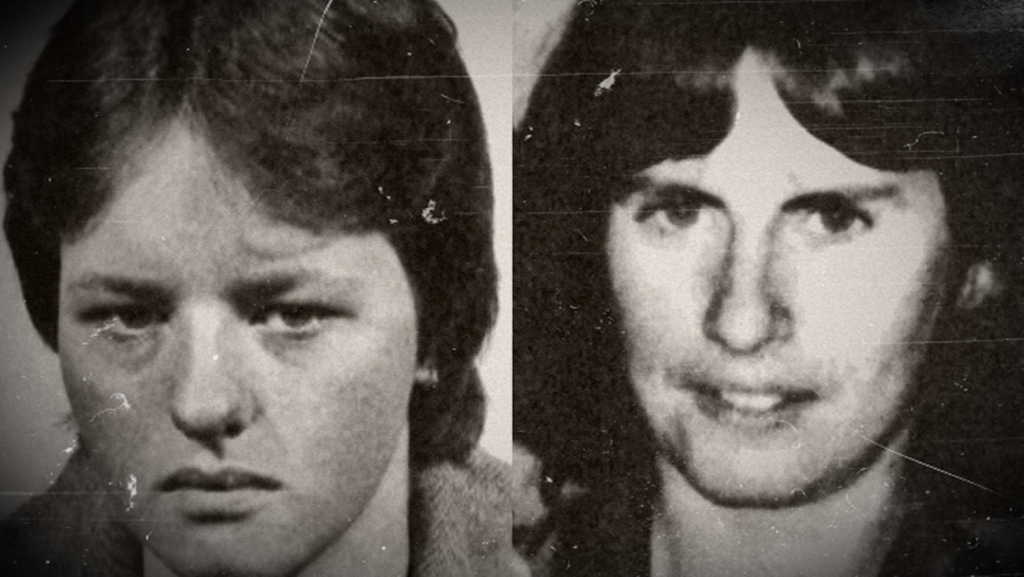
Dundee is the fourth-largest city in Scotland and was never known as a particularly high crime area. But in 1979 and 1980, the murders of two women, eleven months apart, put residents of the city on high alert, suspecting that a serial killer might be in their midst.
On March 20th, 1979, eighteen-year-old Dundee sex worker and mother of one Carol Lannen took a taxi from her residence on Hill Street to the city center to begin her evening. At around eight p.m., she was spotted on Exchange Street getting into what appeared to be another taxi: a red Ford Cortina estate car driven by a man with a mustache. It was the last time she was seen alive.
The following day, two teenagers discovered Carol’s nude, strangled body in Templeton Woods. Police immediately launched a massive manhunt, searching for the mysterious man in the red Cortina.
Eleven days after Carol’s remains were found, her purse and some items of her clothing were recovered eighty-five miles away, tossed onto the banks of the River Don in Aberdeenshire.
The hunt for Carol’s killer went nowhere, but little did authorities know that less than a year later, another very similar crime would rock the city anew, causing residents to fear that a murderous sexual predator was roaming the streets.
Twenty-year-old Elizabeth McCabe was a trainee nurse, a shy, reserved young woman who was something of a homebody, not known for drinking heavily or going for nights out with friends as many people her age did. She lived with her parents in a house on Lyndhurst Avenue in Lochee.
In late 1979, though, she seems to have loosened up a bit for whatever reason and started making occasional forays to local pubs and nightclubs in Dundee. This newfound social life went on for a couple of months, and on Sunday, February 10th, 1980, she went out with several friends, hitting a few pubs around the city. As the night went on, the group ended up at Teazer’s Disco on Union Street.
Although Elizabeth was reportedly in good spirits earlier in the night, her friend Sandra Niven would later state that right around midnight, she found Elizabeth crying in the club’s bathroom, convinced that no one liked her. It’s not known what might have spurred this shift in the young woman’s mood.
At around twelve-thirty a.m., the group was beginning to disperse and wind down the evening. Sandra, who had lost track of Elizabeth in the club sometime before, expected to find her friend waiting for her outside the entrance, but Elizabeth was not there. Sandra then checked a nearby taxi stand, knowing that Elizabeth would usually catch a taxi home, but there was no sign of her there either. Troubled but figuring that Elizabeth had become upset and left on her own without anyone noticing, Sandra went home herself.
Elizabeth never arrived at her residence, however, and her parents were immediately alarmed, as Elizabeth was very conscientious, and had to work the next day. Her mother wanted to report her disappearance to the police right away, but erroneously believed that there was a twenty-four-hour wait, so didn’t phone until that amount of time had passed.
Investigators began searching for the young woman but found nothing for more than two agonizing weeks. Then, sixteen days after Elizabeth went missing, her nude body was found by two rabbit hunters in a clearing in Templeton Woods. The spot where her remains were discovered lay only one-hundred-fifty yards from where Carol Lannen’s body was found the previous March.
Elizabeth had been draped with a dark blue sweater and then hastily covered with branches. A post-mortem examination determined that the victim had died from asphyxia due to compression of her neck. A later review of the evidence concluded that she had likely been killed during a struggle or a sexual assault.
Items of Elizabeth’s clothing were found along Coupar Angus Road in the Dundee city center near the end of February. Two months later, in April of 1980, a photo, a pair of shoes, and pieces of jewelry that belonged to her were recovered from Cobden Street.
During the course of the investigation into Elizabeth’s murder, authorities learned that three months prior to her disappearance, Elizabeth had gotten into a car she mistook for a taxi after a night out. Also, according to her friend Sandra Niven, Elizabeth had been propositioned for sex by a man who thought she was a prostitute not long before she vanished. Elizabeth had joked about the misunderstanding at the time, but detectives saw it as a possible lead.
Two witnesses told the police that they had seen a Ford Cortina with a taxi sign on it in the area at around the time Elizabeth disappeared. They further reported that the driver looked to be alone and had his interior lights on, noting that he was also driving with his wrists, as though he had something on his hands and didn’t want to dirty the steering wheel.
These same witnesses had recognized the driver as a man named Vincent Simpson, the owner of a small taxi company in Newtyle. Police were keen to question Simpson about the murder, and though he did admit to being in Templeton Woods walking his dog a few hours before Elizabeth went missing, he denied ever having seen her before or being involved in her murder.
He also stated that he had gone back into the woods later that night because he’d noticed a car parked there and wanted to see if there was anything he could steal from it. Simpson had a long criminal record of petty offenses stretching back to 1967 and was known to be a gambling addict. Without prompting, he also informed police that he was a peeping tom who often used binoculars to spy on couples in Templeton Woods.
In spite of his suspicious behavior, there was no solid evidence linking Simpson directly to the murder of Elizabeth McCabe, and he was eventually released without charge. As 1980 wore on, the case began to stagnate, and though it remained open, it was placed on the back burner.
More than a decade went by with no further progress on either homicide. Then, in 1996, authorities in Glasgow reopened the infamous Bible John case, in which three women were murdered in 1968 and 1969 by a man who had picked up his victims at the Barrowland Ballroom. This action prompted Dundee officials to review the cases of Carol Lannen and Elizabeth McCabe, which in the ensuing years had become two of the most notorious unsolved crimes in Scotland.
Several more years passed, but in 2004, investigators announced that they were exploring a connection between the slayings of Carol Lannen and Elizabeth McCabe and the so-called World’s End murders, the killing of two seventeen-year-old girls named Christine Eadie and Helen Scott in Edinburgh in 1977. These cases were under the auspices of Operation Trinity, a task force seeking to link unsolved crimes to Scottish serial killer Angus Sinclair.
Sinclair was eventually convicted of the World’s End murders and was strongly suspected of being responsible for the slayings of three other women in Glasgow in 1977: Anna Kenny, Hilda McAuley, and Agnes Cooney.
However, detectives found that Sinclair could not have murdered either Carol Lannen or Elizabeth McCabe, since he was in prison at the time of both murders. As the case review continued, investigators came to the conclusion that the Carol Lannen and Elizabeth McCabe homicides had likely not even been committed by the same perpetrator.
In 2005, after examining newly processed DNA evidence in the case, police arrested taxi driver and original suspect Vincent Simpson for the murder of Elizabeth McCabe. At the time of his trial in October of 2007, he was also saddled with two additional charges of breach of the peace, as he was alleged to have been accosting women in Dundee at around the time of Elizabeth’s disappearance.
The prosecution presented lab results demonstrating that DNA found on the neck and back of the sweater used to drape Elizabeth’s body had very likely come from Simpson, as did a hair that was recovered from the plastic sheet used to take the victim’s body to the mortuary. The man who conducted the DNA tests told the court that the chances of the DNA belonging to anyone other than Victor Simpson hovered around one in forty million.
Simpson’s defense team, though, argued that the samples had been contaminated and that the hair on the plastic sheet wasn’t even found during the first reexamination of the evidence in 2003. Though Simpson did not take the stand in his own defense, his lawyers stated that he had been either carrying fares around in his taxi or at a local casino at the time of the murder.
Prosecuting attorneys shot back by asserting that police had interviewed the casino doorman, who had not remembered Vincent Simpson being there that night. They also introduced testimony from the doorman himself, who claimed that Simpson had actually phoned him and tried to get him to say he was at the casino at the time the crime occurred, as though attempting to establish an alibi.
In spite of the compelling arguments, enough reasonable doubt was evidently introduced into the minds of the jury members because Vincent Simpson was found not guilty by a majority verdict in December of 2007. Simpson returned to his normal life, subsequently giving up driving a taxi and becoming a window cleaner in Camberley.
In 2011, Scotland changed the laws regarding double jeopardy, meaning that a previously acquitted suspect could be tried again for the same crime. In light of this, the Elizabeth McCabe case was reviewed once again, though at the time Simpson told the press that he was not concerned about being re-arrested for the murder.
Since that time, there have been no further updates on either the homicide of Elizabeth McCabe or that of Carol Lannen. Authorities are still hopeful that both cases will someday be put to rest, but as of August 2024, neither victim has received justice.
 Crime Immemorial