
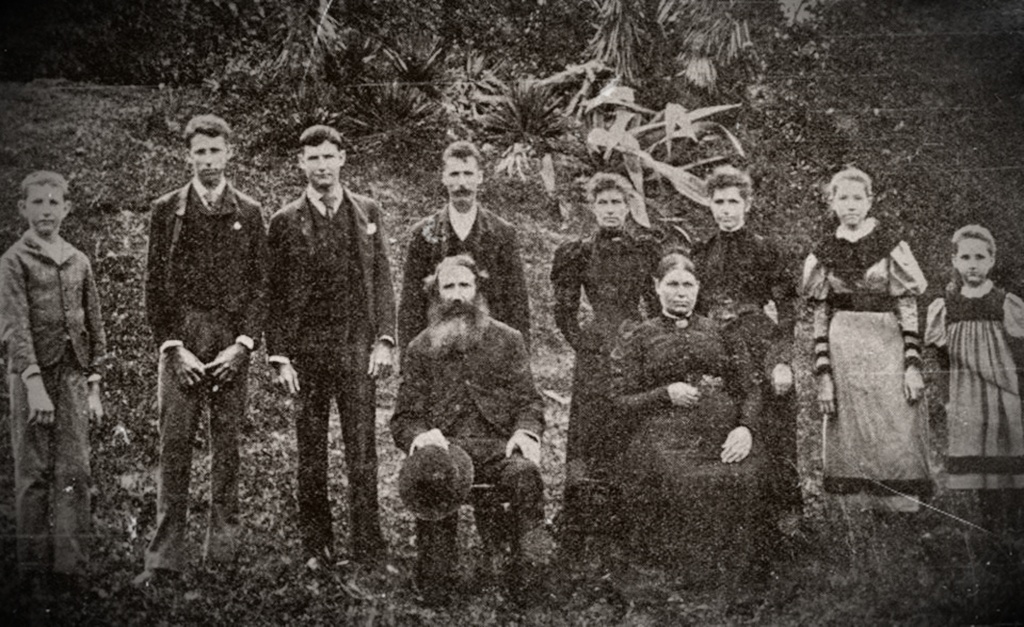
The Murphy family, Irish immigrants who settled in Queensland, Australia around the 1860s, ran a dairy farm at Blackfellow’s Creek, about eight miles from Gatton, a small but growing town sixty-one miles west of Brisbane. Gatton, with a population of around 449 in 1901, was a key stopover point between Brisbane and the Darling Downs, boasting a railway line and two major bridges. The Murphys were a large, religious family, well-integrated into the community, and known for attending St. Mary’s Catholic Church.
On Boxing Day, December 26th, 1898, the Murphy siblings—twenty-nine-year-old Michael, twenty-seven-year-old Norah, and eighteen-year-old Ellen—set out for a dance at the Gatton Divisional Board Hall, a rare social event in the rural district. Michael, who had returned home for the Christmas holidays from his job at a government farm near Westbrook, borrowed his brother-in-law William M’Neill’s sulky (a horse-drawn cart) for the outing. The trio left their farm around eight p.m., arriving in Gatton by nine p.m., only to find the dance had been canceled due to low attendance, particularly of women. Disappointed, they began the six-mile journey back home but never arrived.
The following morning, December 27th, Mrs. Murphy, concerned for her children, sent William M’Neill to search for them. Following the distinctive tracks of his sulky’s wobbling wheel along the Tent-Hill road, M’Neill discovered a horrific scene in a field a little over a mile from Gatton. Michael and Ellen lay back-to-back, just two feet apart, while Norah was positioned twenty-eight feet to the east on a neatly spread rug. All three had been bludgeoned; Michael had also been shot, and Norah strangled. Both sisters had their hands tied behind their backs with handkerchiefs, and their legs were arranged with their feet pointing west—an odd detail never repeated in Australian criminal history. The sulky, forming a triangle with the bodies, stood seventeen-and-a-half feet from Michael and thirty-six feet from Norah, with M’Neill’s horse shot dead between the shafts.
Before alerting the police, M’Neill stopped at the Brian Boru Hotel (later the Imperial Hotel) in Gatton, sharing news of the murders. This led to a rush of up to forty townspeople to the scene, potentially contaminating evidence. The local police sergeant, notified by M’Neill, recognized the case’s severity and attempted to send an urgent telegram to Brisbane for assistance. However, due to a misunderstanding about police authority to mark telegrams as “urgent” and the public holiday delay, the message wasn’t opened until nine a.m. on December 28th. Meanwhile, the sergeant delegated two locals—a magistrate, Thomas Wilson, and a bootmaker, William Devitt—to guard the scene, but neither prevented further contamination.
The investigation, led by Inspector Charles Urquhart, was marred by errors. The delayed telegram and the failure to secure the crime scene allowed critical evidence to be lost. A Royal Commission later criticized Urquhart’s lack of detective skills and his assumption that the murders were a spontaneous act by an itinerant swagman. The commission also faulted the sergeant for not knowing he could send urgent telegrams and for not returning to the scene promptly. The Queensland Government offered a £1,000 reward on January 3rd, 1899, for information leading to the conviction of the killer(s), but no one was ever charged.
The crime scene’s peculiarities—such as the precise arrangement of the bodies and the rug under Norah—suggested a deliberate act, possibly with a personal motive. The brutality, including the sexual assault of the sisters before their deaths, shocked the public, and the case drew national and international attention. Newspapers published lurid details, and the Queensland State Archives received hundreds of public submissions, including letters claiming supernatural insights into the crime.
Several suspects emerged, but none were conclusively linked to the crime. One was Thomas Day, a butcher living nine-hundred feet from the murder site. Witnesses reported seeing him on the road where the Murphys disappeared, and one claimed to have seen him washing blood from a pullover days later. A constable suggested Day’s involvement in another local murder, that of Alfred Stephen Hill in Oxley, with the same revolver potentially used in both crimes. In 1906, a revolver with four spent chambers—matching the shots fired in the Oxley and Gatton cases—was found near Day’s former workplace. However, Day enlisted in the Australian Army after being questioned and deserted in May 1899, leaving his whereabouts unclear.
Another theory, proposed by Brisbane researcher Stephanie Bennett in 2013, pointed to Joe Quinn, a swagman with a criminal history who frequented Gatton. Bennett suggested Quinn acted out of revenge after Michael Murphy exposed his criminal past during an altercation in Longreach during the Shearers’ Strike. While compelling, this theory lacks definitive evidence. More recently, historian Caroline Stevenson argued in a book published by Jack Sim that the Gatton murders were connected to the unsolved murder of a teenage boy in Brisbane, citing twenty-six similarities between the cases, though details remain speculative.
Another suspect, Richard Burgess, a known criminal released from prison in November 1898, was investigated but had an ironclad alibi placing him elsewhere on Boxing Day. Despite his history of violent crimes, including rape, police could not connect him to the murders, and he left Australia in March 1899.
The Gatton Murders remain one of Australia’s most notorious unsolved cases, often ranked among the top unsolved crimes in the nation’s history. The apparent lack of motive, the ritualistic arrangement of the bodies, and the investigative failures have fueled speculation for over a century, but as of this writing, there are likely no hopes of the bizarre triple murder ever being resolved.
 Crime Immemorial