
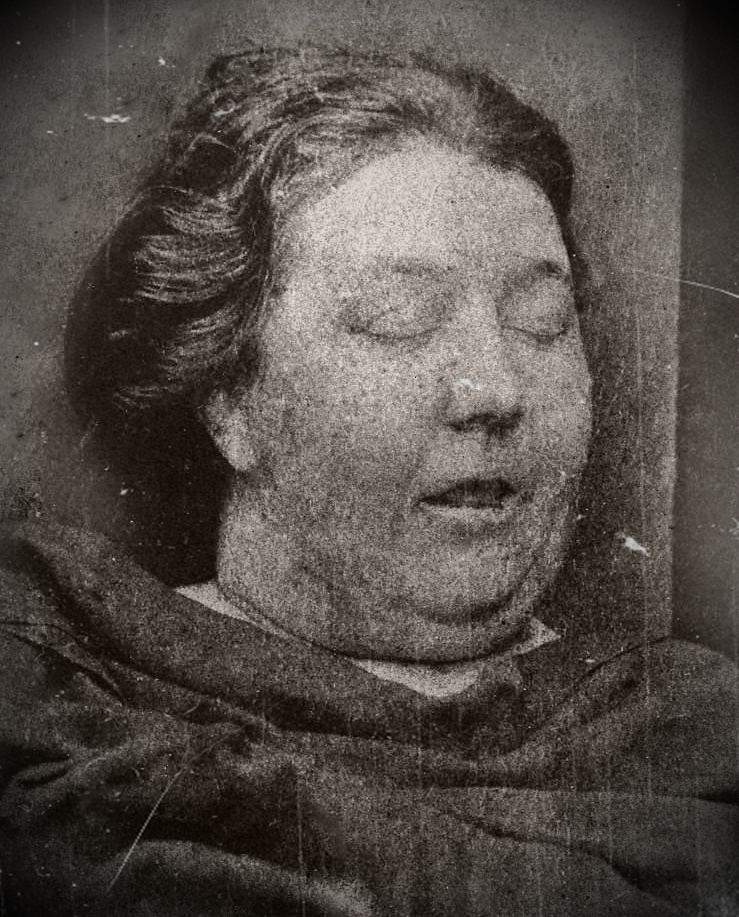
Martha Tabram, born Martha White on May 10th, 1849, in Southwark, London, was the youngest of five children. Her life was fraught with difficulties from an early age. At sixteen, her parents separated, and her father died shortly after. By 1869, she married Henry Samuel Tabram, a furniture packer, and they had two sons, Frederick and Charles. However, Martha’s heavy drinking strained the marriage, leading to their separation in 1875. Henry initially provided an allowance, but this ceased when he learned she was living with another man, Henry Turner, a carpenter.
By 1888, Martha’s life had spiraled further. Her relationship with Turner ended due to her alcoholism, and she resorted to selling trinkets and engaging in prostitution to survive. At the time of her death, she was living in a common lodging house at 19 George Street, Spitalfields, a notorious area plagued by poverty and crime.
On the evening of August 6th, 1888, a Bank Holiday Monday, Martha was seen drinking ale and rum with Mary Ann Connelly, known as “Pearly Poll,” and two soldiers at the Angel and Crown pub near George Yard. Shortly before midnight, the group split into pairs, with Martha accompanying a soldier into George Yard, a narrow, poorly lit alley now known as Gunthorpe Street. This was the last confirmed sighting of her alive.
The events that followed remain shrouded in mystery. Sometime between two a.m. and three-thirty a.m., Martha was attacked on the first-floor landing of George Yard Buildings, a tenement housing the area’s poorest residents. Her assailant inflicted thirty-nine stab wounds, targeting her throat, chest, abdomen, and genitals. Nine wounds pierced her throat, five struck her left lung, two her right lung, one her heart, five her liver, two her spleen, and six her stomach. Dr. Timothy Killeen, who conducted the post-mortem, noted that most wounds were likely caused by a right-handed attacker using a penknife, but a deeper wound to the sternum suggested a larger weapon, possibly a dagger or bayonet. Despite the body’s position—lying on her back with clothing raised, suggesting a sexual context—Killeen found no evidence of intercourse.
The body went unnoticed for hours in the dark stairwell. At two a.m., residents Joseph and Elizabeth Mahoney passed the landing and saw nothing unusual. Around the same time, PC Thomas Barrett questioned a grenadier guardsman loitering nearby, who claimed he was waiting for a friend. At three-thirty a.m., cab driver Albert George Crow mistook Martha’s body for a sleeping vagrant. It wasn’t until just before five a.m. that dock laborer John Saunders Reeves, descending the stairs for work, realized she was dead and alerted authorities.
Inspector Edmund Reid of the Metropolitan Police’s H Division led the investigation. Efforts to identify the soldier seen with Martha proved fruitless. PC Barrett failed to recognize anyone during a visit to the Tower of London on August 7th, and although he picked out a man during a parade of soldiers on August 8th, the identification led nowhere. Pearly Poll’s testimony about the soldiers provided little clarity, and she became elusive after the inquest. Residents reported hearing cries of “Murder!” around the time of the killing, but such disturbances were common in Whitechapel, and no one investigated.
The inquest, held by deputy coroner George Collier on August 23rd, 1888, at the Working Lads’ Institute, concluded that Martha was “foully and brutally murdered by some person or persons unknown.” The jury noted the lack of lighting in the tenement staircases, urging improvements, but no suspect was apprehended.
Martha Tabram’s murder is a focal point in the debate over Jack the Ripper’s victims. While the canonical five—Mary Ann Nichols, Annie Chapman, Elizabeth Stride, Catherine Eddowes, and Mary Jane Kelly—were killed between August 31st and November 9th, 1888, with distinct mutilations suggesting anatomical knowledge, Tabram’s case differs. Her wounds, though numerous, lacked the surgical precision and organ removal seen in later killings. However, the ferocity of the attack, the targeting of a prostitute in Whitechapel, and the geographic proximity to later murders—near the center of the canonical five crime scenes—fuel speculation that she was an early victim, perhaps before the Ripper refined his methods.
Some theories, like that of Australian researcher Ted Linn in 1998, even proposed Henry Samuel Tabram as the Ripper, citing cryptic clues in alleged Ripper letters, though this lacks corroboration. Others, including Inspector Walter Dew, who worked on the case, believed Martha was a Ripper victim. In contrast, a 1894 memorandum by Melville Macnaghten, a senior police official, asserted the Ripper claimed only the canonical five, dismissing Tabram. Modern “Ripperologists” remain divided, with some arguing the use of two weapons and the absence of mutilation suggest a different killer.
Likely buried in a pauper’s grave at the City of London Cemetery, Martha’s exact resting place is unknown, though a memorial plaque now honors her there. Her death, whether at the hands of Jack the Ripper or another, remains unsolved.
 Crime Immemorial