
On the cold morning of March 26th, 1887 in Rahway, New Jersey, four brothers—Alfred, Frank, Thomas, and Irving Worth—made a gruesome discovery while walking to work at the felt mills near Bloodgood’s Pond in Clark. Just off Central Avenue, near Jefferson Avenue and several hundred feet from the Central Avenue Bridge over the Rahway River, they found the frozen body of a young woman lying in a pool of blood. Her throat had been slashed twice from ear to ear, her hands bore defensive wounds, and the right side of her face was severely bruised from a brutal beating. Nearby lay a bloodstained jackknife with a tortoiseshell handle, unmistakably the murder weapon, alongside “huge” footprints in the mud, a man’s straw hat, and a large brown button from a men’s overcoat.
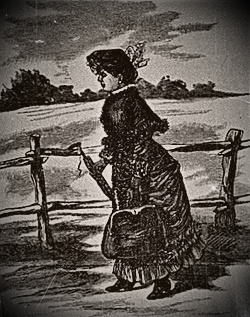
This horrific scene marked the beginning of one of New Jersey’s most infamous unsolved cases, known as the Rahway Murder of 1887 or the case of the “Unknown Woman.”
The victim, believed to be in her early 20s, was described as attractive, with brown hair and blue eyes. Despite extensive efforts, her identity was never confirmed, earning her the moniker “Rahway Jane Doe” or “The Woman in Green,” after the dark green cashmere dress she wore. She had been carrying a basket of eggs.
Her body was found frozen to the ground, indicating she had been killed the previous night, likely after a fierce struggle, as evidenced by the trail of bloodstains and her defensive wounds. Notably, she still wore three rings, a gold pin, and a horseshoe brooch, suggesting robbery was not the motive, though no money was found on her. A black valise containing women’s clothing was discovered 600 to 800 yards away in a stream, adding to the mystery but offering no clear answers.
The murder gripped the nation, drawing thousands to Rahway to view the body at Marsh and Ryan’s undertaking establishment. The Rahway Police Department, led by Chief William Tooker, was unaccustomed to such a high-profile case in their quiet town. To aid identification, the police dressed the body in her original clothing and took photographs—among the first ever used as evidence by a police department. These images were circulated widely, even displayed at the 1887 Chicago World’s Fair, yet no one could identify her. A post-mortem photograph reportedly appeared in the March 30, 1887, issue of the New York World. The New York Times noted frustration with the slow progress of the investigation, criticizing the local police as “country hawkshaws” for delaying the release of the photos. A special train from Jersey City to Rahway was arranged to accommodate the influx of curious visitors, with up to 10,000 people reportedly filing past her coffin. Despite the public spectacle, no definitive leads emerged.
Investigators uncovered tantalizing but inconclusive clues. The large footprints, size eight men’s shoes, suggested a male assailant, and the straw hat and overcoat button pointed to a man’s presence at the scene. A confession by Kasper Shumbeck in Salem, Illinois, in June 1887, briefly raised hopes. Shumbeck claimed he and a friend named John, a Swede, killed a young woman named Clairy in Rahway on March 13th, 1887. However, the date did not match the case details, and the confession was ultimately deemed unreliable.
At the time of the murder, Francis Tumblety, a controversial figure later named by some Ripperologists as a suspect in the Jack the Ripper killings, was living in New York City, just a short distance from Rahway. While no direct evidence links him to the crime, the proximity and the savagery of the murder have fueled speculation among researchers. However, like the victim’s identity and her killer’s, this connection remains unproven.
Public fascination with the slaying led to bizarre episodes, such as a man named Crane exhibiting a rooster on Cherry Street, claiming it hatched from an egg found in the victim’s basket, charging ten cents per view. Despite rewards, hearings, and countless theories from amateur and professional detectives, the case remained unsolved.
In May 1887, the Unknown Woman was laid to rest in Rahway Cemetery next to the historic Merchants’ and Drovers’ Tavern, her white marble headstone inscribed simply, “Unknown Woman Found Dead March 25, 1887.” The case continues to captivate, with local historian Alex Shipley documenting it in his book The Case of the Unknown Woman. For the past thirty years, two sisters have tended her grave, placing a wreath each Christmas and planting flowers in spring. In 2012, to mark the 125th anniversary, the Merchants and Drovers Tavern Museum Association hosted tours of the cemetery, where interpreters in period dress shared stories of the victim and witnesses, keeping the tale alive.
 Crime Immemorial