
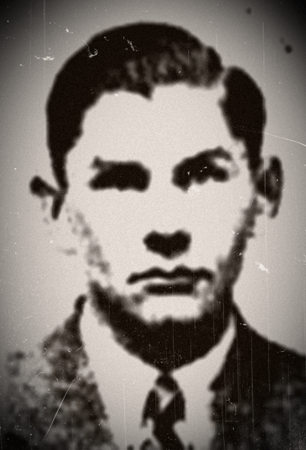
Jerzy Strzadala was born on April 18th, 1915, in the rural village of Zabozorzy in southern Poland. Trained as a wheelwright, his early life was upended by the outbreak of World War II. In 1939, Nazi Germany invaded Poland, and Strzadala lived under occupation until 1943, when he was briefly conscripted into the German Army—a fate that befell many Poles forced into labor or service. Captured by British forces in 1944, he was repatriated to the UK as a displaced person and spent time in camps in Scotland, including Polkomet near Whitburn and Turf Hills in Kinross, where he worked as a medical orderly.
Post-war, Jerzy resettled in the UK through the Polish Resettlement Corps, a program aiding Eastern European veterans and refugees. By July 1947, he had arrived in Hirwaun, a mining village near Aberdare, Glamorgan, Wales, lodging at the Miners’ Hostel while training at a colliery in Oakdale, Monmouthshire. He took a job as an assistant collier at Tirherbert (or Herbert’s) Colliery, descending into the pits each day. Described by those who knew him as polite, quiet, and always ready with a smile, Jerzy kept to himself. He didn’t drink, smoke, or chase nightlife; instead, he scrimped his wages—often carrying £10 to £20 in cash—to send money and clothes back to his elderly mother in Poland. Unmarried and without close friends, he was a man adrift in a new land.
Monday, April 19th, 1948, dawned like any other for the then thirty-three-year-old Jerzy. He clocked in for the day shift at six thirty a.m. and out at two thirty p.m., boarding a bus back to the Hirwaun hostel. Around five p.m., he shared a meal with fellow lodgers, then caught another bus to Aberdare town center with a nineteen-year-old colleague. They parted ways after Jerzy posted a registered letter at the post office and bought brown paper from a newsagent on Cannon Street, perhaps for wrapping a parcel home.
Sighted multiple times in the bustling streets, Jerzy seemed restless. A secretary saw him pacing outside the Empire Ballroom, as if waiting for someone. By seven forty-five p.m., a fellow Polish miner spotted him at the park’s entrance on Park Lane, deep in friendly conversation with a younger man—short, stout, dark-haired, in his mid-twenties, dressed in a blue pinstriped suit. They spoke in Polish, suggesting a prearranged meeting. The witness later recalled it seemed amicable, but he didn’t see them enter the park together.
What happened next remains a mystery. An unconfirmed sighting around nine p.m. placed Jerzy near the park’s boathouse, mere yards from where his body would eventually be found, being followed by another man. The first man ran briefly, then both vanished from view. A midnight rainstorm would later wash away potential blood trails, complicating the scene.
The next morning, April 20th, three schoolboys, on their way to class and trying to aid a lame bird, pushed through the rhododendron thicket off Gland Road. There, twenty-four yards from the boundary wall and thirteen yards from a pathway, lay Jerzy’s body, stretched on its back, face caked in blood. His wallet, pay packet, and a brown paper bag were nearby, but his wristwatch and most of his cash, estimated at several pounds, were gone. Defensive wounds marred his hands and forearms, evidence of a desperate fight.
The boys fled to summon help from a coroner across the road, who alerted police by one thirty p.m. The body was cold; death had come between eight p.m. and midnight, per a post-mortem that revealed forty-four stab wounds, mostly superficial but three deep enough to drain his heart of blood. The weapon was thought to be a sharp, six-inch dagger used with ferocious force.
Glamorgan Constabulary launched a massive probe, but the case’s brutality drew national eyes. On April 22nd, Chief Inspector Robert “Honey” Fabian, Scotland Yard’s star detective, fresh from solving London’s infamous “Blazing Car Murder,” arrived with a team, setting up in a Market Street hotel. He praised his Welsh counterparts as “an excellent lot of chaps” and dove in methodically: door-to-door canvasses, park searches with metal detectors (yielding only a rusty clasp knife), and dredging the lake for the missing blade.
Over 2,000 Polish miners in the Cynon Valley were scrutinized—shift logs checked, possessions searched, interviews hampered by language barriers. The park witness viewed lineups but couldn’t identify the mystery man. Bloodstained banknotes and clothes trickled in from the public, but forensics (primitive by today’s standards) dismissed them as animal blood from butchers or farms. A waistcoat and trousers dumped near the colliery were too pristine to link. Jerzy’s letters, translated from Polish, revealed no enemies, save an anonymous 1946 threat from a jealous suitor in France, ruled out by alibi.
No arrests followed, but theories festered. The simplest was a botched robbery, given the missing watch and cash. Yet the forty-four stab wounds suggested a personal vendetta. In Aberdare’s immigrant enclaves, darker rumors swirled: Jerzy’s wartime conscription had perhaps branded him a Nazi collaborator, and the park meeting was a reckoning by a fellow Pole seeking revenge. One tale claimed the killer was a concentration camp survivor confronting a guard; another, espionage ties from occupied Poland.
In 2009, South Wales Police listed the case among twenty-eight cold files open for review, but no breakthroughs have surfaced. Today, the identity of Jerzy Strzadala’s killer is still unknown.
 Crime Immemorial