
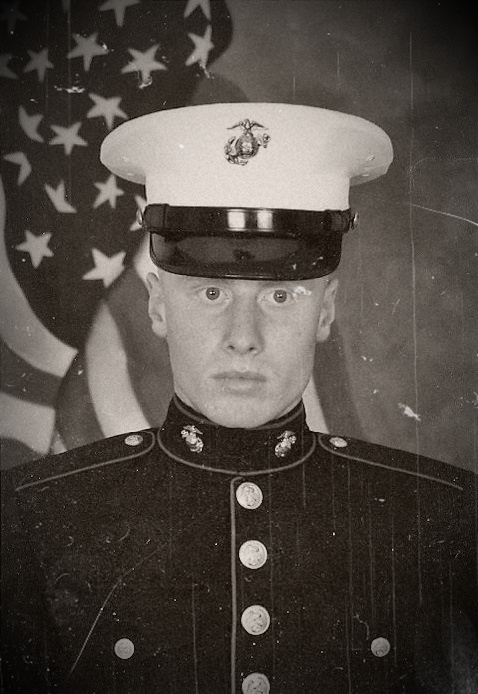
David Vernon Cox, born on November 27th, 1966, in Boston, Massachusetts, grew up in Needham and graduated from Needham High School. From a young age, he aspired to serve in the United States Marine Corps. After enlisting straight out of high school in 1985, David dedicated himself to the Marines, eventually achieving the rank of Corporal (E-4). He served until 1989, including a stint at the Guantanamo Bay Naval Base in Cuba.
David’s time in the Marines brought him into a high-profile incident that would later gain widespread attention. He was one of several Marines involved in a disciplinary action known as a “Code Red,” an unauthorized hazing or beating of a fellow Marine perceived as underperforming. The incident resulted in serious injury to the victim, leading to charges against David Cox and others, including attempted murder and conspiracy to commit murder. David stood trial and was acquitted or had charges resolved in his favor. This real-life event partly inspired playwright Aaron Sorkin’s 1989 stage play A Few Good Men, which was adapted into the acclaimed 1992 film starring Tom Cruise and Jack Nicholson. Though fictionalized, the core elements of military justice, loyalty, and a “code” within the ranks echoed aspects of David’s experience.
By the early 1990s, David had left the Marines and returned to civilian life in Massachusetts. He settled in Natick, living with his girlfriend, Elaine Tinsley, on Water Street. He worked part-time for UPS and was eagerly awaiting confirmation of a full-time position.
On the morning of January 5th, 1994, twenty-seven-year-old David was at home alone, anticipating a call from UPS about the job offer. Elaine left for work around eight thirty a.m. When she called home at noon, there was no answer. Upon returning that evening, she found the apartment unusual: interior doors were open, their pet rabbit was loose, and David was gone. His truck remained in the driveway with keys in the ignition, an uncashed paycheck on the dashboard, and his handgun still in the glove compartment. An answering machine message indicated he had received the job offer from UPS. Initially, police suspected he might have left voluntarily, but the circumstances raised concerns.
Nearly three months later, on April 2nd, 1994, a canoeist paddling along the Charles River in Medfield, a town near Natick, spotted a white high-top sneaker protruding from a pile of pine branches in a wooded preservation area. Approaching the site, the canoeist discovered a body hidden under snow and branches, more than half a mile from the nearest road and roughly five miles from David’s apartment. It was David Cox.
The medical examiner determined David had been killed execution-style: shot four times with a 9mm firearm. The first bullet struck the back of his neck, followed by three more into his left torso. Three 9mm shell casings were recovered at the scene, suggesting he was murdered there. The location—between two hunting ranges—likely meant gunshots blended with routine hunting activity and drew no immediate alarm.
The victim was found wearing his military-issued camouflage field jacket over a black hooded Marine Corps Scout Sniper hoodie, along with jeans and white sneakers: the same outfit he had on when he disappeared. Family and investigators noted he rarely wore his Marine gear in public, making his attire that day particularly puzzling. The sneakers seemed impractical for trudging through eight inches of fresh snow from the previous day, further suggesting he may not have walked far voluntarily or was unaware of the terrain.
Robbery was quickly ruled out; his wallet remained in his pocket with cash and credit cards untouched. Authorities believed David knew his killer and went willingly, possibly lured by someone he trusted. The premeditated nature of the site reinforced this view. Speculation included possible ties to drugs or unresolved issues from his Marine days, but no concrete evidence emerged linking the murder to his military past.
Despite extensive investigation, including a 1996 feature on Unsolved Mysteries, the case went cold. In later years, Massachusetts State Police, including retired Marines Sgt. John Fanning and Trooper Yuriy Bukhenik, reopened efforts around the twenty-fifth anniversary (circa 2019–2022), hoping new forensic techniques or tips might break it open. As of recent reports in the mid-2020s, marking over thirty years since the crime, no arrests have been made, and the killer remains at large.
 Crime Immemorial