
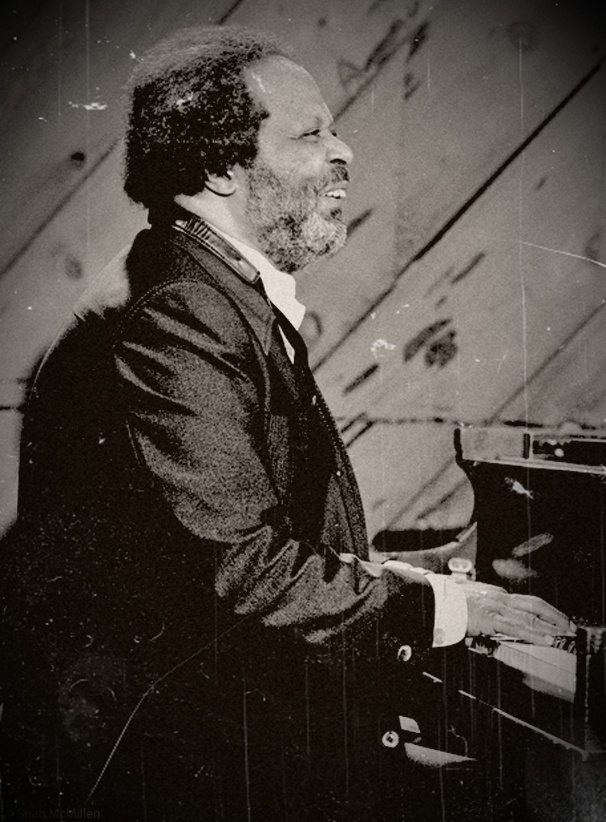
John Arthur “Jaki” Byard Jr. was born on June 15th, 1922, in Worcester, Massachusetts. A highly versatile and eclectic musician, Jaki was proficient on multiple instruments, including piano (his primary), trumpet, saxophones, and more. His playing style masterfully blended stride piano, bebop, avant-garde, ragtime, classical influences, and even elements of vaudeville and theater music, earning him a reputation as one of the most stylistically expansive pianists in jazz history.
Jaki gained prominence in the 1950s and 1960s. He worked extensively with Charles Mingus, touring Europe with the bassist’s band and appearing on landmark recordings such as Mingus Mingus Mingus Mingus Mingus and The Black Saint and the Sinner Lady. He also collaborated with Rahsaan Roland Kirk and other major figures. In addition to performing, Jaki was a dedicated educator, teaching at the New England Conservatory of Music (NEC) in Boston for many years, where he influenced generations of musicians with his broad knowledge and innovative approach. He led his own groups, including the Apollo Stompers, and recorded prolifically as a leader for labels like Prestige, Muse, and Soul Note.
By the late 1990s, Jaki, then in his mid-seventies, had become more reclusive. He lived quietly in the Hollis neighborhood of Queens, New York City (at 192-54 Hollis Avenue), sharing the two-story home with two of his daughters.
On the evening of February 11th, 1999, Jaki Byard was found dead in his home. Family members discovered him slumped on a couch around eleven forty-five p.m. Police arrived shortly after. An autopsy conducted the following day by the New York City Medical Examiner’s Office revealed that he had been killed by a single gunshot wound to the head. The bullet entered through his nose (just below the bridge) and exited under/near his ear or the back of his neck, passing through his skull.
The wound was initially mistaken by an investigator at the scene for signs of a stroke or natural causes. There were no reports of a struggle, forced entry, or signs of robbery. Crucially, other family members in the house at the time reported hearing no gunshot. The death was officially ruled a homicide on February 12th, 1999.
Police theorized that Jaki likely knew his killer, given the intimate nature of the wound, the lack of forced entry, and the apparent absence of noise or disturbance. The weapon was never publicly identified in detail, and no clear motive emerged from early reports.
The New York Police Department investigated the case, but leads appear to have quickly gone cold. Contemporary newspaper accounts covered the discovery and autopsy findings, while tributes in outlets like NPR’s Fresh Air and jazz publications mourned the loss of a giant in the field. Byard’s funeral took place on February 19th, 1999, with mourners singing spirituals including “This Little Light of Mine.”
Over two decades later, the murder remains unsolved. Discussions in jazz forums and occasional retrospectives (such as a 2019 article marking the twentieth anniversary) note that no significant progress was ever announced publicly. The case is frequently cited among the jazz community’s unsolved homicides.
 Crime Immemorial