
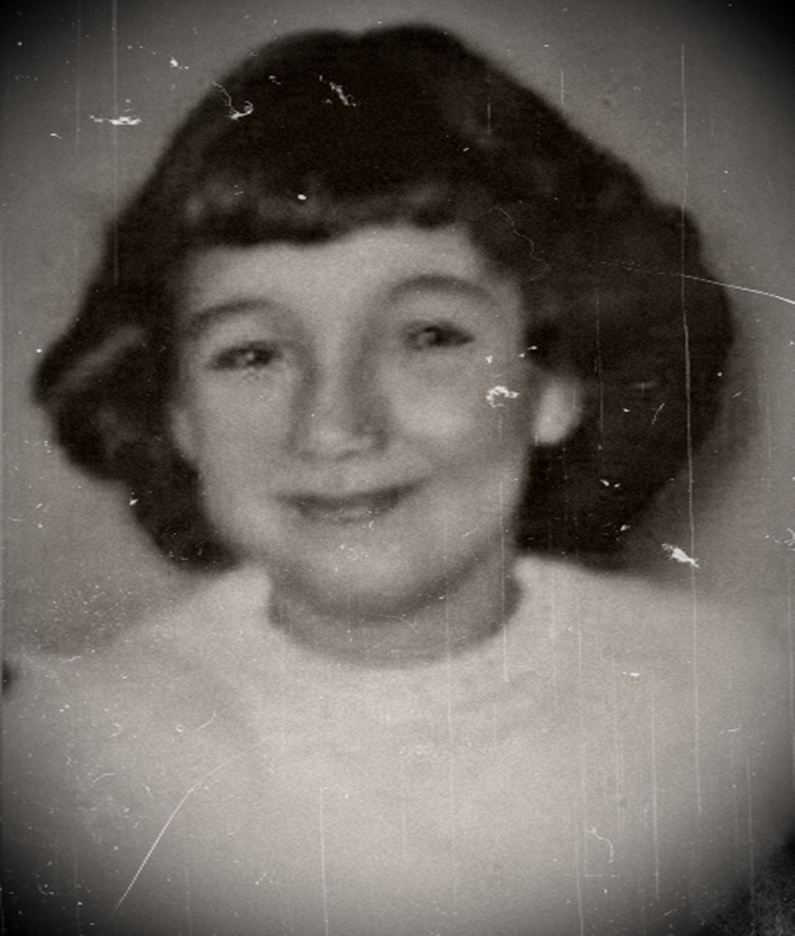
Seven-year-old Maria Ridulph was born in Sycamore, a small town in northern Illinois known for its peaceful, rural charm. The youngest of four children, she lived with her parents, Michael and Frances Ivy Ridulph, on Archie Place. Michael worked at a local factory, while Frances was a homemaker. Maria was described as a bright, honor-roll second-grader at the Evangelical Lutheran Church of St. John, where she earned awards for perfect Sunday school attendance. Friends and family remembered her as high-strung and nervous, a “screamer” who was afraid of the dark, but also playful and endearing.
On the evening of December 3rd, 1957, Maria and her best friend, eight-year-old Kathy Sigman, stepped out after dinner to play in the fresh snow. They engaged in a game called “duck the cars,” darting back and forth to avoid the headlights of passing vehicles near the corner of Archie Place and Center Cross Street. Around six thirty p.m., a man in his early twenties approached them. He introduced himself as “Johnny,” claiming to be twenty-four years old and unmarried. Tall with light hair, a slender chin, a gap in his teeth, and wearing a colorful sweater, he asked if the girls liked dolls and offered Maria a piggyback ride.
Kathy ran home briefly to fetch her mittens. When she returned just minutes later, Maria and “Johnny” were gone. Alarmed, Kathy alerted the Ridulph family, who initially thought Maria might be hiding. Her brother Charles searched the neighborhood, but to no avail. By seven p.m., the family called the police. What followed was a massive search involving local authorities, armed civilians, and soon, the FBI, who joined within two days suspecting a possible interstate abduction under the Lindbergh Law. The case drew national attention, with President Dwight D. Eisenhower reportedly requesting updates from FBI Director J. Edgar Hoover.
For months, hope flickered amid despair. Then, on April 26th, 1958, two tourists hunting for mushrooms in a wooded area along U.S. Route 20 near Woodbine, Illinois—about ninety miles from Sycamore—stumbled upon skeletal remains under a fallen tree. The body, clad only in a shirt, undershirt, and socks, was identified as Maria’s through dental records, a lock of hair, and clothing remnants. Her other garments were missing, and decomposition made determining the cause of death challenging. An initial autopsy by the coroner yielded no definitive answers, and no crime scene photos were taken to prevent leaks.
The FBI withdrew once it was clear the crime remained within Illinois. Investigators pursued leads on transients, sex offenders, and locals known for interacting with children, but nothing stuck. Kathy Sigman, the sole eyewitness, described “Johnny” and viewed suspect photos, even identifying one man in a lineup who had a solid alibi.
One early person of interest was eighteen-year-old John Tessier (later Jack McCullough), a neighbor living two blocks away. His name matched “Johnny,” and he fit the physical description. Questioned on December 4th, Tessier claimed he was in Rockford, forty miles away, enlisting in the Air Force. He provided details of a train trip from Chicago, a six fifty-seven p.m. collect call to his parents from a Rockford post office pay phone, and a meeting with recruiters. Phone records and recruiter statements corroborated his alibi, and he passed a polygraph test. Cleared by December 10th, Tessier shipped out for basic training the next day.
As years turned to decades, Maria’s murder became one of the nation’s oldest unsolved cases. In 1997, Sycamore Police Lieutenant Patrick Solar “closed” it, pointing to deceased carnival worker William Henry Redmond as the likely culprit based on circumstantial evidence, including inmate statements. However, this was never substantiated, and the case lingered in limbo.
The breakthrough came in 2008 when Janet Tessier, McCullough’s half-sister, contacted authorities. She claimed their mother, Eileen, on her deathbed in 1994, implicated John in the disappearance: “Those two little girls, and the one that disappeared, John did it.” Other sisters alleged McCullough molested them as children and lied about his alibi. The case reopened, and in 2011, Kathy (now Chapman) identified a 1957 photo of Tessier as “Johnny.”
McCullough, now seventy-one and living in Seattle under a changed name, was arrested in July 2011. Maria’s body was exhumed for a new autopsy, which suggested she was stabbed in the throat. At his 2012 bench trial, prosecutors relied on eyewitness identification, family accusations, inmate testimonies (claiming McCullough confessed to strangling or smothering Maria), and the unused train ticket suggesting he drove back to Sycamore. No physical evidence linked him to the crime. McCullough was convicted of kidnapping and murder on September 14th, 2012, and sentenced to life in prison, hailed as the resolution of the oldest cold case in U.S. history.
But doubts soon emerged. In 2015, an appellate court upheld the murder conviction but vacated the kidnapping charges due to statutes of limitations. New DeKalb County State’s Attorney Richard Schmack reviewed 4,500 pages of evidence in 2016 and concluded McCullough was innocent. The pivotal proof: confirmed phone records placing him in Rockford at six fifty-seven p.m., making it impossible under road conditions to return to Sycamore in time for the abduction.
On April 15th, 2016, a judge vacated the conviction and released McCullough. Charges were dismissed a week later, and on April 12th, 2017, he received a certificate of innocence. Despite this, some in the Ridulph family and community remain convinced of his guilt.
Maria Ridulph’s murder inspired books like Footsteps in the Snow by Charles Lachman, documentaries, and podcasts. Memorials in Sycamore, including a plaque at the abduction site and a scholarship fund in Maria’s name, honor her memory. But as of this writing in March 2026, the crime remains unresolved.
 Crime Immemorial