
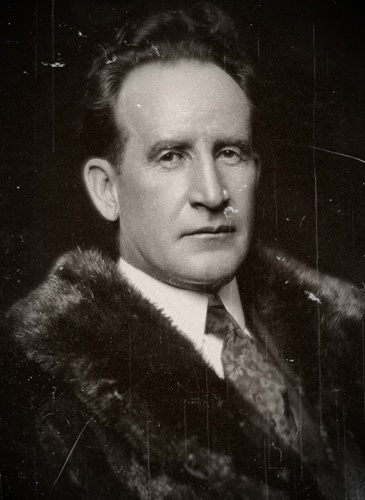
Born on December 23rd, 1874, in Sangerville, Maine, to a prosperous lawyer father and his wife, Harry Oakes was one of five children. He attended Foxcroft Academy, briefly studied at Bowdoin College, and spent two years at Syracuse University Medical School before abandoning academia in 1898 to chase fortune in the Klondike Gold Rush. For the next fifteen years, Harry prospected relentlessly across Alaska, California, Australia, and beyond, enduring hardships that would break lesser men.
His perseverance paid off in 1911 when he staked claim T-1663 in Kirkland Lake, Northern Ontario, Canada. This led to the establishment of the Lake Shore Mine, which by the 1930s became the most productive gold mine in the Western Hemisphere and the second-largest in the Americas. Harry amassed a fortune estimated at $200 million (equivalent to billions today), indulging in luxuries like a 1928 Hispano-Suiza H6B car. He was inducted into the Canadian Mining Hall of Fame, and his former Kirkland Lake home now houses the Museum of Northern History.
In 1923, at age forty-eight, Harry Oakes married Eunice Myrtle McIntyre, a woman half his age, whom he met on a cruise ship in Sydney, Australia. The couple had five children: Nancy, Sydney, Shirley, William Pitt, and Harry Philip. Harry’s philanthropy shone through; he donated land for parks in Niagara Falls, Ontario, funded community projects during the Great Depression, and invested in Florida real estate after the 1928 hurricane.
Facing 85% taxes in Canada, Harry renounced his American citizenship, became a British subject, and relocated to the Bahamas in 1935 at the invitation of real estate developer and legislator Sir Harold Christie, who became a close associate. Harry poured his wealth into the islands: expanding Oakes Field airport, purchasing the British Colonial Hilton Nassau, building a golf course and country club, and developing farming and housing on New Providence. By the early 1940s, he owned about one-third of the island, stimulating the economy of the 70,000-person colony and earning him the title of its most powerful resident.
In recognition of his contributions—donating $500,000 to St. George’s Hospital in London and $1 million to Bahamian charities—King George VI created him Baronet of Nassau in 1939. Harry even served in the House of Assembly. However, his life in paradise was not without tensions, including family strife and business rivalries.
On the evening of July 7th, 1943, a violent storm raged over Nassau. Harry Oakes, then sixty-eight, hosted a small dinner at Westbourne with guests, including Christie, who stayed overnight as a house guest. The family was absent: Eunice and most children were at their summer home in Bar Harbor, Maine, while daughter Nancy was in Miami. After guests departed, Harry retired alone.
Sometime after midnight, he was brutally attacked. Bludgeoned with four savage blows behind his left ear, likely from a miner’s hand pick, and his body partially burned with insecticide or gasoline, feathers from a torn pillow clung to the blood-soaked scene. The flames, concentrated around his eyes, had been doused by the rain gusting through an open window, sparing complete incineration.
Christie claimed to have slept through the storm and crime, discovering the body the next morning. He waited hours before reporting it, adding to the mystery.
The Bahamas’ Governor, the Duke of Windsor (formerly King Edward VIII, exiled to the islands during WWII with his wife Wallis Simpson), took personal charge. A friend of Harry Oakes, the Duke attempted to censor the press but failed when the local Bahamas Tribune published the story. With Scotland Yard unavailable due to the war, he summoned two Miami police captains, Edward Melchen and James Barker, who bungled the case, forgetting fingerprint kits and misleadingly describing the death as suicide initially.
Within thirty-six hours, suspicion fell on Harry’s son-in-law, Count Alfred de Marigny, a Mauritian playboy who had eloped with eighteen-year-old Nancy in 1942 without parental consent. De Marigny, twice previously married and on poor terms with Harry, was accused of seeking inheritance. The key evidence was a fingerprint allegedly on a Chinese screen in the bedroom.
Nancy hired private investigator Raymond Schindler and lawyer Godfrey Higgs. At the trial, de Marigny’s alibi held: dinner guests confirmed he drove them home near the time of the murder. Cross-examination exposed the fingerprint as fabricated, lifted from de Marigny’s water glass during questioning, not the screen, with no matching pattern. Other prints went unprocessed, and Barker’s methods were discredited. After weeks, de Marigny was acquitted, though the jury recommended deportation for his dubious character. No one else was charged.
The murder’s motives remain elusive, with theories abounding. Some point to mafia ties: author Marshall Houts implicated Meyer Lansky, claiming Harry Oakes opposed casinos after initially approving them, with Christie possibly involved in moving the body. Others suggest local businessmen, including Christie, feared Harry relocating his fortune to Mexico, where $15 million vanished, potentially divided among the Duke, Christie, and a Mexican banker.
Nazi sympathizer connections also added intrigue: Swedish industrialist Axel Wenner-Gren, a friend with financial schemes to Mexico, fled amid suspicions. The Duke’s own alleged Nazi leanings and wartime vulnerabilities may have motivated a cover-up to avoid exposing money trails. John Marquis posited Bahamian elites, the “Bay Street Boys,” hired an assassin over property disputes, while James Owen accused de Marigny based on secret Scotland Yard files.
The case inspired books, films like 1984’s Eureka and 1989’s Passion and Paradise, and podcasts. Sir Harry Oakes’s murder endures as one of the 20th century’s most notorious unsolved crimes.
 Crime Immemorial