
On the morning of December 20th, 2004, forestry workers made a grisly discovery deep within High Meadow Woods in the Forest of Dean, Gloucestershire, England. At first glance, the object lying among the frost-covered leaves appeared to be nothing more than a discarded roll of carpet. As they moved closer, they realized they were looking at the charred body of a man curled into the fetal position.
The victim was soon identified as fifty-three-year-old Courtney Davies, a notorious Cardiff criminal with a long history of violence, robbery, firearms offenses, and drug-related crime. His death would become one of Gloucestershire’s most brutal and enduring unsolved murders, a case that bore all the hallmarks of a calculated gangland execution.
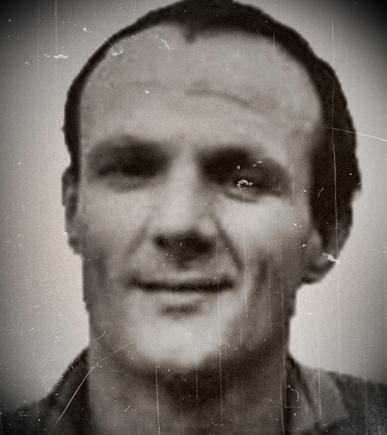
Courtney Davies was well known to police on both sides of the England-Wales border. Born in Cardiff, Courtney spent decades involved in organized crime. He amassed convictions for armed robbery, violence, firearms offenses, and drug trafficking. His most infamous conviction came during the 1980s, when he received a lengthy prison sentence for a violent armed robbery involving the terrorizing of a Welsh businessman and his family.
Although released before serving his full sentence, Courtney reportedly returned to the criminal underworld after leaving prison. By 2004, investigators believed he still maintained connections within organized crime circles, making numerous enemies along the way.
Investigators established that Courtney had been alive on December 19th, 2004, the day before his body was found. Evidence suggested he had travelled from South Wales into Gloucestershire that evening, although exactly why remains uncertain. Detectives believe he met one or more people shortly before his death and was driven into the secluded Forest of Dean.
Police later appealed for information about several vehicles seen travelling along the A4136 between Coleford and Cinderford late that night, including a red Ford Escort, a white Lexus, and a red-and-white motorcycle. Authorities hoped the occupants, or anyone who witnessed them, might hold the key to solving the case. No breakthrough ever came from those appeals, however.
The post-mortem examination revealed a level of violence that shocked even experienced detectives. Courtney Davies had been stabbed more than seventy times, had his throat cut, and had his body doused with gasoline before being set on fire.
The attempt to burn the body was only partially successful. Cold, damp winter conditions prevented the fire from completely destroying forensic evidence.
Detectives concluded the sheer number of stab wounds indicated an intensely personal attack rather than a simple contract killing. It suggested either overwhelming rage or a deliberate effort to send a message to others involved in organized crime.
Gloucestershire Constabulary launched one of the county’s largest murder investigations. Officers interviewed hundreds of witnesses across Gloucestershire, Cardiff, and South Wales while exploring Courtney Davies’ criminal associations.
One significant piece of evidence emerged from the crime scene: DNA recovered from a discarded cigarette end. That evidence eventually led detectives to arrest a thirty-two-year-old Cardiff man.
The suspect maintained that he had indeed driven the victim to the Forest of Dean on the evening before the body was discovered, but he consistently denied participating in the murder.
Despite being charged, the prosecution encountered serious legal difficulties before trial. In April 2006, proceedings at Bristol Crown Court collapsed during preliminary hearings, and the accused was formally acquitted before a jury ever heard the evidence. Without sufficient admissible evidence linking him directly to the killing, prosecutors were unable to continue. The collapse represented the investigation’s biggest setback, and no one else has ever been charged.
Police have never publicly identified a definitive motive, but several theories have circulated over the years. The leading hypothesis remains that Courtney became the victim of an organized crime dispute. His extensive criminal history meant he had accumulated numerous enemies over several decades. The brutality of the murder resembles other revenge killings associated with criminal organizations, where excessive violence serves as a warning to others.
Given Courtney Davies’ reported involvement in drug trafficking, investigators also considered whether disagreements over money, stolen drugs, or unpaid debts may have escalated into murder. However, police have never publicly confirmed evidence supporting this theory.
The extraordinary violence has also prompted speculation that at least one attacker knew Courtney personally and harbored deep resentment. Whether that resentment stemmed from criminal dealings or a personal grievance remains unknown.
More than two decades later, Courtney Davies’ murder officially remains unsolved.

