
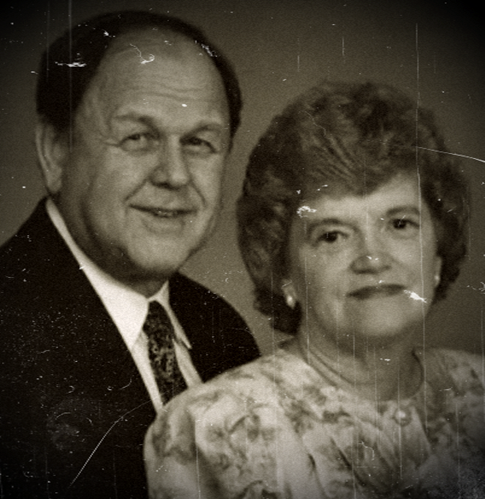
On Sunday, May 29th, 2011, members of Union Baptist Church in Northern Kentucky immediately noticed that two familiar faces were missing.
For decades, seventy-four-year-old Peggy Stephenson had been a fixture at the church organ. Her husband, William “Bill” Stephenson, also seventy-four, was a deacon and an equally reliable presence. Earlier that morning, Bill had also failed to appear at the truck-stop ministry where he regularly conducted services for drivers passing through Florence, Kentucky.
Missing one commitment might have been explainable. Missing both was not like Bill.
Within hours, the reason for their absence would become horrifyingly clear.
William Lee Stephenson and Peggy Ann Parker had known one another since they were young and were married on August 25th, 1956. By 2011, they had been together for nearly fifty-five years and had raised three children—two sons, Tom and Doug, and a daughter, Beth—as well as enjoying a growing family of grandchildren and a great-grandchild.
Their lives were deeply connected to their Christian faith. Bill served as a deacon at Union Baptist Church and devoted a considerable amount of his time to a ministry aimed at long-haul truck drivers. At a TravelCenters of America truck stop near Interstate 75 in Florence, he helped operate a small chapel where drivers could attend services while away from home.
The unconventional congregation suited Bill’s personality. Friends and relatives remembered him as outgoing and comfortable talking with strangers. Peggy was quieter, but equally involved with their church.
Their daughter Beth Stephenson-Victor later described her parents as people who were open and friendly with virtually everyone they encountered.
That generosity would become important to the investigation. Bill, particularly through the truck-stop chapel, came into contact with people from all over the country. Many passed through Florence only once. It created an enormous pool of potential acquaintances, and possible suspects.
The day before the murders, there was nothing obvious to suggest that Bill and Peggy were in danger. According to more recent reporting based on interviews with their family and investigators, the couple attended their granddaughter’s graduation on Saturday, May 28th. Beth saw and spoke with them there. They appeared normal and expected to attend church the following morning.
But something had already occurred that would later attract police attention. Two days earlier, on Friday, May 27th, witnesses at the truck stop had noticed a man apparently trying to find Bill. According to Detective Coy Cox, the stranger was seen near the chapel banging on its door and asking for him.
Investigators subsequently obtained surveillance footage from the truck stop showing a man who resembled the description given by witnesses. Law enforcement circulated his photograph in an attempt to identify him.
Early reports described the man as one of the last people known to have spoken with Bill before his death. Police received tips from across the country, including from a Georgia truck driver who thought he might be the person pictured. Investigators determined through his trucking records that he could not have been in Florence at the relevant time.
Despite years of publicity and investigators traveling through numerous states following leads, the man investigators currently associate with the chapel encounter has never been conclusively identified. As recently as August 2026, detectives were still asking the public for help identifying him. Whether he had anything to do with the murders remains unknown.
Sunday morning, May 29th, arrived. Bill did not show up at the truck-stop ministry. Then neither he nor Peggy appeared at their regular church service.
The Stephensons were so dependable that their absence was immediately noticed. Beth had spoken with her parents the previous day, so she knew they had planned to attend. After church, she repeatedly tried to reach them.
Eventually, she asked her husband, Claude Victor, to go to the condominium and check on them. Claude arrived at their home in the Oakbrook subdivision of Florence.
There was no response at the front door. He went around the building to a sliding door at the rear of the condo. The screen door was closed, but the glass door behind it appeared open. Claude went inside.
At approximately twelve fifty-seven p.m., authorities were notified that Bill and Peggy Stephenson were dead.
They were found in separate rooms. Both had sustained numerous injuries. Public reporting has described their deaths as involving both blunt-force and sharp-force trauma, although police have deliberately withheld many details concerning precisely how each victim was killed.
There was more: the bodies had been positioned. Objects had apparently been moved around the condominium. Household items appeared in locations where they did not ordinarily belong. Investigators discovered markings on some objects. Certain arrangements appeared to correspond to particular relatives or acquaintances of the Stephensons, almost as though the killer were expressing approval or hostility toward specific people.
The manipulation was not confined to the immediate locations of the bodies. Cox has said that things seemed wrong throughout the home.
The detective eventually reached a disturbing conclusion: investigators were not necessarily looking at the crime scene as it had existed when Bill and Peggy were killed. They were looking at a scene deliberately constructed for police to discover afterward.
Another element made the crime particularly unsettling: the killer apparently did not flee immediately after Bill and Peggy died.
Investigators determined that the couple were killed during the early morning hours of May 29th, reportedly between approximately one and four a.m. A medical device associated with one of the victims helped establish a precise point in the timeline.
Evidence also indicated that someone remained inside the residence for a prolonged period afterward, or possibly left and returned.
Cox has since revealed that what he described only as a “timed device” suggested activity connected with the killer extending for as long as eight hours. At least one injury was inflicted after death, providing additional evidence that the person responsible remained involved with the scene long after the initial attack.
There was apparently no hurried attempt to grab valuables and escape. Nothing obviously valuable appeared to have been taken.
Instead, whoever killed the Stephensons appears to have devoted extraordinary time and attention to what would be left behind. That made a conventional burglary gone wrong increasingly difficult to reconcile with the evidence.
The symbols and positioning initially raised another possibility: ritualistic murder.
Detectives did not dismiss it. In 2012, the case was presented to the Vidocq Society, a Philadelphia-based organization whose members include experienced investigators, forensic specialists, and other experts who volunteer their expertise in difficult unsolved cases.
After being shown details never released publicly, experts reportedly concluded that the ritualistic appearance was most likely itself part of the staging rather than evidence of a genuine ritual murder. Cox later received similar assessments during consultation with other specialists, including the FBI’s behavioral-analysis resources.
In other words, the killer may have wanted police to think they were looking at something ritualistic. Why remains one of the central mysteries.
There was, however, physical evidence. In August 2012, authorities announced that the Kentucky State Police laboratory had developed an unidentified DNA profile from evidence collected inside the Stephenson residence. The same profile had been recovered from multiple locations. Investigators believed it could belong to the killer.
The profile was uploaded into CODIS, the FBI’s national DNA database. There was no match.
By that point, investigators had already interviewed hundreds of people and pursued leads through numerous states. For years, DNA samples obtained from people connected to the investigation failed to match the unknown profile. Forensic evidence that initially appeared capable of solving the case instead became another unanswered question.
Cox also faced a more unusual concern. Because the crime scene had been so thoroughly staged, could some of the physical evidence itself have been planted?
If the killer had deliberately introduced objects into the home, DNA or fingerprints recovered from those objects might belong to someone who had never been inside the Stephensons’ condominium. That possibility has complicated nearly every forensic lead in the case.
Among the people scrutinized during the investigation was Charles “Stevie” Stephenson, Bill’s nephew. The family did not accuse him of the murders, but when investigators pressed them to think of anyone who might conceivably have had a grievance, his name arose partly because of previous financial issues within the extended family.
Stevie cooperated with detectives and voluntarily provided fingerprints and DNA. Neither matched the unidentified evidence from Bill and Peggy’s home.
Then, in 2012, the investigation took a strange turn. Stevie became a suspect in an unrelated murder across the state line in Aurora, Indiana.
Sixty-seven-year-old Leigh Jennings had been beaten to death inside her home. Investigators alleged that a skillet and pepper grinder were used in the attack and that money was taken. Stevie was eventually convicted of Jennings’ murder and sentenced to life imprisonment.
The coincidence inevitably brought renewed scrutiny. Detectives again obtained extensive fingerprint and DNA samples from him and compared them against the Stephenson evidence. Again, they did not match.
Investigators continued speaking with Stevie over the years, but no charge has ever been filed against him in connection with Bill and Peggy’s deaths.
DNA was not the only forensic evidence recovered from the condo. Investigators also found a partial fingerprint.
Unlike the DNA profile, however, the print was not complete enough to be routinely searched through the national automated fingerprint system. Detective Cox instead took an unusually labor-intensive approach: copies were distributed to crime laboratories in all fifty states, asking technicians to compare the print with their own databases.
Years passed with no leads. Then, in June 2023, Cox received a remarkable telephone call.
A forensic technician in a western state had retained the Stephenson fingerprint and periodically rerun it against new prints entering the state’s system. The technician had reportedly learned about the case through media coverage and kept checking long after most people might have assumed the investigation had stalled.
Twelve years after the murders, she found a match. And unlike so many previous leads, this one did not point toward a complete stranger.
The fingerprint belonged to a man who had ties to Boone County. He knew Bill and Peggy Stephenson, and had lived in their area. What’s more, investigators learned that he had moved away from Boone County shortly after the murders.
Cox telephoned the man without initially revealing the fingerprint evidence. According to Cox’s account, the man acknowledged knowing Bill and Peggy and initially expressed willingness to help investigators. Cox requested fingerprints and a DNA sample. The man agreed.
An appointment was made. Then, shortly before he was supposed to provide the samples, he changed his mind and told Cox that further communication should go through an attorney.
Investigators obtained a warrant. Cox traveled west to collect the evidence. When authorities went to the man’s residence, he allegedly refused to answer the door, leading investigators to secure additional legal authority to enter. They ultimately obtained the samples.
The result created yet another contradiction. His fingerprint matched the partial print recovered from the Stephenson crime scene. But his DNA did not match the unidentified DNA profile.
Cox has emphasized that the fingerprint was recovered from a location he believes strongly associates it with the perpetrator. But because details of the staging remain secret, investigators have not publicly explained exactly what the print was on or how it came to be there.
The man has neither been charged nor publicly identified. His refusal to continue cooperating cannot by itself establish guilt, and having known the Stephensons potentially provides innocent explanations for some forms of physical evidence depending on where and how the fingerprint was deposited. But the match transformed him into one of the investigation’s most significant persons of interest.
According to information released in August 2026, investigators have narrowed their focus to roughly half a dozen people. The unidentified western-state man remains among them.
The fingerprint development creates an obvious question. If the fingerprint belongs to the killer, whose DNA is in the condominium? One possibility is that more than one person participated in the murders. Another is that the DNA is unrelated to the crime.
Another is the scenario Cox has worried about from the beginning: the killer deliberately brought evidence belonging to someone else into the home as part of the elaborate staging.
There may now be a way to answer that question. In 2026, Cox revealed that investigators had obtained another DNA profile from a second location within the crime scene. It matched the original unidentified profile already in CODIS, strengthening the connection between that unknown person and multiple pieces of evidence inside the home.
Investigators believe the newer DNA evidence may allow additional forensic analysis that was not previously possible. What techniques are being attempted has not been publicly disclosed. No match has yet been announced.
Meanwhile, one of the oldest questions remains unresolved. Who was the man apparently looking for Bill at the truck-stop chapel shortly before the murders? Despite hundreds of interviews, nationwide publicity and years of investigation, authorities still want him identified.
Importantly, Cox confirmed in 2026 that the unidentified chapel man is not the same person as the man whose fingerprint was matched in the western state.
As of this writing in September 2026, the bizarre murder of Bill and Peggy Stephenson remains officially unresolved.

