
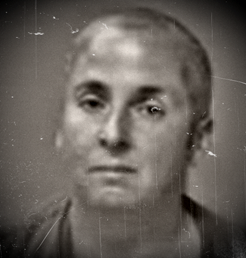
Theresa Marie Dashewich was born in Ohio, but had been living a transient lifestyle since approximately 1999, traveling extensively throughout the United States and frequently relying on truck drivers for transportation. Her travels had taken her across substantial portions of the country. Investigators established that she had spent time in the southern United States, along the West Coast, and throughout the Midwest.
The precise circumstances that led Theresa to adopt this lifestyle have not been extensively documented in publicly available reporting. Information about her childhood, family relationships, employment history, and personal experiences remains limited.
Theresa had become accustomed to navigating the network of highways and truck stops that connect American cities and communities, but naturally this way of life carried considerable risks.
The final documented hours of Theresa’s freedom can be reconstructed with unusual precision, thanks largely to surveillance recordings obtained from businesses in the Billings area. On Friday, June 13th, 2014, at approximately ten p.m. Mountain Time, Theresa was recorded at a Pilot Town Pump gas station in Billings, Montana. Surveillance cameras captured images of her wearing a gray T-shirt, navy sweatpants, and white tennis shoes. She was carrying a duffel bag.
After leaving the Pilot station, Theresa walked to a nearby Flying J truck stop. The Flying J was located near Interstate 90, a major transportation corridor extending through Montana and South Dakota. It was a logical place for someone hoping to secure transportation eastward.
Investigators subsequently determined that Theresa remained in the vicinity of the Flying J for several hours, continuing into the early morning of Saturday, June 14th.
At a few minutes past five a.m., she was observed attempting to obtain a ride from truck drivers who were refueling their vehicles. This became her last confirmed sighting.
Investigators examined surveillance footage covering the hours that followed. At approximately eight a.m., a person resembling Theresa appeared on video walking away from the Flying J toward the eastbound entrance ramp of Interstate 90. Unfortunately, the recording was not clear enough for investigators to establish conclusively that the individual was Theresa. If the person in the video was her, she may have been walking toward a vehicle waiting near the interstate entrance. She might also have been attempting to hitchhike directly from the ramp.
South Dakota investigators later suggested another possibility: Theresa could have arranged transportation with a truck driver before leaving the Flying J, either through a conversation at the truck stop or possibly over a citizens band radio. The available evidence did not establish which of these scenarios, if any, actually occurred. After the possible eight a.m. sighting, Theresa was not seen again on the truck stop’s surveillance recordings.
On Tuesday, June 17th, 2014, at approximately five p.m. Mountain Time, a passing motorist discovered a woman’s body near Interstate 90 in Jackson County, South Dakota. The location was near mile marker 172, east of the small community of Kadoka.
The body had been left in a culvert, one of the drainage structures that allow water to pass beneath or alongside highways. The location was isolated and far removed from the busy commercial truck stops where Theresa had last been seen alive.
The woman had suffered severe injuries consistent with a violent assault. Subsequent investigation established that she had been beaten to death. Authorities eventually identified her as Theresa Dashewich.
The discovery presented investigators with an immediate geographical problem. Theresa’s last confirmed whereabouts had been in Billings, Montana, approximately 375 miles to the west. Her body had been recovered in South Dakota, along the same interstate corridor.
The location of the body suggested that whoever had abandoned her knew how to take advantage of the highway’s remote stretches, where a vehicle could potentially stop without attracting immediate attention.
One of the most unsettling developments in the investigation was the determination that Theresa may not have been free to leave the person or vehicle with whom she was traveling. The FBI reported that investigators had uncovered evidence indicating that she had been held against her will. This finding was significant enough for federal authorities to open a kidnapping investigation.
Because Theresa’s disappearance and the discovery of her body occurred in different states, the investigation required cooperation between several law enforcement agencies. The South Dakota Division of Criminal Investigation assumed the lead role. The FBI provided assistance, recognizing that the interstate dimensions of the case could complicate efforts to identify and locate the perpetrator.
Investigators concentrated considerable attention on the Flying J truck stop in Billings. Surveillance recordings helped them reconstruct Theresa’s movements during her final confirmed hours. They also established a relatively narrow window during which witnesses might have encountered her or observed someone offering her transportation.
In 2015, the FBI announced that Theresa’s murder had been incorporated into its Highway Serial Killings Initiative. The initiative was established to assist law enforcement agencies investigating violent crimes associated with major transportation corridors, including cases involving victims discovered near highways, truck stops, rest areas, and other locations frequented by long-distance travelers.
No publicly confirmed connection between Theresa’s murder and a particular serial killer has been established. Still, the possibility that her killer might have committed other offenses was an avenue of investigation worth considering.
On June 15th, 2015, nearly one year after Theresa’s murder, the FBI and South Dakota authorities renewed their public appeal for information. The FBI announced a reward of up to $5,000 for information leading to an arrest. That amount was offered in addition to a separate $5,000 reward from the South Dakota Division of Criminal Investigation, making the combined publicly announced rewards as much as $10,000 at the time.
As of October 2026, the murder of Theresa Dashewich is still unsolved.

