
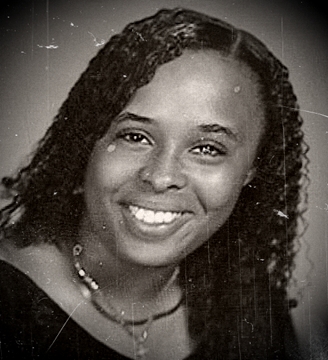
Shortly after eleven p.m. on June 8th, 2007, twenty-five-year-old Tyvon Nicole Whitford was inside her home in rural Putnam County, Florida, with her five-year-old son, eating pizza and watching a movie. She was six months pregnant with a daughter she had already named Ke’mora.
Within minutes, CoCo (as virtually everyone in her life called her) would be lying mortally wounded near the entrance of the home. She had been shot twice through the screen door. Her little boy was still inside.
At approximately eleven thirteen p.m., CoCo managed to call 911 herself. But she was badly injured, and the call ended before the dispatcher could obtain the most important information: who had shot her. Five minutes later, another 911 call came from the house. This time the caller was CoCo’s boyfriend, Terrence “Trouble” Brown, who said he had arrived to find her bleeding and struggling to breathe.
CoCo was rushed to Shands Hospital at the University of Florida in Gainesville. She and her unborn daughter died there on June 9th.
Tyvon Nicole Whitford was born in Gainesville on February 8th, 1982, and grew up in the Hawthorne area. Her obituary records that she graduated from Interlachen High School with the Class of 2001 and was a member of Trinity Baptist Church. At the time of her death she worked as a corrections officer for the Florida Department of Corrections, a job she had held for nearly three years.
Her first child, Larry Jr., was five in the summer of 2007. By then CoCo was expecting another baby, a girl.
Only about a month before her murder, CoCo had moved out of her parents’ home and into a modest two-bedroom residence off County Road 21A, between Hawthorne and Interlachen. Her parents, Ronald and Dale Whitford, lived less than a mile away.
The reconstructed timeline of the shooting is remarkably tight. According to investigators working with Cold Justice, CoCo was shot at approximately eleven twelve p.m. The shots were fired through the screen door of her house. Only a minute later, CoCo called 911. The dispatcher attempted to establish her location, but the call was disconnected before CoCo could identify her attacker. Attempts were made to call her back.
Larry Jr. was in the house. Although early accounts stated that he did not witness the actual shooting, his later recollections make clear that he saw its horrifying aftermath. In his 2024 letter published by Project: Cold Case, he described being with his mother as she lay dying and remembered exchanging a final “I love you” with her.
Then, at approximately eleven eighteen p.m., another person called 911: Terrence Brown. Brown was CoCo’s boyfriend and the father of her unborn child. According to the account later examined by investigators, he said he had been on his way to CoCo’s house and had stopped at a gas station to buy Tylenol for her. He claimed that when he arrived, he found CoCo badly wounded.
During the 911 call, the dispatcher attempted to tell Brown how to help her. The later Cold Justice review noted, however, that Brown appeared to be outside rather than beside CoCo as the dispatcher tried to guide him through CPR.
Then came another detail investigators found unusual. At approximately eleven twenty-two p.m., as law enforcement officers began arriving, Brown left. Rather than remaining at the house, he drove the short distance to Ronald and Dale Whitford’s home to tell them that something terrible had happened to their daughter. The Whitfords had already heard emergency sirens nearby. They rushed back to CoCo’s residence with him.
Paramedics transported CoCo to Shands Hospital in Gainesville, but doctors could not save her. CoCo died on June 9th, 2007. Her unborn daughter, Ke’mora, died with her.
From the beginning, several features of the scene suggested that CoCo had not simply been the victim of a burglary gone wrong. Investigators found no sign of forced entry. Nothing appeared to have been taken from the house. CoCo had apparently been confronted at or near her doorway, and the murder weapon was never recovered.
Her work as a corrections officer naturally raised another possibility. Had an inmate, former inmate or someone connected to the prison system targeted her? Investigators considered it, but the theory never gained much traction. Years later, one of CoCo’s former colleagues told the Cold Justice team that she had been well liked at Gainesville Correctional Institution and was cautious about answering her door to strangers.
That latter detail was potentially important. If CoCo normally would not open the door to someone she did not know, there was reason to wonder whether she had recognized the person outside. Therefore, attention increasingly turned toward her personal relationships.
Brown quickly became a person of interest in the investigation. Authorities learned that CoCo’s relationship with Brown was complicated; for one thing, Brown was married. His wife, Hope Brown, reportedly learned about his relationship with CoCo months before the murder. By June 2007, CoCo was visibly pregnant with Brown’s child. The circumstances immediately presented investigators with a potential tangle of jealousy, infidelity and conflict.
Fifteen years after the murder, CoCo’s case received its most substantial burst of national attention when Putnam County investigators worked with veteran prosecutor Kelly Siegler and investigator Abbey Abbondandolo for an episode of Oxygen’s Cold Justice.
The team returned to the crime scene, reconsidered the timing of the two 911 calls, interviewed family members and former coworkers and tracked down people who had been near the house on the night CoCo was shot.
Several witnesses made troubling claims. A former coworker, Tamar Leak, told investigators that she had noticed bruises on CoCo and believed CoCo had been in an abusive relationship with Brown. Another former corrections officer, Scotty Moore, similarly recalled seeing bruises after what he described as a fight between the couple.
Most disturbing was something CoCo herself was reported to have said before she died. According to a report reviewed during the Cold Justice investigation, she had told people at work: “If anything happens to me, he did it.”
The timing has always been one of the most intriguing aspects of the case. CoCo was apparently shot around eleven twelve p.m. She called 911 a minute later. Brown called 911 five minutes after that, leaving only a handful of minutes between the shooting and Brown’s reported discovery of CoCo.
If Brown’s account was accurate, an unknown gunman would have had to approach CoCo’s house, shoot her, flee and disappear shortly before Brown arrived. The geography complicated that possibility. During the Cold Justice reinvestigation, detectives recreated the shooting at the property. A nearby bar was visible from CoCo’s house, and the house could likewise be observed from around the bar. Investigators interviewed people who had been there that night, hoping that someone had seen either Brown or another person moving to and from the residence.
One woman, Patricia High, recalled hearing what sounded like two gunshots and then seeing Brown leave CoCo’s property. Investigators acknowledged, however, that what she saw could have been Brown leaving to get CoCo’s parents after discovering the shooting. Her recollection alone could not establish that he had been present when the shots were fired.
Then investigators found another witness. Terrence Keenon told the team that he had been outside the nearby bar that night. According to Oxygen’s account of the investigation, Keenon placed Brown at CoCo’s residence both before and after the gunfire. For investigators, that was potentially significant because it conflicted with the basic implication of Brown’s original story: that he arrived only after someone else had shot CoCo.
When investigators confronted Brown during the renewed investigation, he denied killing her. The interview ended without a confession or arrest.
Investigators also examined Brown’s then-wife, Hope. Given that her husband was having a relationship with CoCo—and that CoCo was pregnant—jealousy was an obvious possible motive to explore. Witnesses told investigators that CoCo and Hope had confronted one another about the pregnancy. Hope denied any involvement in the murder.
The renewed investigation also uncovered circumstances that weakened the theory against her. Brown had reportedly been unfaithful on other occasions and had fathered children with other women, yet investigators found no comparable history of Hope attacking those women. The Cold Justice team ultimately appeared less persuaded by the theory that she had suddenly decided to murder CoCo.
In 2013, another shooting brought that pain violently back to the surface. CoCo’s brother Ronald was shot in the head during a confrontation in Gainesville. He survived with a graze wound, but Dale told WUFT that the incident reopened the family’s trauma over CoCo’s death and her continuing frustration that the 2007 murder remained unsolved.
As of this writing, no one has been convicted of killing Tyvon “CoCo” Whitford.

