
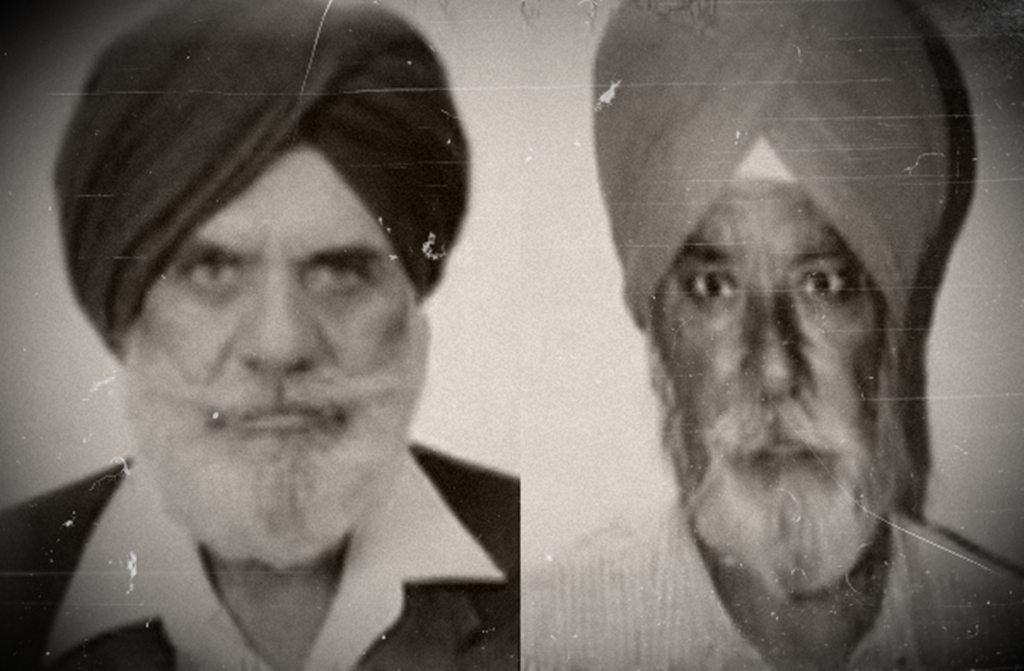
Sixty-five-year-old Surinder Singh and seventy-eight-year-old Gurmej Singh Atwal had both emigrated from India and settled in Elk Grove, California, a growing suburb south of Sacramento. They were neighbors, friends, and grandfathers who enjoyed spending time with their families and maintaining an active lifestyle.
Surinder had immigrated to the United States in 2005, after working as a truck driver in India and Libya. Gurmej had arrived in 2001 with his family, eventually settling in Elk Grove in 2003. Before moving to America, Gurmej had worked for the state government of Punjab, India. Both men had built new lives surrounded by their children and grandchildren.
Their daily walks had become a familiar part of their retirement. On most afternoons, the two friends would meet and stroll through their neighborhood, often stopping to rest near a bus shelter overlooking Highway 99.
Friday, March 4th, 2011, began as another ordinary day. The men left their homes for their customary afternoon walk, unaware that they would never return.
Sometime that afternoon, Surinder and Gurmej were walking along East Stockton Boulevard near Geneva Pointe Drive when an unidentified assailant opened fire on them. The attack occurred in broad daylight, close to a busy highway where passing motorists might have witnessed the shooting. Both men were struck by gunfire and collapsed on the sidewalk. The shooter fled, leaving the victims seriously wounded.
Shortly after four-thirty p.m., the wife of a family friend discovered the two men lying on the sidewalk. Emergency services were summoned, and Elk Grove police officers responded. Surinder was pronounced dead at the scene. Gurmej, who had suffered gunshot wounds to his upper torso, was transported to a nearby hospital in critical condition.
The news devastated both families. Gurmej’s son, Kamaljit Singh Atwal, had returned home from his job as a truck driver earlier that afternoon. He had silenced his phone, unaware that a family friend was repeatedly trying to reach him. When his daughter alerted him to the calls, he learned that something terrible had happened to his father. He hurried to the shooting location, approximately a ten-minute walk from his home, where police had already cordoned off the area. His father was fighting for his life, and the family could do little but hope he would survive.
While Surinder’s family prepared for his funeral, Gurmej remained hospitalized in intensive care. His injuries were severe, and he required life support. Initially, his family had reason to hope that he might recover, but his condition failed to improve as doctors had anticipated. On April 15th, 2011, six weeks after the shooting, Gurmej Singh Atwal died from his injuries.
From the beginning, investigators struggled to establish why the two men had been attacked. Neither victim had been robbed, and relatives told investigators that Surinder and Gurmej had no known enemies. The shooting appeared to have occurred without any preceding confrontation that could explain the violence.
Detectives began searching for a vehicle that witnesses had reportedly seen in the vicinity of the shooting. Initially, police asked the public to look for a tan or light brown Ford F-150 pickup truck, believed to be a model manufactured between 1999 and 2003. As the investigation progressed, detectives developed a more detailed description. By February 2012, authorities described the vehicle believed to have been involved as a gold or tan raised pickup truck with a standard bed. The updated description was based on witness statements.
Investigators also recovered shell casings from the crime scene. According to Detective Kevin Papineau, the casings were found within a roughly fifteen-foot circle surrounding the victims’ bodies. Police declined to reveal the exact number of casings recovered or the type of firearm involved, withholding certain details of the shooting from the public.
Authorities established a traffic checkpoint near the shooting location, stopping motorists who regularly traveled through the area in the hope of finding someone who had witnessed the attack or noticed the suspicious vehicle. Despite these efforts, the investigation failed to produce an arrest.
Community members and organizations contributed money toward a reward for information. The reward, which initially stood at approximately $30,000, had grown to around $57,000 by February 2012. Yet no one came forward with information sufficient to identify and prosecute the killer.
One of the most troubling questions surrounding the murders was whether the victims had been targeted because of their religious identity. Both men were practicing Sikhs who wore traditional turbans and maintained long beards as expressions of their faith.
In the years following the September 11th, 2001, terrorist attacks, members of the Sikh community had experienced harassment, discrimination, and violence in the United States. Some attacks occurred because perpetrators mistakenly identified Sikh men as Muslim, although Sikhism and Islam are distinct religions.
The possibility that Surinder Singh and Gurmej Singh Atwal had been victims of religiously motivated violence immediately concerned investigators and community leaders. The day after the shooting, Elk Grove Police Chief Robert Lehner acknowledged that the men’s recognizable Sikh appearance, combined with the absence of another apparent motive, raised the possibility that the attack had been motivated by prejudice.
The FBI became involved in the investigation, assisting local authorities as they examined whether the shooting could have constituted a federal hate crime. The killings prompted widespread concern among Sikh Americans, particularly among older residents who feared they could be attacked while going about their daily routines.
As the years passed, the community continued to remember both men. In April 2021, Elk Grove dedicated its 100th park, Singh and Kaur Park, in their honor. Located on Ponta Delgada Drive in the city’s Laguna Ridge area, the park serves as a permanent memorial to the two friends and their contributions to the community. Its name also honors the wider Sikh community, for whom Singh and Kaur are important traditional names.
In March 2026, fifteen years after the murders, the case remained unsolved. In an interview with PBS KVIE’s Abridged, Elk Grove Police Department spokesperson Sgt. Jason Jimenez confirmed that investigators had undertaken a renewed examination of the case approximately six years earlier. Detectives reviewed the evidence, reinterviewed witnesses, and explored whether advances in forensic technology, including DNA analysis, could provide new investigative opportunities. Unfortunately, the renewed investigation produced no additional leads.
Jimenez also confirmed that authorities still had not determined a motive. Investigators could neither establish that the killings were a hate crime nor rule out that possibility.
The murders of Surinder Singh and Gurmej Singh Atwal remain among Elk Grove’s most enduring unsolved crimes.

