
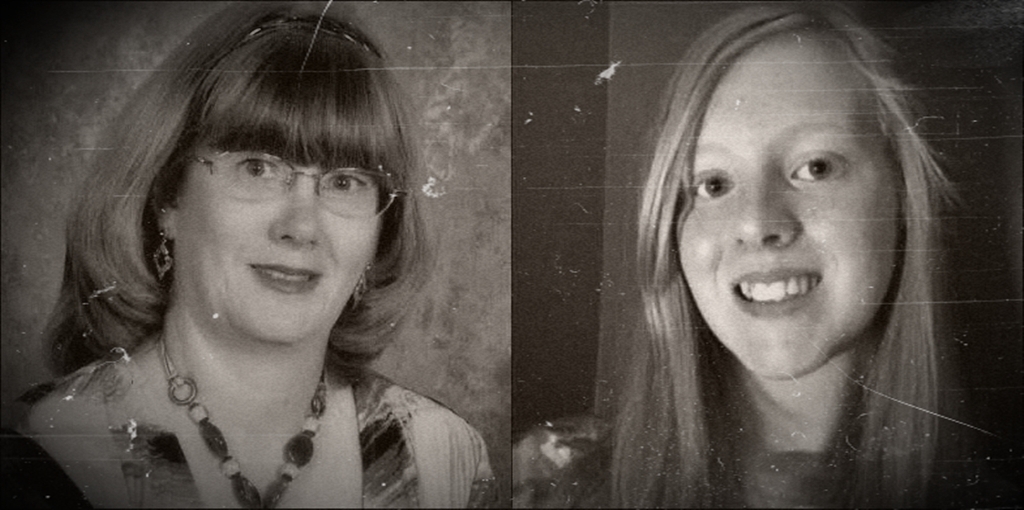
Forty-eight-year-old Kathy Netherland had devoted much of her adult life to caring for other people. Born Kathy Hardin, she grew up in Kentucky and experienced family tragedy at an early age. Her mother died when Kathy was approximately five years old, and she and her younger sister, Stacey, spent part of their childhood living with their grandparents. Those early experiences helped shape a woman whom friends, relatives, and colleagues would later remember for her compassion, generosity, and willingness to put other people’s needs before her own.
By 2014, Kathy was working as a special education teacher at Bardstown Elementary School in Kentucky. She had developed a reputation for connecting with students who struggled in conventional classrooms, particularly children with behavioral and learning difficulties. Colleagues remembered her as patient and devoted, someone who recognized potential in children others sometimes dismissed.
She frequently purchased classroom supplies with her own money, stayed late to help students, and took a personal interest in their well-being. Her colleagues also remembered her lively personality, distinctive enthusiasm for rock music, and affection for the British band Def Leppard.
Outside school, Kathy’s life revolved around her family. She and her husband, Bob Netherland, had raised two daughters, Holly and Samantha. The family lived in an older house along Springfield Road, a stretch of U.S. Highway 150 running through the Botland community southeast of Bardstown.
In the summer of 2013, Bob died after battling colon cancer. His death was devastating for the family, particularly Samantha, who had been close to her father. Kathy was left to navigate widowhood while continuing her work and supporting her daughters. Holly, the older daughter, was attending college away from home, while Samantha remained with her mother.
Despite their grief, there were signs that the family was beginning to adjust. Kathy was looking toward the future, and Samantha’s academic success provided an important source of happiness. A sixteen-year-old sophomore at Bardstown High School, Samantha participated in the school’s academic team and chorus. She was intelligent, ambitious, and particularly interested in science. She also enjoyed volunteering at the local humane society and had expressed an interest in pursuing marine biology. One of her proudest accomplishments came when she was accepted into the Gatton Academy of Mathematics and Science at Western Kentucky University. The academy offers gifted high school students an opportunity to complete their final two years of secondary education in a university environment while earning college credits. Admission is competitive, and Samantha’s acceptance was a significant achievement. For a teenager whose family had recently experienced such a painful loss, the news represented an important step forward.
Kathy was enormously proud of her daughter. In an interview with the local newspaper following Samantha’s acceptance, she spoke about the determination her daughter had demonstrated despite losing her father.
Samantha also had more ordinary teenage milestones to look forward to. She was preparing to attend her high school prom and had recently selected a dress. A boy had invited her to the dance with a playful arrangement of lollipops, and the prospect of attending the event was an exciting part of her spring.
Only days before the murders, Kathy sent her sister Stacey Hibbard a photograph of Samantha trying on her prom dress. That photograph would become especially painful for the family. It was one of the last images Stacey received of her niece alive.
Monday, April 21st, 2014, began as an ordinary school day for Kathy and Samantha. Both were expected to return home afterward, and there was nothing publicly known about their activities that suggested they anticipated danger.
On the morning of Tuesday, April 22nd, Kathy failed to arrive at Bardstown Elementary School. Her absence was immediately unusual; Kathy was considered dependable and conscientious. If she intended to miss work, her colleagues expected her to notify the school and make arrangements for her students. When no explanation arrived, coworkers became concerned.
Gladys King, a teaching assistant who worked closely with Kathy, initially wondered whether she had overslept or unexpectedly gone somewhere to visit her older daughter, Holly. But those explanations did not fit Kathy’s usual behavior.
King and Kathy’s stepsister Stephanie Thompson, who also worked at the school, began trying to determine what had happened. They contacted Bardstown High School and learned that Samantha had not attended classes either. The fact that both mother and daughter were missing made the situation increasingly alarming. Attempts to contact Kathy by telephone went unanswered. Eventually, relatives were contacted.
Kathy’s father, Norris Hardin, went to the family home along Springfield Road with another family member, identified in later reporting as Kathy’s stepsister Gayle. They arrived sometime after ten a.m. Kathy’s vehicle was still parked outside. Nobody answered when they attempted to make contact.
Hardin looked through a window and saw his daughter lying motionless on the dining-room floor. Moving around the house, he saw Samantha inside as well. It became horrifyingly clear that something terrible had happened. Authorities were contacted at approximately ten forty a.m. Police and emergency personnel arrived at the residence shortly afterward.
Investigators would subsequently determine that the murders occurred at approximately eight p.m. on April 21st. Precisely what happened inside the Netherland residence has never been fully disclosed. Police have withheld substantial portions of the evidence, including details concerning the sequence of the attacks, the number of offenders, and the circumstances under which the killer or killers entered the house.
What is known is that both victims suffered exceptionally violent injuries, suggesting an attack that went far beyond what might ordinarily be associated with a simple burglary. The medical evidence eventually revealed that Kathy had sustained multiple gunshot wounds. Samantha, meanwhile, had suffered extensive blunt-force trauma to the head and injuries inflicted with a sharp weapon. Both victims also had cuts to their necks.
Kentucky State Police assumed responsibility for investigating the murders, working to reconstruct the victims’ final hours and identify anyone who might have visited the residence on April 21st. Investigators collected physical evidence, examined the surrounding property, interviewed relatives and acquaintances, and sought surveillance footage from businesses along Springfield Road.
One of their earliest challenges was determining a motive. Kathy was a respected teacher. Samantha was a successful student with an apparently bright future. Neither had a known history of involvement in serious disputes, and their relatives could not identify anyone who would have wanted to harm them. The brutality of the killings nevertheless suggested to some investigators that the victims might have been deliberately targeted.
In October 2014, Trooper Jeff Gregory told CBS News that the evidence did not suggest a random attack. Yet he also acknowledged the difficulty of identifying a motive, which was preventing detectives from narrowing their investigation.
Authorities also explored the possibility of multiple perpetrators. The differences between the injuries sustained by Kathy and Samantha, together with the nature of the crime scene, made that an investigative possibility.
Although detectives pursued numerous leads, their investigation gradually focused public attention on one especially important piece of evidence: a mysterious black automobile captured by a surveillance camera near the house.
On April 25th, 2014, Kentucky State Police appealed to the public for help identifying three vehicles that had been traveling northbound on U.S. Highway 150 around the time of the murders. The vehicles included a dark-colored heavy-duty Ford pickup pulling a livestock trailer, a red Ford Ranger pickup, and a black four-door Chevrolet Impala.
Initially, police were interested in determining whether the occupants of any of these vehicles had witnessed something relevant to the investigation. Within several days, however, detectives eliminated the two pickup trucks from consideration. Their attention shifted to the Impala.
On April 28th, police announced that they believed the car’s occupants might have been involved in the murders. The vehicle was described as a black Chevrolet Impala, likely manufactured between 2006 and 2013, with windows that did not appear to be tinted. Surveillance footage showed the car traveling from the Botland area toward Bardstown at approximately eight p.m. on April 21st. State police released a surveillance image of the automobile, hoping that someone would recognize its distinctive appearance or remember seeing a similar vehicle in the area.
The appeal generated considerable public attention. Detectives received tips and reviewed vehicle registrations, but the investigation did not produce the breakthrough they had anticipated.
By October 2014, approximately six months after the murders, police were still attempting to locate the automobile and identify its occupants. Gregory remained convinced that the vehicle represented an important investigative lead. Yet despite the attention surrounding the Impala, no one was publicly charged with the murders, and no confirmed suspect was identified.
The deaths of Kathy and Samantha Netherland occurred at an especially unsettling time for residents of Bardstown and the surrounding countryside. Less than a year earlier, on May 25th, 2013, Bardstown police officer Jason Ellis had been murdered in an ambush along the Bluegrass Parkway. Ellis, a thirty-three-year-old officer and father of two, was returning home from work when he encountered tree limbs obstructing an exit ramp. After stopping to clear the roadway, he was fatally shot. The seemingly calculated nature of his murder deeply disturbed the community.
Now, in April 2014, a respected teacher and her teenage daughter had been murdered inside their home. Although the two cases were markedly different, they created a climate of uncertainty in a region more commonly associated with historic architecture, bourbon distilleries, and small-town hospitality than with notorious unsolved crimes.
During the years following the Netherland murders, Bardstown attracted growing national attention because of several other serious criminal investigations. The 2013 murder of Officer Jason Ellis had already alarmed residents. Then, in July 2015, a local mother named Crystal Rogers disappeared. Her abandoned vehicle was discovered along the Bluegrass Parkway, and her disappearance became the subject of a highly publicized investigation. And in November 2016, Crystal’s father, Tommy Ballard, was fatally shot while hunting on family property.
The series of crimes contributed to Bardstown’s reputation in true-crime media as a community struggling with several disturbing mysteries. Because the incidents occurred within a relatively small geographic area, speculation arose that they might be connected.
In 2019, however, Kentucky State Police spokesperson Scotty Sharp stated that investigators had no evidence indicating that the cases were related.
One of the most significant publicly reported developments in the Netherland case came on April 22nd, 2024, the tenth anniversary of the discovery of the bodies. In an interview with WAVE News, Kathy’s sister Stacey Hibbard described additional surveillance footage that had not previously been released to the public.
According to Hibbard, investigators possessed video obtained from a liquor store across Springfield Road from the Netherland residence. The recording allegedly showed the black Chevrolet Impala driving past the house in the direction of Springfield. A short time later, the same vehicle appeared to return. Hibbard believed the driver may have turned around using a nearby road or loop before approaching the property again. She said the footage then showed the vehicle going behind the Netherland house.
What reportedly happened next was particularly significant. According to Hibbard’s account, a dark figure could be seen walking across the porch toward the front door. A few seconds later, someone apparently opened the door and admitted the person. Hibbard also stated that the automobile departed less than fifteen minutes later.
If her interpretation is accurate, the recording suggests that investigators may have possessed considerably more detailed information about the offender’s movements than previously acknowledged publicly. It could also raise important questions about whether the person entering the house was expected, whether the victims recognized the visitor, and whether the attack was planned.
The video has not been publicly released in full, and Hibbard acknowledged that its quality was insufficient to identify the figure. Furthermore, the reported appearance of someone opening the door does not prove that the individual willingly admitted a familiar visitor. Without additional evidence, the circumstances of entry remain uncertain.
When WAVE requested access to the footage and additional investigative information, Kentucky State Police declined to provide it. The agency cited its policy of withholding specific details while an investigation remains active.
During the 2024 interview, Stacey Hibbard also discussed a possibility that had troubled her for years: that Samantha, rather than Kathy, might have been the principal target. Her concern centered on the different methods of violence used against the victims. Kathy had been shot, while Samantha had been subjected to a severe physical assault involving blunt-force and sharp-force injuries. To Hibbard, the nature of Samantha’s wounds suggested that the attack might have been directed specifically at the teenager.
Yet even she acknowledged the difficulty of explaining such a motive. Samantha was a high-achieving student, preparing to attend a prestigious academy, and there was no publicly established dispute or relationship that could account for the attack.
As of October 2026, the most recently available case listings continue to classify the homicides of both Kathy and Samantha Netherland as open and unsolved.

